I Disagree With The Cardinal Archbishop Of Guadalajara

First, let me note a point on which I agree with him, though.

According to Catholic News Agency,

The archbishop of Guadalajara, Mexico, Cardinal Juan Sandoval Íñiguez expressed his support this week for protests by Hispanics in the United States, saying the “undocumented” are persons who also possess the dignity of the children of God.

That much is true. The protesters are largely baptized people, and the baptized possess the dignity of the children of God. And even the unbaptized possess the dignity of human persons created in God’s image. At the same time, that is a dignity that can be abused, as when people, baptized or otherwise, break the law.

Here’s where the disagreement comes in:

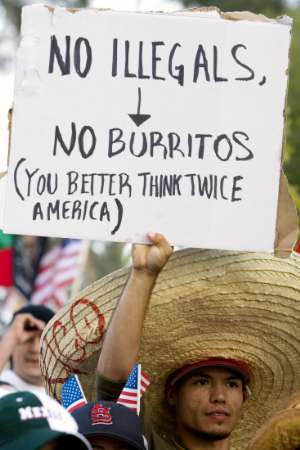
During the inauguration of the Diocesan Museum of the Mexican Martyrs, the cardinal said the undocumented should not be called “illegal” because they are not criminals, but rather people who out of necessity or “ignorance left without their papers.”  He said the country to which they travel should treat them with justice and grant them a status that “respects first and foremost their human dignity.”

The U.S. should indeed treat illegal aliens with human dignity, but treating them with justice means acknowledging that they have broken the law, making their presence in this country "illegal."

It may be morally legitimate at times to do illegal things out of moral necessity, but this does not automatically make the act legal under civil law (though in some cases civil law may honor a necessity defense).

The Cardinal Archbishop is not dealing straight here. The number of illegal immigrants from Mexico who out of "ignorance left without their papers" is diminimously small. Children may have been dragged along by their parents in that condition, but the number of adults who did so is extremely low or non-existent. They knew darn well that they needed the appropriate papers to cross into the United States. Otherwise they wouldn’t be using obscure desert trails and paying coyotes sums of money to smuggle them across crammed into the backs of vans and semi-trucks.

I’m sorry, but sometimes the truth hurts, and the truth is that non-citizens who have come into this country illegally are illegal aliens by definition.

We do neither them nor the American people a favor if we try to paper over this reality with terminology that would seek to mask this fact.

To do so only distracts from the core moral questions of whether their presence in this country can be morally justified or not (that’s where the necessity defense plays a role) and what is to be done about the situation.

Hell In A Nutshell

Screwtape

If Uncle Screwtape had thumbs, he’d be giving The DaVinci Code two thumbs up.

"Now, Wormwood, before you object to my calling this book ‘non-fiction’ — since it is technically classified as ‘fiction’ — let me say that it is essentially non-fiction, at least as far as our purposes are concerned. That’s because it’s principle delight for our side is that in the tacky plastic shell of some below-average ‘fiction’ the book parades as ‘fact’ a veritable phalanx of practical propaganda and disinformation that would make our dear Herr Goebbels (Circle Eight, third spiderhole on the right) jade green with envy! Souls by the boatload are blithely believing almost all of the deliciously corrosive non-facts that are congealed everywhere in it, like flies in bad aspic, and it is that precisely which most recommends this glorious effort as worthy of our dedicated and especial study.

"But where to begin in describing to you its myriad delights? First, a brief synopsis of the plot: a museum curator is murdered by a fanatical albino Christian bigot (nice opening, no?); the curator’s granddaughter and an American ‘symbologist’ (don’t ask me, I haven’t the time) try to find the real killer and are launched on a wildly implausible and fantastically cryptical search for the proverbial Holy Grail, all the while chased by angry gendarmes and the aforementioned unhinged albino. In the process they (and the lucky reader) discover that: the Church is murderous and evil; the Bible is a hoax; Jesus is not divine, but merely a married mortal and an earnest proto-feminist (!); there is no such thing as Truth; and oh, yes… is the truest kind of prayer. Can you stand it? A virtuoso performance, no? It’s as if the author’s somehow squeezed all of hell into a walnut shell. And oh, yes, one more historical ‘fact’: Leonardo DaVinci’s homosexuality was ‘flamboyant’! Do tell."

GET THE STORY. (Warning: Put down the coffee mug and clear the throat first. JimmyAkin.org takes no responsibility for the state of your keyboard, monitor, or respiratory system if you read this while drinking or eating.)

(Nod to Mark Shea for the link.)

I’ve read a number of Screwtapian musings by writers attempting to channel C. S. Lewis, but this is the first one I’ve read of which I think even Lewis himself would approve. Eric Metaxas nails Screwtape. Read the whole thing.

Hand Holding & Rubrics

A reader writes:

I have heard you and others say it is not written that holding hands is part of the proper way to say the Lords Prayer during the Liturgy. I have looked in the GIRM. No instructions are given as to posture, sitting, standing or holding hands. Is there another reference I can read about the church’s instructions?

The posture for this point in the liturgy is standing. This actually is found in the GIRM, but it isn’t as explicit as one might want. Here is the reference:

43. The faithful should stand from the beginning of the Entrance chant, or while the priest approaches the altar, until the end of the Collect; for the Alleluia chant before the Gospel; while the Gospel itself is proclaimed; during the Profession of Faith and the Prayer of the Faithful; from the invitation, Orate, fraters (Pray, brethren), before the prayer over the offerings until the end of Mass, except at the places indicated below.

They should, however, sit while the readings before the Gospel and the responsorial Psalm are proclaimed and for the homily and while the Preparation of the Gifts at the Offertory is taking place; and, as circumstances allow, they may sit or kneel while the period of sacred silence after Communion is observed.

In the dioceses of the United States of America, they should kneel beginning after the singing or recitation of the Sanctus until after the Amen of the Eucharistic Prayer, except when prevented on occasion by reasons of health, lack of space, the large number of people present, or some other good reason. Those who do not kneel ought to make a profound bow when the priest genuflects after the consecration. The faithful kneel after the Agnus Dei unless the Diocesan Bishop determines otherwise.

With a view to a uniformity in gestures and postures during one and the same celebration, the faithful should follow the directions which the deacon, lay minister, or priest gives according to whatever is indicated in the Missal.

The part in blue is what governs the posture during the Lord’s Prayer. Since this occurs after the Orate, Fratres ("Pray, Bretheren") it is in the part of Mass where standing is the default posture. There is no exception carved out for it in what follows, so standing is what is supposed to be happening for the Lord’s Prayer.

Standing means standing without doing anything fancy with your arms. It is distinct, for example, from the orans posture, which the priest uses when he stands and prays with arms outstretched. It is also distinct from the hand-holding posture.

The latter is not expressly forbidden in liturgical law because it is one of those "Please don’t eat the daisies" situations. The legislator (the pope) did not envision that anybody would try to alter the standing posture in this way. As a result, the practice is not expressly forbidden, the same way that standing on one foot and hopping up and down as an effort to get closer to God in heaven is not expressly forbidden.

In general what liturgical documents do is to say what people should be doing and not focus on what they should not be doing (though there are exceptions). To prevent "Please don’t eat the daisies" situations, what the law does is prohibit things that aren’t mentioned in the liturgical books. Here’s the basic rule:

Can.  846 §1. In celebrating the sacraments the liturgical books approved by competent authority are to be observed faithfully; accordingly, no one is to add, omit, or alter anything in them on one’s own authority.

Changing from standing to hand holding during the Lord’s Prayer would be an alteration or addition of something provided for in the liturgical books and thus would be at variance with the law.

The reader also writes:

I have also heard the term "the rubrics of the Mass". Is this a separate document? If so, where do I find it at?

The rubrics aren’t found in a separate book. They’re little instructions written into the Sacramentary itself. For example, they tell the priest when to perform certain actions with respect to the prayers that he is saying. To set them off from the text of the prayers (which are printed in black ink), these instructions are printed in red ink. The Latin word for red is "ruber," and so the little red instructions in book came to be called "rubrics."

If you’d like to see them, just look in a normal Sacramentary. (Though they won’t address hand holding either.)

Re-Doing The Crucifixion?

A reader writes:

You know the way non-Catholics always say we are re-doing the crucifixion at every Mass. I want to say, No, we’re re-doing the Last Supper (as He said to do); at the Last Supper, Christ is pre-presenting the Calvary sacrifice, so if they could participate in it ahead of time, why can’t we participate in it after the time? So my question is, is it accurate to say that the Mass is a re-enactment of the Last Supper, rather than of the crucifixion?

There’s a sense in which it’s a re-enactment of both, but I think you’re on to something here. The way a current Mass re-enacts the two is not the same.

To flesh out the idea, we need to consider the relationship between three events: The Last Supper (a.k.a. The First Mass), the Crucifixion, and any particular Mass being held today.

Obviously, all three of these are related to each other, but the nature of the relationship differs.

The Masses (either the first one or a contemporary one) make present the sacrifice of the Cross in a special sense. According to the Catechism of the Catholic Church (quoting the Council of Trent):

1367 The sacrifice of Christ and the sacrifice of the Eucharist are one single sacrifice: "[a] The victim is one and the same: [b] the same now offers through the ministry of priests, who then offered himself on the cross; [c] only the manner of offering is different." "In this divine sacrifice which is celebrated in the Mass, the same Christ who offered himself once in a bloody manner on the altar of the cross is contained and is offered in an unbloody manner."

I’ve added the [a], [b], and [c] in that for the sake of clarity. [a] and [b]spell out the senses in which the sacrifice is the same: It has the same victim ([a]) and the same priest ([b]). Other sources add that the purpose of the sacrifice is the same (our redemption), making it the same sacrifices in those three senses. What is different is the manner of offering ([c]). Christ offered himself on the Cross by the shedding of his blood (i.e., in a bloody manner) but today he offers himself without shedding his blood (i.e., in an unbloody manner) while "enthroned gloriously in heaven". (So this doesn’t seem to be just a time warp to Calvary in A.D. 30.)

So that’s how the Masses are related to the Crucifixion.

Now, how is a current Mass related to the First Mass?

As you allude to, Jesus told his apostles:

"This is my body which is given for you. Do this in remembrance of me" [Luke 22:19b].

This is the command by which Jesus ordained his apostles as priests (since he was performing a sacrificial action and commanded them to do it, thus commanding them to perform sacrifice), but what is it precisely that he is commanding them to do?

Is it to nail him to a Cross?

No, if we read the first part of the verse, we find:

And he took bread, and when he had given thanks he broke it and gave it to them [Luke 22:19a].

So when Jesus says "Do this," the "this" he is referring to is the act of taking bread, giving thanks/blessing it (the word here in Greek is eucharistEsas–"gave thanks"–from which we get "Eucharist"), and distributed it to those present. In other words, he told them to say Mass.

So in fulfilling Jesus’ command to "Do this" what the Catholic priests are doing is to saying Mass, just as Jesus did, not nailing him to a Cross. (As should be obvious.)

Thus the relationship between the Masses (first or later) and the Cross is one of presentation–they make the sacrifice of the Cross present in specific senses–but the relationship of current Masses to the first Mass is one of direct replication.

That means that the thing that is being repeated is the celebration of Mass, not the Crucifixion.

Your point about the Last Suppre pre-presenting the sacrifice of the Cross the way contemporary Masses re-presenting it is also a good one: If Jesus didn’t have a problem with having the Last Supper pre-presenting what he would do on the Cross–and if he told us to keep doing it after the Crucifixion–then we should have no problem with the Mass re-presenting the sacrifice of the Cross (in the senses indicated above).

In other words, whatever the relationship is of the Eucharist to the Cross, Jesus didn’t have a problem with it, so we shouldn’t either.

The Law Of Fast: Food

I know I said I was going to take Triduum off from blogging, and I know that this comes rather late in the day, but in case it’ll help anybody, here goes. . . .

You often hear it said that the law of fast allows one full meal per day and two smaller meals provided that the two smaller meals do not add up to a second full meal.

I’ve even said that myself.

But this is false. At least in the United States.

If you check the legal sources, the bit about the two smaller meals not adding up to a second one is not to be found.

First, here’s what the Church’s universal law–found in the 1966 Apostolic Constitution Paenitemini–says:

The law of fasting allows only one full meal a day, but does not prohibit taking some food in the morning and evening, observing—as far as quantity and quality are concerned—approved local custom [Norms, III:2].

So there’s nothing in that about the two smaller meals (which aren’t even called meals, just “some food,” with the implication that it’s less than the “one full meal” that’s allowed) adding up to anything.

So if that requirement is not found in universal law, then it must be found in the particular law of the United States if it is to be binding here. So let’s check the complimentary norms issued by the USCCB.

HERE’S THE RELEVANT ONE OF THE CURRENT NORMS.

If you read that, all it does is say that the norms established in the U.S. bishop’s 1966 document On Penance and Abstinence are still in force.

SO LET’S CHECK ON PENANCE AND ABSTINENCE.

If you do that, you’ll see that the bishops didn’t address the subject there, either.

Therefore, while it may be customary in some places to try to calculate whether the two snacks add up to a second meal, this is not a requirement that has force of law in the United States.

Personally, I’ve always found the adding up of the two snacks to be really problematic, because my meals vary in size considerably, and I don’t have a fixed meal size. And how is that supposed to be measured, anyway? In calories? In food volume?

The good news is that this need not be a point of scrupulosity for people. You can have one full meal a day and two snacks, but you don’t need to scruple about what the two snacks add up to.

Blog Triduum Off

I’m going to be taking a break from blogging over Triduum (which technically doesn’t start until the Mass of the Lord’s Supper tonight, but I’m counting the of Holy Thursday as part of my break).

Regular blogging service will resume Easter Monday.

In the meantime, I’d invite you to get more out of this smallest of liturgical seasons by reading

POPE BENEDICT’S ADDRESS FROM YESTERDAY EXPLAINING THE SIGNIFICANCE OF TRIDUUM

and

PASCHALE SOLEMNITATIS, THE VATICAN DOCUMENT DEVOTED TO THIS SEASON AND EASTER

Also, have fun with the archives!

I’ve Been Bible Memed

MM of Theology of the Body has tagged me as part of a meme on Bibles, so here goes:

1. How many Bibles are in your home?

Hmmm. I’m not sure. Depending on what you count as a "Bible" (e.g., both OT and NT with deuteros, OT and NT without deuteros, just OT, just NT, just Torah) between thirty and fifty probably.

2. What rooms are they in?

Well, most of them are in the kind of large, living area where I have most of my bookshelves. I’ve also got some (espeically original language ones) in my bedroom, where I keep most of my biblical languages books, and there’s probably some in the unused second bedroom, too.

Except for the original language ones, though, I tend not to use paper Bibles that much. Instead, I use electronic ones online. They’re much more convenient for the kind of stuff I’m looking up or when I’m writing.

3. What translations do you have?

Gak! There’s no way I can answer that.

Suffice it to say that I have all of the major Catholic and Protestant translations, as well as a bunch of specialty ones.

4. Do you have a preference?

When writing I normally use the RSV (esp. the RSV:CE) since it’s the standard one that the publishers I work with use (as well as being a good one itself).

If I’m needing to get a feel for other translations, I generally go to the NASB and the NKJV for more literal ones and the NIV for a dynamic one.

If I need to really nail something down I go to the original language versions.

5. Nominate an interesting verse:

Hmmm. I nominate all the verses in Ecclesiastes, because that book is so hard to interpret, which makes it interesting.

MEME REPLICATION: I hereby tag any other bloggers out there who wish to be tagged with this meme. Commenters who also wish to be memed are hereby tagged as well.

People Are Not Commodities

For a while I’ve wondered what supergenius Thomas Sowell would say about a particular argument that some might make regarding immigration.

It could be argued, and some have argued, that an open borders or open borders-like policy could be justified on the same grounds as a free trade agreement.

Free trade agreements between nations remove protectionist barriers between them so that their economies can work more efficiently and grow, to the mutual enrichment (literal enrichment) of the populations in both nations. The more efficient the market is allowed to be, the more it can generate value for those who participate in the market.

For example: Suppose that the nation of Freedonia is really good at making computers but really bad at making DVD players. It can make high quality computers really cheap, allowing purchasers to get a good product at a low price. But it’s home-grown DVD players are shoddy and expensive.

Now suppose that the nation of Sylvania is the reverse: It has lots of high-quality, inexpensive DVD players but makes shoddy, expensive computers.

The market-efficient solution is to allow Sylvania’s DVD players to get sold in Freedonia and to allow Freedonia’s computers to get sold in Sylvania. That way both populations get high-quality products at low prices, and they can either spend the rest of their money on something else (growing their economies further) or take extra time off from work to spend with their family since they don’t need to make as much money to purchase the things they want to buy.

(NOTE: If computers and DVD players are too frivolous for you, replace them with carrots and potatoes or other commodities that you find meaningful.)

(NOTE 2: If Freedonia and Sylvania are too frivolous for you, replace them with Tomania and Osterlich or other countries that you find meaningful.)

A market that allows commodities to freely flow from where they are abundant to where they are not thus improves the lives of people in both places.

Until original sin gets involved.

Original sin makes us want to do things like protect our interests at the expense of others.

For example: Suppose that you’re a maker of DVD players in Freedonia. You make substandard, expensive DVD players, so it’s not in your interest to have to compete with the DVD player makers in Sylvania, who crank out better, cheaper DVD players than you do.

So you start lobbying your legislators to pass protectionist measures like tariffs and import caps to keep you from having to compete with the DVD players makers in Sylvania. You don’t want there to be many Sylvanian DVD players on the market, and you want them to be as expensive as possible for the consumer so that customers will buy yours instead.

After all, you don’t want to have to retool your manufacturing process so that your players are as good and as inexpensive as those from the other country, and you certainly don’t want to have to get out of the DVD player making business and learn how to make something else useful. You want to maintain the nice, comfortable status quo that existed before Sylvanians were able to compete with you.

The fact that protecting your interests by limiting the supply and jacking up the price of Sylvanian DVD players hurts both the people in Sylvania and your fellow Freedonian citizens/customers is beside the point. You just want to make sure that your interests are protected, even at the expense (literal expense) of others.

And that’s normal for humans in a fallen condition.

It’s a real act of maturity to be able to say, "Y’know, those folks are just better at this than I am. I should either improve myself or find something else productive I can do. That way everyone’ll benefit."

But if this free-trade principle benefits people in both countries by allowing commodities to move to where they’re most needed, what about applying it to labor markets?

Should we have an open borders policy, too, so that workers can move with as little impediment as possible from where the jobs ain’t to where the jobs are?

Even if that meant some displacements of natives from positions in some jobs, so that they’d need to get retrained for other fields, wouldn’t a long-term, mature view of the situation mean that the people of both countries would ultimately benefit in the end?

There’s certainly a measure of truth in that, but how much truth is there? On balance, would it be a good thing or a bad thing?

What would Thomas Sowell say about this?

Interestingly, what he says is the same thing that many who favor closed markets say. Have you ever heard opponents of free trade insisting on how evil it is to treat people like commodities?

Sowell’s answer to the open borders question is the same: People are not commodities.

GET THE STORY.

Universal Indult Coming Soon?

A reader writes:

Hey Jimmy, I consider you an "in the know" type, so I thought I would pass this along.  (:

http://closedcafeteria.blogspot.com/2006/04/universal-indult-rumor-part-ii.html

Have you heard about this?  Or are we just getting our hopes up over a cruel-but-clever joke?

The story that the reader links is one in which Gerald at The Cafeteria Is Closed links an article in an Italian website devoted to liturgy that reports that B16 has already signed an indult allowing greater celebration of the Tridentine Rite of Mass.

Since the existence of such an indult hasn’t been publicly announced by the Holy See, it’s tempting to simply say that this is one of rumors that constantly circulates about all things Vatican, but other sources are picking up on the same thing.

According to Catholic News Service, the indult exists and has been signed by B16, it will allow universal celebration of the Tridentine Rite, and it may get publicly announced as soon as tomorrow.

GET THE STORY.

We know that this is something that has been under discussion for some time in the current pontificate, and just last week B16 held a second closed-door meeting with members of the Roman curia, following which the Vatican released no information about the topic that was discussed (contrary to what they did after the previous curia meeting in February, where it was announced that the reconciliation of the SSPX was under discussion).

This closed-mouth handling of the recent curia meeting suggests that something significant was under discussion, and speculation is that it involved the reportedly-signed indult.

I don’t know if the pope has signed an indult, but I suspect that if he hasn’t yet, he will. I predicted that as soon as he was elected, based on comment he made when he was still Pre-16.

I also don’t know if he’ll make the announcement in Holy Week, but I wouldn’t put it past him.

I support universal permission to celebrate the Tridentine Rite of Mass, but I’d note that the existence of such a permission would not necessarily change a lot, particular at first, because there are two significant obstacles to a wide celebration of this rite:

1) Few priests have the interest or ability to say the former rite at this point, and it would take time for them to get prepped and trained to say it.

2) Many bishops would not look favorably on their priests exercising this liturgical option. As a result, many priests would refrain from doing so lest they incur their bishop’s displeasure and wind up with punitive actions or career-limiting moves being taken against them.

Over time there would be a gravitation of priests who want to celebrate this rite to those dioceses where the bishop looks favorably on it, resulting in traditional dioceses becoming slightly more traditional and progressivist dioceses becoming slightly more progressivist–at least in relative terms.

In absolute terms, some priests even in progressivist dioceses would start exercising the option (particularly
over time) and so there would be a wider availability of Masses
celebrated according to this rite even where it ain’t welcome, resulting in a net plus to the Church.