While I Was Gone . . .

ConfirmationThe recent mystery photo I did reveals that I recently took a trip, though up to now I haven’t mentioned the purpose of the trip.

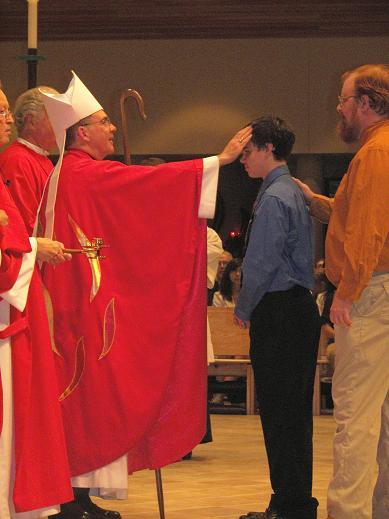
The purpose was so that I could go to Arkansas for the confirmation of one of my godsons, which as you can tell is what is going on in this picture.

I am presenting my godson Colin to Bishop James Sartain of Little Rock, who is confirming him.

Colin is an smart young man who shows a lot of promise. He takes his faith seriously, he’s got some great friends, and he’s got a lot of interests, including music and video games, as well as reading. In fact, he recommended a book to me that I’m going to get and read myself.

It was a real pleasure to get together with him and his family, and I extended my trip by an extra day so I could spend more time with them. It was a really special time for me.

I was also impressed with Bishop Sartain. He’s a Tennessee boy, and before the service I went up to him to make sure I was going to pronounce his name correctly during the service (that’s something that’s important to me, the way my last name gets mangled). Turns out his is pronounced SAR-tan, though he says he’ll answer to other things.

While I was waiting to ask him the question, he was telling some folks about a hunting trip he went on with friends down in Mississippi, so that scored him points in my book.

Incidentally, I have reason to think that this photo of us may show up in the diocesan newspaper, The Arkansas Catholic, so any blog readers who get the paper might keep an eye out for it.

Shelby Steele on White Guilt & Iraq

Steele
I have liked Shelby Steele ever since his book The Content of Our Character came out back in the nineties.

I had to pass on this excellent opinion piece by Steele, from today’s Wall Street Journal.

Anyone with even a casual interest in U.S. History will appreciate the insight that Steele draws from our military experiences since WWII.

His premise is that White Guilt causes us to wage war only at a level tolerable to our enemies. The subtitle of the piece asks the question "Why is America so delicate with the enemy?".

His exploration of the meaning of the term "white guilt" alone makes the article a worthy read.

Our enemies see our restraint as weakness and they are correct, in a sense. From our perspective, we may see it as self-imposed weakness that comes from strength. Our enemies don’t feel they have the luxury of moderating their war efforts. We apparently do.

I think many Iraq war critics fail to grasp what a tricky job it is to make war against a weaker and poorer nation, even if the job needs doing. The truth is that we could squash Iraq like a bug. We could carpet bomb their cities into oblivion and set up whatever kind of government we durn well pleased, but we don’t. If we had no scruples, we could easily make the insurgency impossible. We could pour three times the current number of troops into Iraq (as Colin Powell has suggested). The fact that we don’t is a topic worthy of serious investigation, and Steele does an admirable job.

Steele sees the same White Guilt induced paralysis throughout the West. He also sees it in our seeming inability to take any kind of intelligible position on immigration.

Not that White Guilt in itself doesn’t have its place. We should rightly feel shame at some of our national sins; slavery, wanton destruction of native populations, the headlong rush into hedonistic materialism following the industrial revolution. It was likely our own imperiaslism, exported to Japan, that came back to us in WWII.

We have laboriously overcome some of these national sins. We are yet paying penance for others, and some we are still actively engaged in (that would be the hedonism thing).

Clear sighted commentary like this, from Shelby Steele and others, helps us to put things into perspective and move on, completing our penance for past sins, and leaving us free to tackle our current ones.

Everyone should read this.

GET THE STORY.

What Are My Qualifications?

In the combox down yonder, a reader writes:

I stumbled onto your blog by accident. Read several areas of commentary. Was a bit befuddled as to why there is nothing on the site explaining why you are qualified to answer questions or give advice on behalf of the Roman Catholic Church and its practices and canon law rather than directing one to their local priest or bishop.

So I did a little research and found that you work for Catholic Answers.com, but that still doesn’t answer the question.

Okay! I’ll do what I can to help clarify matters!

Is your advice reviewed by Rome or your local bishop to make sure that it is correct and accurate.

No, there is not enough time for that.

Do you not have a moral obligation as a Catholic to gain prior approval of your commentary by you local bishop in order to make sure you are not misleading other Catholics in giving advice (including interpretation of Canon law) on what is proper and what is not?

I have a moral obligation to make sure that what I say is accurate, and I take that obligation very, very seriously. I would daresay that I take it much more seriously than many do, but I do not have the moral or canonical obligation to get prior approval on everything I write on matters related to the faith.

But I don’t have the moral obligation because to seek prior approval on what I write because if people had this obligation then the work of spreading and explaining the faith would come to a screeching halt. There are only 4,400 Catholic bishops in the world, but there are 6,000,000,000 people who need education in the faith. If bishops were required to pre-approve everything that was written to help evangelize the world then they would not be able to eat or sleep. They would spend all their time reading and pre-approving documents–either that or the number of documents would diminish to a trickle and the project of promoting the Christian faith would come to the screeching halt I mentioned earlier.

In recognition of the pressing need for works that promote the faith, canon law only requires imprimaturs on a handful of highly important works, like translations of Scripture or catechisms. It does not require imprimaturs (granted before or after publication) for ordinary attempts to explain points of Church teaching or law. (You can read the requirements for imprimaturs HERE).

As I said, though I don’t have the moral or canonical obligation to get pre-approval on everything I write (though I do on those things I write that require imprimaturs), I do have the moral obligation to make sure that I am right, and I am very serious about that.

This is one of the reasons I "show my work" by quoting from official Church documents whenever possible and by spelling out the links in my reasoning so that people can see and evaluate it for themselves. I don’t just present my conclusions and say "This is what the Church teaches." I know a lot of people do that, but I strive not to be one of them.

I also strive to make it clear whether what I’m saying is a matter of personal opinion or Church teaching–which is something else I wish others would do more often than is presently the case.

My goal in doing this work is what I call "transparency to the Church." I want to present to people what the Church presents without addition, subtraction, or alteration. I strive to tell people what the authentic Magisterium of the Church has said even when I’m not comfortable with it, and when I’m asked a question that the Magisterium has not addressed, I try to make it clear that the answer I’m giving is not to be confused with official Church teaching.

I’m not perfect, and I’m sure that people can point to examples where I have failed in this regard, but this is the goal that I earnestly pursue.

Given your commentary in posts on canon law, and your view of it, can you point me to a the reference that would allow for a dispensation to allow a priest to not be celibate and participate actively in a parish community life?

I’ve been working toward doing a post on the topic of how a laicized priest can and cannot involve himself in parish life for a while. I already know what the general parameters are, but I’m in the process of procuring a copy of the standard document that is issued to priests when they are laicized that spells these matters out. As soon as I have it and can get it typed in, I’ll post it so that people can see for themselves what the general rules are. (That way they don’t have to take me at my word; they can read the document for themselves.)

I hope to have this done later in the week, though it might stretch into next week. Please stop back by and check.

Would you say your a liberal or conservative Catholic? I can’t understand how people can consider themselves liberal and Catholic.

I don’t know whether you’re using the terms "liberal" and "conservative" in a political or a theological sense, though I suspect the latter. Theologically, I strive to be a scrupulously orthodox Catholic, which you might call conservative.

As for the bunny story, why do you bother to post this kind of trash? Shouldn’t your posts directed at furthering God’s word?

God made us to have a sense of humor and to spend time on things other than theology. He meant us to live full orbed lives and to be interested in many topics. I try to reflect this on my blog by using humor (like the ongoing "The Easter Bunny is EVIL!" joke) and by posting about topics other than religion so that we can marvel together about other aspects of God’s creation and the human spirit (which is part of his creation).

Interested in answers.

I hope these help!

One subject that you raised but didn’t put into the form of a question is my qualifications to do all this.

My academic training is in philosophy, which intersects to a considerable degree with the work I do. I am also an autodidact who has managed to acquire a background in apologetics, biblical studies, theology, liturgy, canon law, and related disciplines.

Because I have learned this material on my own, I do not have an institution such as the Church or a university that has put its seal of approval on me (in areas other than philosophy) and said, "Listen to this guy; he knows what he’s talking about."

In the absence of such a seal of approval, the only defense there is for my answers is making sure that they are right. I can’t rely for my credibility on the fact that someone else has vouched for me.

Since no institution has handed me a reputation for accuracy by putting its seal of approval on me, the only way I can build a reputation for accuracy is by regularly being accurate and showing why my answers are accurate. That’s another of the reasons I "show my work" by backing them up with Church documents and spelling out the reasoning behind the conclusions I offer so that people can evaluate them for themselves.

This means I go to more pains to make sure that I’m right than if I had an institutional seal of approval. If I were a priest, for example, I could often get along by just saying "This is the way it is," and many people wouldn’t challenge me (especially to my face) because I was a priest. Not being a priest, I don’t have that luxury, so I have to go to extra lengths to ensure accuracy since truth is the only defense I have.

Hope this helps, and hope you’ll keep reading!

Condoms & HIV/AIDS

I’ve gotten a bunch of e-mails about the stories circulating in the Catholic press that the Holy See may be issuing a document dealing with the topic of condoms and the transmission of HIV/AIDS.

From what I can tell, the known facts seem to be these:

1) Pope Benedict asked one of the Vatican dicasteries (the Pontifical Council for Health Pastoral Care) to prepare such a document (after some cardinals started making remarks in the press that sounded favorable toward using condoms to prevent the spread of AIDS, thus creating a public issue that needs clarification).

2) The document is presently in the consultation stage (word is that the Congregation for the Doctrine of the Faith is now looking at it).

3) When the consultation is finished, the document will be forwarded to B16 for him to decide what (if anything) to do with it. So NONE of this is a done deal at this point.

GET THE STORY.

Now, let’s go deeper: John Allen says (EXCERPTS),

Sources told NCR this week that a draft study currently being prepared by the Pontifical Council for Health Pastoral Care would provisionally accept the use of condoms in the narrow context of a married couple, where one partner is infected with HIV/AIDS and the other is not, as a means to prevent transmission of the disease.

Cardinal Javier Lozano Barragàn, President of the Pontifical Council for Health Pastoral Care, confirmed in an April 23 interview with the Roman newspaper La Repubblica that his office was asked by Pope Benedict XVI to look into the subject.

Speaking on background, an official in Lozano Barragàn’s office later told NCR that the draft takes a favorable position on the use of condoms to halt the spread of the disease "inside marriage and the family, not outside of it."

GET THAT STORY. (CLINICAL LANGUAGE WARNING)

Allen does a pretty good job explaining the moral dimensions of what the document might say, but let’s get into the moral issue involved and try to envision what the document might say if it comes out along the lines that Allen indicates are currently being discussed.

This matter is sensitive enough, though, that I’ll put the substantive discussion of it below the fold for the sake of decorum.

(CLINICAL LANGUAGE WARNING BELOW.)

Continue reading “Condoms & HIV/AIDS”

Opie – Laughing all the way to the bank?

RonhowTim J here.

You know… this is just a hair-brained possibility (or is it hare-brained?), and something that I guess is one of the inevitable cultural mutations of the DaVinci Code phenomenon, but it strikes me as plausible, and so though I have no evidence for it, I wanted to run it past y’all.

Heck, Dan Brown works without evidence all the time.

I watched one of the longer DVC trailers on TV this past weekend, and it struck me as oddly… innocuous. I mean, it depicted all these supposedly mind-wrenching, earth-shattering events, but it came off as rather… frothy – like one of those old Hollywood action serials, where you were supposed to get all worked up about the hero’s predicament, but all the time you knew it was really no big deal.

I haven’t seen the DVC film (and plan to go see Over The Hedge instead, on May 19th), but what I saw of the trailer left me with the impression that the acting is so over-the-top, and the direction so florrid that the film may come off about as plausible as The League of Extrordinary Gentlemen, and about as serious as Young Frankenstein.

I admit, it could be because I already think of the film’s raw material as ridiculous, and so I’m predisposed to laugh.

Except I wasn’t really expecting to laugh. I was expecting that a full-length DVC trailer would leave me irritated, concerned and maybe a little demoralized. It didn’t.

So, is it possible that little Opie Cunningham has directed the DaVinci Code as a farce? Might he have given the subject the cinematic treatment it truly warrants? Is he that good?

Part of me would like to think so, given that he grew up on the set of the Andy Griffith Show, singing hymns during breaks in shooting with Andy, Don Knotts and everybody. Wouldn’t it be great if he snapped up the DVC movie gig so he could give it the subtle lampooning it deserves?

Like I said, I have no evidence except for my own reaction to the trailer… I’m just sayin’, that’s all.

Grist for the continually grinding mill.

Important Clarifications On Sainthood

B16 has issued a document to the Congregation for the Causes of Saints that tightens up some of the procedures that have been used in recent years.

True to form, the Vatican web folks don’t have it translated into English yet–or even easily locatable via browsing,

BUT HERE IT IS.

The site serving it seems to be having connectivity problems, though,
so I’ve also put a copy of it in the below-the-fold section of this
post.

It’s been a few days, and none of the news services seem to have translated the document, but perhaps one of the Italian-speakers reading the blog may choose to perform a spiritual service for the English-speaking community by translating the short document (it’s about 1300 words in Italian). If so, I’d be happy to post the complete text.

In the meantime, we’re dependent on press-reports concerning what the pope said, such as

THIS ONE and THIS ONE and THIS ONE.

The general assessment that everyone is making is that B16 is significantly tightening up the requirements for sainthood in a way that could–in time, though perhaps not immediately–slow the astounding number of saints that have been canonized in recent years (i.e., during JP2’s reign, JP2 having proclaimed more saints than all the popes in the last 500 years PUT TOGETHER and having beatified even more people).

The reasons for JP2’s unprecedented number of canonizations is not fully clear to me, though it is something that has often been speculated upon. One of the speculations I find most interesting is that JP2 basically gave the Congregation for the Causes of Saints a kick in the pants and told them to start working on the backlog of causes that they had been sitting on, but I doubt that this would fully explain the sudden rush of saints.

As part of that rush, a number of questionable things were done, particularly in the area of proclaiming individuals to be martyrs.

Historically, martyrs are people who (a) accepted death that was being offered to them (b) because of hatred for the Christian faith.

They witnessed to the truth of the Christian faith even to the point of accepting death rather than denying it, making them witnesses in the superlative sense and qualifying them to be called "martyrs" (from the Greek word for "witnesses").

For someone to be a martyr in the classic sense, both of the above elements have to be present. The person has to accept death (meaning: they were given a choice to avoid death by denying the faith) and they have to be killed because of hatred for the faith (meaning: not for some other reason).

Thus I would not be a martyr if I go to Mass one day and al-Qa’eda blows up the church that I am in. In this case I wasn’t given the chance to avoid death by renouncing my faith. I was killed because I was a Christian, but I wasn’t given the chance to witness to the truth of the faith by accepting death rather than denying it.

That, as CNS points out, seems relevant to the potential canonization of Archbishop Oscar Romero, who was assassinated while he was saying Mass and had no chance to save his life by denying the faith.

Similarly, you would not be a martyr if someone killed you not out of hatred for Christianity but for some other reason, such as a political or social one. Thus if you are an outspoken social or political activist who runs afoul of the local Powers That Be and they decide to off you to shut you up, you’re not being killed because of hatred of the faith. The Powers That Be may even be Christians themselves (although not good ones) and have no problem at all with Christians in general, only with outspoken activists who make themselves inconvenient.

(I know the argument that by being an outspoken activist you may be witnessing to important Christian values, but this isn’t enough. The Christian faith doesn’t demand that every single person become the kind of outspoken activist you were, so it wasn’t the Christian faith that required this of you. You could have toned down your activism without denying the Christian faith. It is a refusal to deny the faith that makes a martyr, and you weren’t put in the situation of having to deny the faith in order to save your life.)

Unfortunately, in the recent rush of saints a number of people were proclaimed martyrs who did not appear to meet these criteria. While these people are certainly in heaven because of the infallibility of canonizations, the label "martyr" was applied to them in a way that did not meet the historic criteria for its usage.

The good news is that B16 seems to be hip to this, and he wants the term "martyr" used more rigorously and in its historic sense.

That, to my mind, is a good thing, because to expand the term "martyr" to new, unclear usages (a) sows confusion about what a martyr is and thus (b) dilutes and diminishes the witness of those who really did accept death rather than deny the Christian faith.

If the term "martyr" gets used in a new, fuzzy sense then I no longer know from the fact that a particular saint is a "matyr" that they witnessed to the truth of the faith by giving their live to avoid denying it. They may have just been murdered by a Christian-hater or killed because they were too outspoken an activist, and those aren’t the same things.

B16 also put the kibosh on a suggestion by some that the Church ought to count "moral miracles" (e.g., the conversions of notorious sinners) rather than "physical miracles" (e.g., medically unexplainable healings) toward sainthood.

MORE ANALYSIS FROM ED PETERS.

At least all this is how it seems from press reports–pending our getting a translation of the Italian original.

Click below to see that.

Continue reading “Important Clarifications On Sainthood”

Vegans Need Not Apply

Fruitarian

You’ve been feeling ashamed of killing innocent potatoes, corn, eggplant, and artichokes in your pursuit of a totally vegan diet, haven’t you? But you keep justifying this willful slaughter of hapless vegetables because a body has to eat, right?

Well, the solution is now at hand! Forget about going vegan. Go Fruitarian!

"Welcome to the Fruitarian site, the international meeting point for people who love to eat fruit. We eat raw fruit only … and we feel GREAT!!!!

"This site will be sponsored by ‘The International Fruitarian Foundation,’ a non-profit organization, to welcome, support, connect and defend the interests of all fruitarians around the world, to promote the style of life of living on fruit only. You will be able to learn about nutrition, fruit, seeds, fruit trees, and the environment for a better life…"

SEE THE SITE.

If you’ll excuse me now, I hear Ronald McDonald calling my name. And he’s not offering a fruit-and-seed patty.

Jewish Ceremonials Today

A reader writes:

There were means provided by God in the Old Testament for forgiveness of sins, I believe. I imagine these were in-effect promissory notes, to be fulfilled when Christ retroactively ratified them. So do those same means — I don’t have the books right here to look them up, but I think I mean Yom Kippur, the Day of Atonement — still work? — for Jews who don’t realize they’ve been subsumed by the sacrament of Confession?

This is an interesting and somewhat tricky question, and Catholic theology does not have a definitive answer on it, but there are some parameters to the options that are open in answering it, and I can tell you what answer I personally am inclined toward.

So here goes. . . .

If you read the passages in the Old Testament that discuss the sacrifices that were offered (e.g., Leviticus 1-7) or the Jewish festal calendar (chiefly Leviticus 23) then it is quite clear that some kind of atonement/forgiveness is promised through the celebration of these rites. That’s parameter #1: We have to say that people were somehow doing some kind of reconciliation with God through these things.

We can’t just say that these were symbols of reconciliations that had already been effected. The text isn’t written in a way that allows that. It’s "IF you want to get reconciled with God THEN you do this ceremony," not "IF you’ve been reconciled with God THEN do this ceremony as a symbol."

Parameter #2 is given to us by the book of Hebrews:

It is impossible  that the blood of bulls and goats should take away sins (10:4).

So despite the straight-forward IF/THEN algorithms of the sacrificial economy in the Old Testament, there has to be more to it.

Here’s where things get messy.

It’s initially tempting to think of matters in terms of a simple promisory note situation: The blood of bulls and goats don’t intrinsically take away sins, but by virtue of their foreshadowing of Christ, they did–at least before the sacrifice of the Cross was made. The Old Testament ceremonies discharged our debt of sin on the model of a credit card (i.e., funds to be deposited in the future), while New Testament ceremonies discharge the same debt on the model of a debit card (i.e., funds already deposited).

But there’s reason to think that this analysis isn’t all there is to it, either, for Hebrews goes on to describe Jewish priests of the day offering sacrifices that don’t take away sins:

Every priest stands daily at his service, offering repeatedly the same sacrifices, which can never take away sins. But when Christ had offered for all time a single sacrifice for sins, he sat down at the right hand of God (10:11-12).

This makes it sound like the Jewish offerings never took away sins.

I could see someone saying, "Well, maybe the author of Hebrews is saying that in his day–AFTER the sacrifice of the Cross but BEFORE the destruction of the Temple in A.D. 70–their sacrifices were ineffective, but prior to that, prior to the time Christ died on the Cross, they were effective," but this doesn’t seem to fit with the flow of his argument. He seems to envision the Old Testament sacrifices as always inadequate in some sense, which is why Christ had to come and make his fully adequate sacrifice for us. That seems to be the major thrust of his argument.

So we’ve got one parameter telling us that there was some kind of reconciliation effected through the Old Testament sacrifices and we’ve got another parameter telling us that it wasn’t the full, definitive reconciliation that was made through Christ.

The truth therefore is to be found within the space marked off by these two parameters, and here is where theological speculation and opinion comes in.

It seems to me that part of the answer is to be found in the fact that the concept of reconciliation with God is focused very differently in the Old Testament than in the New. One of the things I have a chance to explore in my book The Salvation Controversy

<hypnosis>BUY THE SALVATION CONTROVERSY, BUY THE SALVATION CONTROVERSY</hypnosis>

is that in the Old Testament atonement is much more this-worldly. People are wanting to get reconciled with God so that temporal disasters like sickness and poverty and war and physical death won’t happen to them. In the book, I call this "temporal atonement."

It’s in marked contrast to what the New Testament is focused on, which is getting right with God in this life so that you don’t spend the next one in hell. In the book, I call that "eternal atonement."

It seems to me that part of the answer to the efficacy of the Old Testament ceremonies is that they were focused on making temporal atonement–on getting right with God so that we don’t suffer temporal calamities–and they didn’t really have in focus what happens to us in the next life.

At least early on.

By the later period of the Old Testament–as witnessed by Judah Macabee’s sacrifice for those who had died–there was a desire becoming manifest to secure blessings in the next life through the use of the ceremonies. These blessings may not have been conceived of as eternal ones. Judah Macabee’s sacrifice presumably dealt with the temporal effects of sin that linger into the next life (i.e., purgatory) rather than securing eternal salvation for the fallen warriors, but the desire to use the ceremonies to receive some kind of blessing in the next life was there.

This desire grew to the point that in the first century A.D.–when securing eternal salvation had become a pressing concern in the consciousness of the Jewish people–people were conceiving of the Temple ceremonies as securing eternal salvation.

And that’s when Christ came and offered his sacrifice and the authors of the New Testament (chiefly Paul and the author of Hebrews) made a BIG point that the Temple sacrifices did not do what people were thinking of them as doing. That’s why Christ had to come.

I’m thus inclined to say that the Old Testament ceremonies were focused on providing temporal atonement and that eternal atonement was something that was secondary.

But let’s explore that secondary side for a minute.

Suppose that you’re God and that your people have sinned and you’ve set up a sacrificial economy for them to get right with you when they’ve done so.

At the moment, the things that they’re focused on are avoiding temporal calamities in their own, tiny little lives. As God, you have a clearer awareness than they do of the fact that they also have an eternal destiny, and they have some awareness of this, too. But what’s really importent to them at the moment is that they don’t get sick or invaded or have a famine. They’re like kids–thinking more about today than tomorrow.

And so they bring bulls and goats into your Temple and offer them to you to say that they’re sorry for their sins and please don’t squash us, and so you don’t squash them, because they really are sorry and want to make it up to you in the way that you deem appropriate.

So where does that leave their eternal destiny?

Are you, as God, going to say to them upon death, "I’m sorry, but all those sacrifices you made had nothing to do with your eternal salvation, so although I was merciful to you in life, I’m not going to be merciful to you in death, so to hell with you"?

I don’t think so. That’s not the vision of the God that we’re given in the Bible.

It seems much more likely to me that you’re going to say something like, "You know, those sacrifices that you did to get right with me so I wouldn’t squash you were focused on temporal salvation, and they really didn’t do anything toward your eternal salvation–for the blood of bulls and goats cannot take away sins, at least in the eternal sense–but by offering those sacrifices and otherwise trying to follow my will, you were showing that you had a heart for me. You were turning your will away from your sins and toward me, and so you were reconciling yourselves with me inwardly and the sacrifices you offered were an outward sign of that inward desire for union with me. They weren’t enough to bring about that union, but they showed that you were doing what you could. You were trying to do your part. Therefore, I’ve done my part, too, by making a sacrifice through my Son that is capable of taking care of the eternal effects of your sins, so well done my good and faithful servant. Come on into heaven. Your union with me is achieved."

So underneath the desire to get right with God in this life to avoid being squashed was a deeper desire for union with him in general, and that desire would apply to the next life as well as this.

And God would honor that.

So what would we say about Jewish ceremonials today?

It seems to me that we’d say the same thing: The ceremonials themselves cannot be said to provide an objective means of securing eternal salvation, just like the blood of bulls and goats in the Temple era didn’t. But for a Jew who is performing them out of a desire to be reconciled with God, if he’s doing what he thinks God wants him to do, then God will honor that inward desire for and will towards reconciliation.

The reconciliation will be provided exclusively through the sacrifice of his Son and not through the ceremonials that are being performed, but the will toward union with God is what God will honor.

So Yom Kippur and other ceremonials today don’t objectively provide a means of eternal salvation for Jewish people–only Christ and the sacraments he has established do that–but the will toward God shown by Jews in pursuing these in good conscience is something that God will receive.
They Call Me “Trinity”?

A reader writes:

hi jimmy, i have my confirmation soon and im looking for some names and i really like the name Trinity and i would like to know if its alright for a confirmation name. please let me know as soon as possible.

"Trinity" is an unusual name to pick for a confirmation name. It’s a description of the nature/existence of God, and it’s a name that isn’t traditional in Christian culture.

These are considerations that might make you not want to choose the name "Trinity" as a confirmation name.

On the other hand, here is how the name would be regarded canonically . . .

There is no mention of confirmation names in the Code of Canon Law. Under current canon law, they are a Catholic folk tradition that may or may not be used, at the confirmand’s discretion.

Should they be used, they most likely should be understood on the model of baptismal names–which are mentioned in canon law, given the general legal and sacramental parallelism between baptism and confirmation.

Here is what canon law says regarding baptismal names:

Can.  855

Parents, sponsors, and the pastor are to take care that a name foreign to Christian sensibility is not given.

It is going to be hard to argue that the name "Trinity" is "foreign to Christian sensibility." While it is true that not many people have been named this, that fact alone is not sufficient to make a name "foreign" to Christian tradition. The name may be uncommon, but this canon has not been understood so as to make uncommon names foreign and thus impermissible.

When we look beyond commonality to the content of the name itself, "Trinity" definitely cannot be seen as foreign to Christian sensibility. "Trinity" is the nature/existence of God in the Christian conception, so it can’t be foreign in and of itself.

One could argue that the name "Trinity" is too close to the nature/existence of God to be a fitting name,  but this will be hard to maintain given the common Hispanic name of "Jesus." If Spanish-speakers can name their children "Jesus," then it is going to be hard to say that "Trinity" is too close to the nature/existence of God for it to be impermissible as "foreign to Christian sensibility."

As further evidence that the name is  not foreign to Christian sensibility, some folks actually have the name "Trinity."

And some religious have incorporated the name "Trinity" into their religious name, like Philip of the Blessed Trinity.

If you wanted to take the edge off the use of the name, you might choose the name of a religious like Philip of the Blessed Trinity, whose name you could shorten in practice to "Trinity," but I find no grounds on which to say that the name itself would be canonically impermissible.

In fact, since the goal of the Christian life is to grow closer to God and thus more like God, wanting to name oneself in some way after the central mystery of the Christian faith would seem to be a spiritually positive impulse.

BTW, after your confirmation please write back and let me know if "Trinity" Is Still My Name.

Photo Mystery Solved!

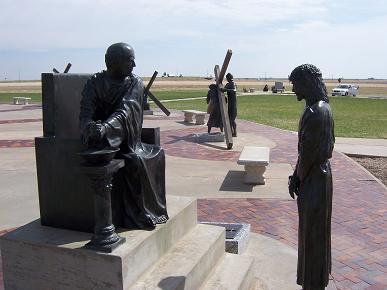
Groom_stationsThanks for all the guesses about where I was in yesterday’s mystery photo. I hadn’t heard of most of the other giant crosses that folks mentioned.

The answer is that I was at the giant cross in Groom, Texas–population 587 (Saaaaaa-lute!).

The Groom cross site advertises itself as the world’s biggest cross (which it was, though another town has apparently built one that is 8 feet taller now) and also "A religious experience like no other!"

The latter is a tag line you see on a roadsign on I-40 to get you to stop at the cross, which is run by the innocuously named "Cross Ministries" (a.k.a. Cross Of Our Lord Jesus Christ Ministries).

What happens when you stop and get out of your vehicle is that you find there is a whole bunch of stuff at the cross. In fact, once you get there the real focus ceases to be on the giant cross itself, which comes to seem more like something impressive and visible from the roadside (from miles away!) designed to get you to stop and see the real religious content of the site.

Most of that religious content consists of life-sized statues forming the Stations of the Cross (above), though there are also other items, like a large plaque of the Ten Commandments with Jesus’ commandment to love at the bottom of it and a life-size replica of the Shroud of Turin and a life-size Empty Tomb (with an angel in it) and a pro-life memorial with Jesus holding a tiny, aborted baby in his hand.

Now, "Cross Ministries" is a name that sounds very interdenominational, and it’s nice to see an interdenominational group including something as Catholic as the Stations of the Cross (especially in the form of life-sized statues).

Only as you start working your way around the stations, you start suspecting that this group isn’t as interdenominational as it seems.

There are certain Catholic touches. . . . like when right before you get to the statues depicting the Crucifixion, you have to walk past another statue of Jesus celebrating the Eucharist at the Last Supper, emphasizing the link between the Cross and the Eucharist. And then there are these plaques on the ground explaining what the statues are, with Bible verses for you to meditate on, and the plaques around the Eucharist statue are all Bible verses emphasizing the Real Presence.

And for the Fourth Station (Jesus Meets His Mother, Mary) one of the Bible verses on the plaque is from Revelation 12.

And one of the plaques on the way to the gift shop (after you finish doing the stations) is titled "Pillar of Truth" and cites 1 Timothy 3:15.

And right in front of the gift shop is a huge fountain with a statue of Jesus and the plaque says "Divine Mercy Fountain," and the statue of Jesus is posed just like he is in the Divine Mercy devotion (only he doesn’t have rays of light streaming from his chest).

And in the gift shop there are not only tons of the kind of gift items (not books) that you’d find in a Protestant bookstore, there are also Divine Mercy posters (with the rays of light) and pictures of Mary and books by Cardinal Ratzinger and pictures of John Paul II and Pope Benedict.

Given the "Pillar of Truth" references that crop up more than once at the site, I half expected to find copies of Pillar of Fire, Pillar of Truth in the gift shop (which would have been cool, since I’m a co-author of that booklet), but I didn’t. I’ll have to contact the folks who run the site and see if they’d like me to send them some.

But all the Catholic stuff is doesn’t stop Protestants from being able to find meaning in this.

While I was there I spoke with a black lady truck driver from L.A. who had stopped and who gave every sign of being Protestant, yet who agreed with me when I said how much I liked the fact that they included the Stations of the Cross.

And then on the wall in the gift shop there’s a photo of Charlie Daniels (who is Protestant as far as I can tell, though he has Catholic-friendly themes in his songs sometimes, as in his "El Toreador" song) that the singer has autographed to the guys who run the site.

So I was really impressed!

Not only was the site moving to me as a Catholic, but it is intriguing and non-in-your-face enough that many  Protestants will find meaning in it, too.

What a wonderful way to help Protestants driving by on I-40 to stop and have a spiritual experience that puts them in touch with aspects of Christian spirituality that they otherwise would never experience.

Kudos to Cross Ministries!

Incidentally, I got pictures of the whole site and may do a web presentation on it for those who can’t make the trip to Groom–if there’s sufficient interest in that (and if I could get some help splicing and sizing the photos for the web).

MORE ON CROSS MINISTRIES.