I’m looking for a utility that would enable me to change British to American spellings in a document. Maybe some kind of grep thing. Anyone have a line on anything like that?
Some of those can mess with Internet texts that I convert to speech.
I’m looking for a utility that would enable me to change British to American spellings in a document. Maybe some kind of grep thing. Anyone have a line on anything like that?
Some of those can mess with Internet texts that I convert to speech.
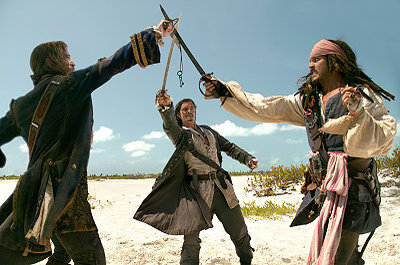 So I saw Pirates of the Caribbean: Dead Man’s Chest last Saturday (actually, before my pre-written post on it went up) and I thought it really rocked.
It had a bunch of cool stuff in it, some of which I can’t say because it would be too much of a spoiler, but here are some isolated snippets of cool things that won’t give away the plot.
COOL THINGS IN PRACTES OF THE CARIBBEAN 2:
1) Johnny Depp’s performance.
2) The way the crewman finishes the line "The captain is acting strange."
3) Davy Jones (SDG’s really right on this one; Davy Jones has the potential to rival Jabba the Hutt as an iconic image, which is why I’m not posting a picture of him; I don’t want to spoil his entrance)
4) The make-up effects for Davy Jones’s men.
5) In particular the conch-headed man, and especially what he does in his very last appearance in the film.
6) The island escape sequence. MAN, THIS TOTALLY ROCKS! I CAN’T THINK OF ANYTHING LIKE THIS EVER BEING FILMED BEFORE.
7) The "Jack-kabob"
8) The schlorp / shlub sound effects when the suckers on various tentacles are doing things.
9) The unusual "eye makeup"
10) The way that Jack and Elizabeth’s prophecies about each other come true.
11) The "Hello, beastie" moment.
12) The three-way swordfight.
13) The "rolling climax"
14) The humorous cliffhanger.
Don’t know what I’m talking about?
BTW, if the theaters are even half as hectic this weekend as they were last (when the film was selling out right and left), buy your tickes online or over the phone and make a point of showing up a little early.
If you have seen the film, feel free to share your own cool things in the movie. (SPOILERS OKAY since it’ll be in the combox.)
BTW, next summer’s final part of the Pirates trilogy may not be the end of the series.
JOHNNY DEPP HAS INDICATED HE’D BE INTERESTED IN PLAYING THE PART AGAIN.
Last week I did sometihng I haven’t done in around 20 years–I went to an actual science fiction convention. (More on that later.)
Scott of SFFAudio reminded me of something that I learned at the convention: There is a publishing house that offers ordinary HTML texts of many of the books it sci-fi books it publishes for download–either free or, in some cases, for a subscription fee.
The publisher is Baen, and it’s part of an interesting marketing philosophy that they’re trying out (i.e., letting people read some for free will prime their appetite to also purchase material, so you’ll end up making money).
Ordinary HTML files are great for me (as opposed to the formats many eBooks are published in) because I can easily turn them into audio books using my TextAloud program.
So I’m definitely going to be visiting their site.
A reader writes:
Hello, Mr. Akin –
My name is Scott, and I just noticed on your most recent post that you use
your iPod for audiobooks. Though I’m sure you listen to a wide variety of
stuff, I know you have an interest in science fiction, so I’d like to point
you to my site, SFFaudio, which features news, reviews, and commentary on
the world of science fiction and fantasy audio.I’m Catholic, and enjoy your site very much. My co-editor/website partner
is not a religious believer.SFFaudio can be found at www.sffaudio.com. I hope it’s of use to you.
God bless, fellow audiobook fan,
ScottPS – I’m currently listening to "The Sparrow" by Mary Doria Russell from
Brilliance. I’m about 1/8 of the way in… it’s interesting that much of
the science fiction that treats religion in a respectful way (rare enough,
indeed) features a Jesuit. So far, the novel is quite good.
Cool!
Having a site that coordinates sci-fi, etc., audio is a great idea. I looked it over, and there’s a lot of useful resources there.
A reader writes:
I’ve never heard the term "presumption of faith" used before but in thinking about the issue of Bishops withholding Communion from wayward politicians, it strikes me that the Church applies almost universally this principle (expressed in other ways).
Like presumption of innocence in court, the Church presumes faith when one asks for any of the sacraments. Because we cannot know another’s heart as God can, we have to take their word that they are able to receive the sacrament and believe what the sacrament does.
In the case of communion, it has been said many times that the confessional is empty and the communion lines are full. Logic, knowledge of human concupiscence, and just the results of some of the most recent surveys of Catholics tells us that there is something wrong with the picture, but in the communion line the Church applies presumption of faith because she has to.
It is only where a person publically advertises their sin and just as publically seeks communion while demonstrating no purpose of amendment (a requisite for a good confession if that confession had indeed taken place privately), it is only in that kind a circumstance that a public response is required to avert scandal.
Others holding the same views privately and acting upon those views could receive communion in an unworthy manner and the priest or bishop may never know because they are acting on the presumption of faith.
And so on.
Does that make any sense as a concept?
It does, though I’d tweak it a bit.
There is indeed a presumption that the Church makes in admitting people to Communion, though it isn’t just a presumption that they have faith. It also presumes that they meet the other requirements for Communion, such as being in a state of grace, having the proper dispositions, having fasted for an hour before the moment of Communion, and so forth. These are summed up under the heading of "worthiness to receive Communion" (which is a bit paradoxical given that immediately before Communion we say "Lord, I am not worthy to receive you," but there we are). I’d therefore phrase the presumption as a presumption of worthiness rather than a presumption of faith.
This presumption holds except in very specific cases. A Catholic presenting himself for holy Communion is not to be denied except unless he is prohibited by law from receiving. The Code of Canon Law provides:
Can. 912 Any baptized person not prohibited by law can and must be admitted to holy communion.
Now, there are people who are prohibited by law from receiving (e.g., because they’re in mortal sin, because they haven’t fasted, etc.), but in the practice of the Church the evaluation of these criteria is left to the individual communicant in the vast majority of cases. The only time in the Code that priest and other ministers of Communion are told not to give Communion to a person who presents himself is in the following canon:
Can. 915 Those who have been excommunicated or interdicted after the imposition or declaration of the penalty and others obstinately persevering in manifest grave sin are not to be admitted to holy communion.
Since declared excommunications (as opposed to automatic excommunications) and declared interdicts are as rare as hen’s teeth, the most commonly triggered part of this canon is that concerning "others obstinately persevering in manifest grave sin." That means people who are publicly known to be involved in grave sin and who refuse to amend their ways.
As a practical matter, only those individuals are denied Communion (if even they are). Otherwise the presumption of worthiness to receive holy Communion operates.
A reader writes:
Jimmy, I have been bothered by the question of Jesus’ geneology. A lot of scripture refers to Him as son of David, descended from David’s line etc., and I think it traces the geneology down through Joseph, who was not Jesus’ natural father. Can you help me here?
A lot of folks have this question, and it’s natural to wonder about this.
It’s true that Jesus was not physically descended from Joseph and thus could not have been physically descended from David via Joseph. However, physical descent is not the only form of descent there is.
There’s also adoptive descent or legal descent.
This occurred in a variety of contexts in ancient Hebrew society. As members of a patriarchical society, everybody in Israel needed to be related to somebody in order to know their place in the world, and this led to a lot of adoptions, including adoptions that were done posthumously–after the death of the person "doing" the adoption.
That’s essentially what’s going on in the case of the levirate marriage. If a man died childless, his brother was expected to marry the widow in order to produce a son who would legally be the son of the dead man. That’s a kind of posthumous "adoption" of the son by his deceased legal father, who happens not to be the same individual as his biological father.
Yet this didn’t stop the son’s sons from being reckoned as the dead man’s grandsons. Legal descent was counted as descent in a real and binding way. In fact, in the case of the levirite marriage, legal descent was more important than biological descent, for producing a legal heir to the dead man was the whole reason for the levirite marriage to being with.
There is some evidence that levirite marriages occurred in the genealogies of Christ.
So if legal descent of that kind doesn’t interrupt the descent of Christ from David then Christ being legally but not biologically the son of Joseph wouldn’t either.
This, then, may be how we are to understand Christ’s descent from David: He was a legal heir of David and so he was a son of David. Period. The biology doesn’t matter.
Or it may be that there is more to it.
St. Paul says in Romans 1:3 that Christ was "descended from David according to the flesh." There’s a question here about how literally he means the word "flesh." He may just mean it to mean "humanly," in which case he could just be thinking of Christ’s legal descent from David via Joseph.
But he may mean the term more literally than that. If he does then . . . well . . . Christ got flesh from Mary, so perhaps Mary was also a descendant of David and Christ received biological descent from David in that fashion.
If you’re a regular JA.O blog reader who lives in Southern California–within driving distance of El Cajon–I’ve got a special offer.
Catholic Answers wants to accelerate the work being done on Secret Project #4, and we’re looking for local folks to help us from home!
To help, you’d need:
1) A computer
2) A word processor (preferably Microsoft Word; if not that then something compatible)
3) E-mail
4) To be able to drive or otherwise get to Catholic Answers to pick up materials.
5) Some free time between now and mid-August (a number of hours worth, the more the better, though as few as six would do) and
6) To keep quiet about what is revealed to you about the project.
This is help that could be done at night or on weekends. Responsible older teenagers wanting some extra Summer money would be able to help with it as well.
It’s not at all hard or complex work–just doing very simple things in a word processor (in fact, it could be a bit unchallenging).
There would be some modest pay ($$) involved, and in addition you’d have our profound thanks (!!) and the knowledge that you helped with a project that has the potential to revolutionize the field of apologetics.
If you’re interested, E-MAIL ME and let me know your availability and phone number.
Thanks much, folks!
Sorry, folks, but except for the note immediately above this one, I’m afraid that I’m having to take an undesired blog day off.
TypePad’s service was down Wednesday evening (and much of the day) and this prevented me from blogging. Assuming there are no new problems, normal blogging should resume tomorrow.
UPDATE: TypePad seems to have had to revert to a backup copy of their system in order to solve the problem they were having. As a result, some of my posts went back into draft mode (they have now been restored) and it looks like they lost yesterdays comments. Rats. I loved Suzanne’s amazingly candid one on the post about godparents.
Apple and Microsoft appear to both be trying to get out an interesting new product in time for Christmas: the wireless iPod (or, in Microsoft’s case, a wireless mp3 player):
Current iPod owners have to sit in front of a computer to download music onto the gadget. But with the wireless version, they would be able to download new songs anywhere and at any time – as long as there is a wireless network in the area.
I thought the story was interesting, and it touched on some additional interesting things, but I’m not bowled over by the idea of a wireless iPod.
I use my iPod every day (mostly for audiobooks), and I think it would be nice to have the ability to download content wirelessly, but that’s not the highest thing on my most-wanted iPod features list.
I haven’t had a lot of success using wireless hotspots with my laptop, and I don’t know if they’d fare much better with a wireless iPod.
They also aren’t all over the place (yet). If I could have cellphone-type coverage for downloads (i.e., if I could take my iPod virtually anywhere and get content), that would be better, but I just don’t hang out in wi-fi hotspots (not even Starbucks).
And then there’s the matter of trying to navigate a wireless music store with a click wheel. Ick.
What I’d rather have a Bluetooth iPod so I could get the content from my computer without having to hook up the iPod physically.
Built-in speakers for the iPod would be even better.
What I’d like most of all are good wireless earbuds (probably kept in a compartment inside the iPod when not in use so they can recharge) that have significant battery life so that I can listen to my iPod in public without having that annoying cord between the Pod and the buds.
I know that there are already some wireless headsets for iPods, but I haven’t been impressed with the ones I’ve seen thus far, and I’d rather have earbuds that I could plug into the iPod for recharging when not in use.
But that’s just me.
Whadda y’all want in an iPod (or equivalent device)?
A reader writes:
My husband and I converted to Catholicism 4 years ago. We are currently expecting our 5th child, the 3rd to be born since our reception into the Church. My question concerns the choosing of Godparents for this new child. Is it ok for us to choose the same set of Godparents for this child as for one of the other children? We have many devout Christian friends and family, but they are mainly Protestants and so unsuitable for Godparents. There are very few Catholic couples that are we close enough to, and know their faith well enough to ask them to be Godparents. The two couples that we have already asked are still the best candidates from our "pool" of friends and family. I would like to know what is okay canonically, as well as what the tradition on this question is.
Canonically there is no problem at all in having the same godparents for one child as for another. There is no canonical requirement that one child in a family must have a different set of godparents than another, as can be seen from our recent discussion of the requirements.
As far as what is traditional–well, that may vary significantly from culture to culture. In America it seems to me that most Catholics (at least the ones that I know) tend to have different godparents for different children–at least most of the time–but this is in no way binding.
Doing the best thing for the kid would take priority in my mind, and if that mean having the same ones for different kids because those are the best ones available, then that’s what I’d do.
Incidentally, thanks for giving me the occasion to tie up another couple of godparent questions that came up in our previous discussion.
There was some question about whether a person who is non-Christian could serve as a formal "witness" to the baptism. The answer is that, by my reading of the canon, the answer is no.
What the canon (CIC 874) says is:
§2. A baptized person who belongs to a non-Catholic ecclesial community is not to participate except together with a Catholic sponsor and then only as a witness of the baptism.
Now, the phrase "baptized person who belongs to a non-Catholic ecclesial community" has a technical meaning in canon law, and what it means is: Protestant.
Eastern Orthodox can be godparents, as we noted, as long as there is also a Catholic godparent (see sectoin 98b of this document) don’t fall under that designation because they have validly ordained bishops and so are members of churches rather than "ecclesial communities." Because Protestants don’t (in general) have validly ordained bishops they don’t have "churches" in the full sense and so Vatican II and canon law use the term "ecclesial community" to refer to their communions.
In the declartion Dominus Iesus, Cardinal Ratzinger noted:
[T]he ecclesial communities which have not preserved the valid Episcopate and the genuine and integral substance of the Eucharistic mystery, are not Churches in the proper sense; however, those who are baptized in these communities are, by Baptism, incorporated in Christ and thus are in a certain communion, albeit imperfect, with the Church (no. 17).
Canon 874 §2 is thus making a specific exception for baptized Protestants to serve as designated witnesses, together with a Catholic godparent. It is not making an exception for non-Christians.
The rule is thus that there is always to be at least one Catholic godparent, who can be either male or female.
If there is an additional godparent then it must be of the opposite sex and can be either Catholic or Eastern Orthodox.
There also can be a Catholic godparent and a baptized Protestant witness.
A non-Christian or a non-baptized Protestant (some Protestant groups do not mandate baptism) could not serve as a witness but would have to have a looser, less official relationship with the child, such as an unofficial "uncle" or mentor or something.