

A reader writes:
I was wondering about the origin on the custom of not leaving the
Exposed Eucharist alone during Adoration? Is it canonical law or what?
First, kudos for recognizing the distinction between adoration and exposition. One can adore the Eucharist whether exposition is taking place or not. Many folks get these two mixed up.
In inquiring about the origin of the rule, I take it that you are asking what is the basis for this in current ecclesiastical law, rather than its historical origin. If you are looking for information on that, you might try here.
The Code of Canon Law only deals briefly with the subject of Eucharistic exposition. Those canons are part of the general section on the reservation of the Eucharist, which are online here.
The actual basis for the requirement is found in the Church’s liturgical documents. Specifically, it is found in a document known as Holy Communion and the Worship of the Eucharist Outside of Mass, which is published in The Rites, volume 1.
The section on the exposition of the Blessed Sacrament explains:
85. If exposition of the blessed sacrament goes on for a day or
for several successive days, it should be interrupted during the celebration of Mass, unless it is
celebrated in a chapel separate from the area of exposition and at least some of the faithful remain
in adoration.86. In churches and oratories where the eucharist is
reserved, it is recommended that solemn exposition of the blessed sacrament for an extended period
of time should take place once a year, even though this period is not strictly continuous. In this
way the local community may meditate on this mystery more deeply and adore.This kind of exposition, however, may take place only if
there is assurance of the participation of a reasonable number of the faithful.88. Where there cannot be uninterrupted exposition because
there is not a sufficient number of worshipers, it is permissible to replace the blessed
sacrament in the tabernacle at fixed hours that are announced ahead of time. But this may not be done more
than twice a day, for example, atmidday
and at
night.
From what I can tell, there is not an explicit statement to the effect that "There must always be at least one of the faithful present in adoration during the exposition of the Eucharist" in either of the main legal documents that are relevant (i.e., the Code and the one I just quoted), but it seems implicit in Holy Communion and the Worship of the Eucharist Outside of Mass that there are to be people present in adoration during exposition. Otherwise there would be no point to talking about needing a sufficient number of people to allow for a lengthy exposition.
Still, one could read this and say, "Okay, so you need people there generally, but not necessarily every single moment. If someone needs to step out of the room for a few minutes for some important reason, that would be okay."
Given the way HCWEOM is written, you could take that interpretation if you were of a mind to.
Which is why God created instructions issued by Vatican dicasteries.
According to the instruction Redemptionis Sacramentum, issued by the Congregation for Divine Worship and the Discipline of the Sacraments,
[138.] Still, the Most Holy Sacrament, when exposed, must never be left unattended even for the briefest space of time. It should therefore be arranged that at least some of the faithful always be present at fixed times, even if they take alternating turns.
The instruction thus clarifies the ambiguity that one could see in the primary legal document.
So there you have it.
 Recently I had the great pleasure of reading Tim Powers’ latest novel,
Three Days To Never.
I also had the great pleasure of hosting an interview with the man himself, right here on JA.O.
But in looking around, I found a couple of additional interviews he did about the book, and I’d thought I’d pass them along for readers who are Tim Powers fans or who should be Tim Powers fans (which would be everybody).
Both of these interviews are conducted by people who know science fiction better than I.
THE FIRST IS WITH THE GOOD FOLKS AT SCIFI.COM
and
THE SECOND WAS CONDUCTED BY SCIENCE FICTION AUTHOR JOHN SHIRLEY.
I was pleased to see how much different material is brought out by the three interviews. Tim got asked questions that were different enough that each gives him a chance to say new and interesting things about the book, and about his writing in general, so I hope y’all’ll check ’em out.
Oh, and don’t forget to
Okay, creativity of this caliber should not go unnoticed. Down yonder, a reader writes:
He sneaks around and can’t be found,
Until he’s on TV…
He takes a Moonie for a wife,
Embracing heresy;
And underneath his mitre,
Seems his lost his sanity.
I heard him once professing Docetism.He’s always breaking canons
But his penitence is real
He’s always late for everything
Except for every meal
I hate to have to say it
But I very firmly feel
Milingo’s even worse than Charlie Curran!I’d like to say a word in his behalf
(then say it, Sr. Margaretta)
Milingo makes me… laugh.How do you solve a problem like Milingo?
How do you make a bishop keep in line?
How do you find a word that means Milingo?
A flibbertijibbet! A will-o’-the wisp! A clown!If bishops are dogs, Emmanuel is a dingo
Which even a German Shepherd couldn’t tame.
So how do you make him stay
And shut up for just one day?
How do you keep a crosier from his hand?Oh, how do you solve a problem like Milingo?
How do you keep a Moonie’s feet on land?When I’m with him I’m distressed
Things he blesses don’t seem blessed
And you never know what stunt he’s pulling next
He’s defiant as M. Luther
Wacky as Rosemary Reuther
He’s a bishop! He’s a nutcase! He’s a wreck!He’s a Gnostic without Gnoss
Like a crosier sans a cross
He could make a Trappist hermit scream out loud
He is funny, he wild
Pray his wife is not with child!
He’s a headache, he’s amusing
He’s a looooooonHow do you solve a problem like Milingo?
How do you make a bishop keep in line?
How do you find a word that means Milingo?
A flibbertijibbet! A will-o’-the wisp! A clown!Many a thing you know you’d like to tell him:
Celibacy’s not just a papal whim
So how do you make him stay
And shut up for just one day?
How do you keep a crosier from his hand?Oh, how do you solve a problem like Milingo?
How do you keep a Moonie’s feet on land?
CHICAGO, September 21, 2006 – "Contrary to popular belief, contraception is
not the answer to reducing the number of abortions," said Joseph M.
Scheidler, National Director of the Chicago-based Pro-Life Action League.
"And it is not the solution to teen pregnancy."
On September 22 and 23, the Pro-Life Action League will host a national
conference to highlight the fact that the contraception theory is a lie.
Speakers at the two-day conference, entitled "Contraception Is Not the
Answer," will focus on the impact that contraception has had on our culture
– its effects on women, on men, on marriage, and on the culture.
Presenters include Dr. Lionel Tiger, the Charles Darwin Professor of
Anthropology at Rutgers University, Dr. Jennifer Roback Morse, author of
Smart Sex: How to Find Life-Long Love in a Hook-Up World, and demographer
Andrew Pollard, director of EMP Intelligence Service in Northampton,
England.
"Contraception Is Not the Answer" opens Friday, September 22 at 6:00 p.m. at
the Crowne Plaza Hotel in Rosemont, IL, with a presentation on the failure
of "comprehensive" sex education programs, and an analysis of the Protestant
embrace of contraception in the twentieth century.
A press conference will be held Saturday, September 23 at 8:00 a.m. in
Ballroom One of the Crowne Plaza, prior to the presentations scheduled for
the day. Dr. Allan Carlson, president of the Howard Center, Dr. Janet Smith,
professor of theology at Sacred Heart Major Seminary in Detroit, Damon
Clarke Owens, director of Joy-Filled Marriage, and Fr. Thomas Euteneuer,
president of Human Life International, will join Dr. Tiger, Dr. Morse and
Prof. Pollard to answer questions from the media.
"I believe this is exactly the right time to confront the common
misconceptions about the effects of contraception," said Scheidler. "This
conference will prove to be historic."
For further information see www.prolifeaction.org/cinta or call
773-777-2900. A brief preview of several of the conference presentations can
be accessed on the Pro-Life Action League website at
www.prolifeaction.org/cinta/teleseminars.htm.
-30-
I just wanted to pen a note that I’ve been meaning to pen for quite a while.
Without using an actual pen, of course.
Here’s what’s on my mind: We’ve had a dramatic growth in the number of comments that folks are leaving since JA.O started, and I think that’s just great. I enjoy reading folks’ comments, watching discussions underway, etc., just as much as everyone else. In fact, in some ways moreso since the comments tell me that I’m connecting with people–that I’m writing stuff that they find interesting enough to comment on. I’m always really pleased to see it when a post gets a large number of comments, and kinda disappointed when it gets only one or two (or none). But on balance, the comboxes on JA.O have become a very active place, with many recent posts having 100-200 comments or more.
Wow! Thanks, guys!
The amount of com traffic (to borrow a Star Trek term; or is it B5?) is so great at this point that I am unable to keep up with it. Since my blog is a side project that is not part of work, I can only blog in the evenings (or during lunch or on break), which is why you see me commenting so infrequently during the day. When I get home in the evenings, though, I have to focus on writing the posts for the next day (otherwise folks’ll have nothing new to read). Consequently, I can’t spend a lot of time reading the comboxes. I try to skim them, but I can’t do much more than that.
Now here’s why I mention this: I sometimes see folks asking me questions in the comboxes or making requests or things like that. I feel bad that there are probably many people who are asking questions or making requests that I never see.
So I have my own request to make: If anyone has a question or suggestion that they want to make sure that I see, I’d ask that it be e-mailed to me.
I read and appreciate all of the e-mail I get, though–as I’ve
noted–I unfortunately do not have time to reply to it all and I can’t
promise that I’ll do a blog post based on any particular e-mail. Time
constraints prohibit that, but I really do want to be able to know
about and give attention to the questions and suggestions people have.
Of course, you can put the same question or request in the combox, too, as long as it’s on topic. I often see people posting questions for me in the combox when then another reader (or readers) helpfully answer before I even stumble across the place, so the other readers are a great resource for trying to get questions answered also. Just the other day one gentleman asked for a list of good sources to turn to when trying to get official answers to questions, and I thought that the ones the other comboxers came up with were excellent. In fact, the ones I saw being recommended were the same ones I would have recommended myself, which made me really proud of what intelligent readers I have.
So thanks, and have a great day!
 It’s always interesting when you read two different, allegedly objective news stories and come away with contrary impressions of the state of the facts.
Take THIS ONE and THIS ONE as examples.
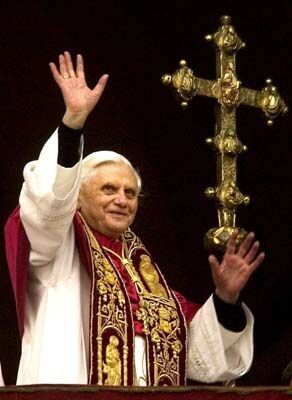
Both are covering the current controversy regarding Pope Benedict’s remarks on Islam, but they convey significantly different impressions of the state of things.
For example, the first article–by Reuters–has this hopeful note:
One of the few signs that the crisis may have peaked came from Iran’s hard-line president, Mahmoud Ahmadinejad, who told NBC television in New York that now that the Pope has taken back his statement "there is no problem."
That makes it sound like the controversy may have peaked, and it is a quite significant thing when a hate-inflamer like Ahmadinejad is saying that there is no problem. That sounds like a signal that he will not be using his government-controlled hate press to further inflame passion on this the way he did with the Danish cartoons.
But the second article–by The Evening Standard–conveys a different impression:
Pope Benedict faces a growing chorus of demands to make an unequivocal apology for remarks seen as portraying Islam as a violent faith, despite attempts by Western leaders and churchmen to defuse the crisis.
That makes it sound like the controversy is still building.
Admittedly, these matters are subjective and hard to gauge–but then THAT’S THE POINT, isn’t it? Unless the pieces are clearly labelled as opinion or analysis then they’re supposed to be objectively sticking ot the facts–or so the MSM would have us believe.
Then there’s another matter where the two pieces convey a different impression of the facts, and here the contrast between the two news services is reversed. According to Reuters,
In Turkey, Mehmet Ali Agca, who tried to kill Pope John Paul in 1981, warned Benedict not to make a planned visit to the country in late November, saying his life would be in danger.
"As someone who knows these matters well, I say your life is in danger. Don’t come to Turkey," Agca, who is serving a sentence for the killing of a newspaper editor in the 1970s, said in comments released in a statement by his lawyer.
From this one would think that Mehmet Ali Agca is sincerely concerned about Pope Benedict’s wellbeing (which he may indeed be) and issuing what could be sound advice (and it may indeed be) based on being an apparently sane and balanced individual with a realistic view of things, whatever his past crimes may have been.
In fact, Mehmet Ali Agca is a dangerously unbalanced fantasy-prone individual who regularly makes wild, non-reality-based statements that apparently come from his own delusional inner life.
While The Evening Standard doesn’t make as blunt (and as evaluative) a statement as I just did, it does at least report the facts in a way that allows the reader to infer what a crazyman Agca is:
In his two page letter to leading Italian Rome based daily La Repubblica, Agca, who was a member of the Turkish terrorist cell the White Wolves, wrote: "Pope Ratzinger listen to someone who knows these things very well.
"Your life is in danger. You absolutely must not come to Turkey. Pope Benedict you must know that between 1980 and 2000 I was in contact with various Western intelligence services and with the Vatican.
"In those twenty tears I learnt many things and I came into possession of many classified secrets."
The letter closed with Agca imploring Pope Benedict to resign for his own safety he wrote: "For your own welfare you must make a grand gesture of honour and resign.
"Then you must return to your native land (Germany) and in your place an Italian cardinal can be elected Pope, possibly (cardinal Dionigi) Tettamanzi or (cardinal Tarcisio) Bertone.
"Then the Vatican should become a centre of peace and fraternity. The world has a need of this it does not need hatred and vendetta."
While it’s praiseworthy that The Evening Standard reported the facts regarding Agca’s current letter more fully and thus put the reader into a better position to evaluate the sanity of the man, it was still writing the piece according to a scare script, pouring the story into a pre-formed mold and to my mind still constitutes shallow reporting since Agca has repeatedly said totally bizarre things and the reader is not informed of this fact.
If it was going to make Agca the centerpiece of its story, it at least should have interviewed someone who could offer an assessment of the reliability of the man.
For example, shortly before the death of John Paul II he gave an interview with La Repubblica, in which he asserted:
In the 1980’s, certain Vatican supporters believed that I was the new messiah and to free me they organized all the intrigue about Emanuela Orlandi and the other incidents they won’t reveal" [SOURCE].
Meanwhile, the Vatican Information Service released the following text from Pope Benedict’s Wednesday audience concerning his speech at the University of Regensburg:
"I chose the theme," he said, "of the relationship between faith and reason. In order to introduce my audience to the dramatic nature and current importance of the subject, I quoted some words from a Christian-Muslim dialogue from the 14th century in which the Christian – the Byzantine Emperor Manuel II Paleologus – presented to his Muslim interlocutor, in a manner we find incomprehensibly brusque, the problem of the relationship between faith and violence.
"This quotation, unfortunately, has lent itself to misunderstandings. However, to an attentive reader of my text it is clear that in no way did I wish to make my own the negative words pronounced by the medieval emperor, and that their polemical content does not express my personal convictions. My intentions were quite otherwise: on the basis of what Manuel II subsequently said in a positive sense … concerning the reason that must guide us in transmitting the faith, I wished to explain that not religion and violence, but religion and reason, go together.
"The theme of my talk was, then, the relationship between faith and reason," he added. "I wished to call for a dialogue of the Christian faith with the modern world and for dialogue between all cultures and religions. I hope that at various moments of my visit – when, for example, in Munich I underlined how it important it is to respect what is sacred for others – what emerged was my deep respect for all the great religions, and in particular for Muslims who ‘worship the one God,’ and with whom we are committed to promoting ‘peace, liberty, social justice and moral values for the benefit of all humanity.’
"I trust, therefore, that following the initial reactions, my words at the University of Regensburg may constitute an impulse and encouragement towards positive, even self-critical, dialogue both among religions and between modern reason and Christian faith" [SOURCE].
Regarding the Wednesday audience, the Reuters piece noted this significant fact:
[A]s is customary, the Pope still was driven among the crowd standing on the back of an open jeep as it passed among tens of thousands of people in the square.
Which is one of the reasons I say B16 isn’t afraid to be martyred.
Despite what happened in that same square when Mehmet Ali Agca–a Muslim–tried to kill John Paul II, and despite the imminent reasonability of using a bullet-proof popemobile for security purposes, one of the first things B16 did in office was return to the practice of using an open vehicle–a clear signal that he is willing to accept the risks that this entails in order to be more accessible to those he is trying to serve.
Or that’s what one wag called it.

 SNIP:
SNIP:
Tuesday night, Hale showed another photo taken by Atlantis’ crew of a second mystery object floating near the shuttle.
"While we have not definitively put this interesting little picture to bed, there is considerable thought that it is just a plastic bag that came from somewhere and got loose," Hale said.
I don’t get it.
Every space pirate worth his space salt knows that the shuttle always jettisons its trash just before going into hyperspace.
Safe landing, guys!
 Sigh.
Sigh.
How to put this delicately?
( . . . still waiting for inspiration.)
Okay, let’s not put it delicately.
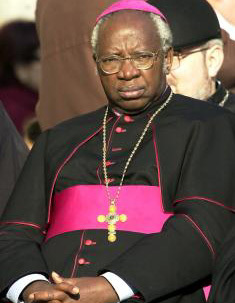
Archbishop emeritus of Lusaka Emmanuel Milingo is out of control. (Actually, that was pretty delicate compared to what I’m tempted to write.)
Worse, he’s out of control and rampaging through the United States, campaigning for married priests with his own civil law wife (I have to be in the qualifier becaue he’s not really married to her; he is impeded from being able to validly contract a marriage due to his holy orders, so his union with her is automatically null–same thing goes for all the non-laicized priests who "left the priesthood" to get "married"; see Canon 1087), who was personally picked for him by the long-time lunatic and antichrist, Sun Myung Moon.
HERE’S GENERAL BACKGROUND ON MILINGO.
Now, to address the question posed in the title of this post: Just how do you deal with an enfant terrible like this?
I mean, if you’re B16, you’ve got to do something. You can’t just let him rampage through downtown Tokyo, detroying buildings left and right.
AND PRESS ACCOUNTS INDICATE THAT SOMETHING IS, INDEED, IN THE WORKS.
But preciesely what’s going on isn’t fully clear.