(CHT to the reader who e-mailed!)
Yeah, the ending is a little dark, but it should only cause the Pluto haters to think more deeply about what they have done.
(CHT to the reader who e-mailed!)
Yeah, the ending is a little dark, but it should only cause the Pluto haters to think more deeply about what they have done.
. . . are FINALLY back up.
I know this has been an enormous frustration for folks who regularly use the forums, and it has been a HUGE headache for us as well.
Because I’ve gotten a number of e-mails about the problem, I’ve been meaning to do a post about it, letting folks know when the forums would be back up, but I kept getting told that we were on the verge of having them up and I wanted the post to reflect that, but one problem after another intervened and kept pushing the date back a day or so each time, and thus this post is later than I meant it to be.
Sorry about that.
Anyway–since I know a lot of folks are wondering what happened–here’s what did: A mysterious event occurred three weeks ago that wiped out the forums. Period. They were gone. The nature of this event is not entirely clear, but it appears that it likely was a hacker attack on the server where the forums are hosted.
Also (apparently) destroyed were the backups of the forums that were resident there. The most recent backup copy of the forums database that escaped destruction (for reasons I won’t disclose for security reasons) was from April, meaning that this was all we had to use to rebuild with, so even when the forums came up again that means all conversations underway would have to get a 5 month reset. (So basically people will have to restart their conversations from scratch.)
Worse, the people who registered since the last surviving backup–about 4,000 of them–would have to re-register.
Once the forums went down and we learned that it was likely a hacker attack that took them out, we realized that we wouldn’t be able to just put the forums back up the way they were, with no additional security. It would do nobody any good to simply put up the forums the way they were and let the hackers come back and take them down again a week or two later, just as the forum patrons were getting used to having them back.
So we undertook a massive upgrade–a new box for the forums to run off of, a fresh install of the forum software with all the latest security upgrades, additional security provided by our hosting service, a new backup system that will not be vulnerable to the kind of multi-month data loss we suffered this time, various ways I can’t talk about to thwart additional attacks, etc.
And absolutely none of this was in the budget–but we’re making the investment to keep the forums up and secure in the future.
We’re extremely serious about this and have had multiple meetings devising ways to try and ensure that this kind of event never replicates, and the need to take such extensive protection measures has slowed down our ability to get the forums back online.
It’s been a huge headache for our web guys–getting multiple pieces of hardware and software, configured properly, and working together in a new, tighter security environment–integrating what can be salvaged from the old forums, and testing the systems to try and make sure that they’ll work properly and wouldn’t immediately break as soon as we got them back online.
We wish–very strongly–that it hadn’t taken three weeks to accomplish all this, and forum users have our apologies, but we wanted to be very thorough so as to not have an even more frustrating crash as soon as or soon after we went back on line.
Having said that, the forums are back up and functioning so,
Incidentally, one note about getting to the forums: Apparently we don’t yet have all the ordinary ways of accessing them smoothed out (that’ll be a top priority), so for now you need to get to them by going to forum(singular) dot catholic dot com, with no Ws up front, like this:
UPDATE: You can now get back in by going to forums.catholic.com (plural) or from the forums tab on the Catholic.com homepage.
NOTE TO FELLOW BLOGGERS: Many of your readers may be users of the Catholic Answers Forums. Please consider a post letting folks know that they are back up. Thanks!
A reader writes:
My mother related an event to me that her friend witnessed.
During the distribution of Eucharist, a young girl about 14 approached to receive. She was wearing a typical teenage dress with spaghetti straps. As she approached the priest, he looked past her and waved her on. Her mother was behind her and said it’s okay, she’s old enough to receive. He didn’t answer, just waved her on again. She moved on without receiving. An older woman who saw what happened, took her shawl and wrapped it around the girls shoulders….the priest then went to where the girl was sitting and gave her communion once her shoulders were covered.
My question is…can he do that? I’m in agreement with dressing appropriately for church. But is it within the scope of the priest’s authority to deny someone Eucharist based on her outfit?
It is very difficult to establish a basis in the law for what the priest did in this case. First, let’s start with a general, hermeneutical canon:
Can. 18 Laws which
establish a penalty, restrict the free exercise of rights, or contain an
exception from the law are subject to strict interpretation.
Laws that would restrict the faithful’s right to receive Communion therefore must be interpreted strictly. If there is doubt as to the applicability of a law, the doubt must be read in favor of the free exercise of the right of the faithful.
Now let’s hop forward in the Code:
Can. 843 §1. Sacred ministers cannot deny the sacraments to those who seek them at appropriate times, are properly disposed, and are not prohibited by law from receiving them.
This canon is phrased negatively–that is, it says what sacred ministers cannot do. If a person meets the qualifications listed then a pastor cannot deny them the sacraments. Whether the canon is convertible such that a pastor can deny a person who seeks the sacraments at an inappropriate time, who is not properly disposed, or who is prohibited by law is not stated, but it seems clear that the minister can do so.
If the minister were to deny the girl Communion based on anything in this canon, it would have to be the on the grounds that the girl was not properly disposed, since her clothing has nothing to do with what time she is seeking to receive Communion and since there are no laws that expressly prohibit a person from receiving Communion based on the clothing they are wearing.
But there is a problem here. Actually, there are three.
First, the Code says further on:
Can. 912 Any baptized person not prohibited by law can and must be admitted to holy communion.
Whatever else it does, this canon lays additional stress on the gravity of reasons that a minister must have for denying Communion to one seeking it (at least during the context of a Mass). The fact that the earlier condition of proper disposition is omitted from this canon is at least suggestive that the minister should not be attempting to judge the dispositions of the communicant. He should not be trying to judge whether the person is displaying sufficient reverence, for example. He should only focus on whether the person is prohibited by law from receiving.
Thus he should be asking questions like, "Is this person baptized?", "Is this person a Catholic?", "Has this person been admitted to Holy Communion?", "Is this person under a penalty like excommunication?"–not "Does this person appear sufficiently reverent?", "Has this person fasted for an hour?", or even "Has this person been to confession?"
This is further undrescored by the following canon:
Can. 915 Those who have been excommunicated or interdicted after the imposition or declaration of the penalty and others obstinately persevering in manifest grave sin are not to be admitted to holy communion.
You’ll note that the condition needed to deny someone Communion in this canon on grounds of sin is not just that they are in mortal sin or have not been to confession since committing a mortal sin. It is that they are "obstinately persevering in manifest grave sin," which means a whole bunch of things–not only is the sin mortal (or at least grave), it must be publicly known, they must be continuing to do it (as opposed to having stopped it and just not gone to confession yet), and they must do so after some kind of warning (obstinately).
This indicates that, if a priest knows that a person does not have the proper disposition of being free of unconfessed mortal sins then he cannot deny the person Communion. For example, if he knows that the person recently committed secret sin X and that the person has not been absolved of it because just before Mass the person attempted confession to the priest in question and the priest denied him absolution because he wasn’t actually contrite then the priest still cannot refuse him Communion because the sin was secret (not publicly known and thus not manifest) and thus he is not "obstinately persevering in manifest grave sin."
The conjunction of canons 912 and 915 thus suggests that, in the case of the Eucharist, the question of whether a person is properly disposed is to be judged by the communicant and not by the minister. He can deny you Communion if you are prohibited by law from receiving it (e.g., if you are obstinately persevering in manifest grave sin) but it is not his job to judge whether you are sufficiently disposed. That determination is your job, not the ministers. (And, after all, do we really want extraordinary ministers of Holy Communion making that determination on our behalf?)
So that’s problem #1: There is a significant case to be made–particularly in light of the strict construction that canon 18 requires–that canon 912 modifies canon 843 in such a way that the minister is not to attempt to judge the proper disposition of a person seeking to receive holy Communion.
But then there’s problem #2: Even if it is within the minister’s purview to judge the proper disposition of a communicant, there are no canons dealing with proper vesture for receiving Communion. There are other laws establishing the proper dispositions for receiving Communion–you must be reverent, you must have fasted for an hour, you must not be conscious of unconfessed mortal sin, etc.–but nowhere does the law list what kind of clothing you are wearing as a requirement for proper disposition.
The absence of any laws dealing with this thus creates a case for saying that a particular kind of vesture is simply not required for proper disposition as the law understands it, and thus–per the struct construction required by canon 18–the minister would not be allowed to bar a person based on their type of vesture (unless, of course, the clothing they were wearing constituted obstinate perseverance in manifest grave sin; see below).
But even if this, too, is rejected, there’s still problem #3: What vesture is appropriate for receiving Communion is unambiguously culturally relative. In some cultures–like certain places in Africa–women do not wear tops at all, and the Church does not bar them from Communion on this ground. So one is going to have to judge whether the clothing is considered appropriate according to the local cultural norms, whether one approves of those norms or not (per canon 18’s strict construction).
If the local culture permits 14 year old girls to wear string-tied tops that reveal their shoulders–or strapless wedding dresses that do the same thing–then a minister will not be permitted to deny Holy Communion on that basis.
Now, if the local culture doesn’t allow something–for example, women going completely topless, or men going topless in church, or wearing a Nazi armband, or wearing a shirt that uses the F-word or the S-word or the N-word (things which might be nailable under the obstinate perseverance in manifest grave sin requirement)–then the minister (prescinding from problems #1 and #2) refuse Communion, but not if this is what people in the culture are permitted to wear.
Since teenage girls in our culture are commonly permitted to wear string-tied tops that expose their shoulders, it is going to be very difficult to use canon 843–given the three problems here named and the strict construction that must be put on the matter–to deny a girl Communion in our culture on the ground that she is wearing such a shirt.
A minister may not like it–and he may be right to not like it–but it is not easy to find a basis in the law for denying the girl in this case Communion on grounds of strictly constructed improper disposition.
The only other ground I could see is the one in canon 915 regarding obstinate perseverance in manifest grave sin, but this is not going to work, either. A teenage girl wearing a dress that reveals her shoulders–or her bellybutton–is simply not gravely sinning by the mere fact of doing so. She may be dressing immodestly, but she is not committing a sin that will send her to hell (if done with adequate knowledge and consent) simply because she shows her shoulders (or bellybutton) in public.
Further, if she were obstinately persevering in manifest grave sin then the priest shouldn’t have given her Communion simply because someone put a shawl over her shoulders. He should have told her to go to confession.
I thus find it very difficult to find an adequate basis in the law for what the priest did in restricting the girl’s exercise of her right to receive Holy Communion.
That is not to say that the Holy See would not be within its rights to develop a dress code for receiving Communion. It might be well advised to do so–or at least to require the national bishops’ conferences to develop their own national dress codes, but this far it has not done so, and one cannot bar people from Communion based on what one wishes the law said.
Canon 18 won’t let you.
Down yonder, a reader writes:
Jimmy, you should take this quiz and share your results…
I’m generally pretty skeptical of these "Which X Are You?" quizzes, but for once why not. Here’s how I scored:
You scored as Anselm.
Anselm is the outstanding theologian of the medieval period.He sees man’s primary problem as having failed to render unto God what we owe him, so God becomes man in Christ and gives God what he is due. You should read ‘Cur Deus Homo?’
Which theologian are you? |
For what it’s worth, I thought this quiz was better than most I’ve seen, though there were a number of ambiguities in the wording of the questions and you had to guess at what the quiz author meant. Also, his assessment of what levels of agreement or disagreement with what proposition and how well that corresponds to which theologians, while pretty good (I am more like Anselm and Augustine theologically than the others), is open to challenge.
The big limitation that the quiz is done in terms of what propositions particular theologians are known for, and it doesn’t doesn’t give an accurate representation of how much you’re like a particular guy based on what you think about a couple of his propositions. Thus I’m actually a lot less like Barth and Schleiermacher than the quiz would indicate. I’d have systematic disagreements with them (meaning: overall disagreements with their systems)–as should be evident by the fact I’m an orthodox Catholic and they were not Catholics–even if there are a couple of their propositions I could find a significant measure of truth in.
Which is a long way of saying: This is why I’m skeptical of such quizzes.
But if it’s recognized as completely unscientific and just in fun . . .
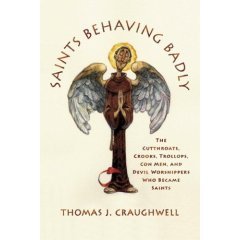 I recently received an advance copy of a book called Saints Behvaing Badly by Thomas Craughwell and I’ll offer my thoughts on it soon, after I’ve had a chance to go through it.
The book looks at the human side of saints–the side that is often diminished or dimmed in pious saint stories.
The fact is that the saints were often human, all too human as the phrase goes, and while some might consider it impious to point this out (and while it would be impious to dwell on it obsessively), it also can be inspirational to realize that the saints were indeed imperfect but nevertheless were able to overcome and display heroic virtue.
In that sense, looking at the imperfections of the saints can play a useful and encouraging role for those of us whose salvation is not yet won.
In the meantime,
As a public service announcement, with a little help from Stephen Colbert, I’d like to announce that the following are hereby ON NOTICE.

(CHT: Southern Appeal.)
Who are you putting on notice?
A reader writes:
What is the church teaching on location of hell and the duality of it Abraham’s bosom vs. hell fire.
I am curious because I recently came across some audio claiming to be the sounds of hell emanating from a 9 mile dig in Siberia". I am also wondering what you could tell me about this story and any of the others I mentioned.
I have surfed and read numerous sites opinions and even heard that we, the Americans have a similar story form the 60’s. Then I read about Jacques Cousteau hearing screaming voices coming from beneath the seabed of Cuba.
I also recently learned of the deep sea worms that were discovered living in 180 plus degree tempereatures and read about what Jesus said "where their worm dieth not, and the fire is not quenched" (Mark 9:43-48).
Finally I read about the "paradise" side of hell, Abraham’s bosom and then fire and brimstone Hell.
The Church allows a great deal of liberty in the interpretation of Scripture. For the vast majority of passages–including the parable of Lazarus and rich man (the one mentioning Abraham’s bosom)–the Church basically allows one to interpret the text in the way one feels that the evidence best supports, as long as one does not contradict a doctrine of the faith.
While stories about hearing what sounds like sounds of hell are scary and interesting to think about, I find it very unlikely that there is any truth to them, for several reasons:
First, departed souls don’t have physical form and thus would not naturally be able to make noise. No body, no throat, no lungs.
Second, the depiction of hell as "down" in Scripture is a metaphor. Hell isn’t really "down" any more than heaven is "up." The two are not physical places in this universe. You couldn’t go to heaven with a space ship or to hell with a backhoe. Heaven and hell are depicted as inaccessably high and inaccessibly low because they are places that are inaccessible to humans–we can’t physically go there in this life–and so Scripture metaphorically uses inaccessible places (up in the sky, under the earth) to depict where they are.
(Incidentally, note that though the two places are not in this universe, they can receive physical bodies–for the saved and the damned will have their bodies after the resurrection, just as Jesus and Mary do in heaven now.)
Third, if you think about the physics of sound (i.e., acoustics) then it would quickly be clear that voices don’t penetrate rock and earth very far. Even if you had a lot of voices, they wouldn’t be able to penetrate rock and earth very far at all as recognizable screams. That’s one reason we can’t find trapped miners that easily and can’t hear them until the material trapping them is very thin. Consequently, it is unlikely that Jacques Cousteau could detect the sounds of screaming under the ocean floor unless hell was very, very close to the surface.
Same thing goes with voices from holes in the ground. Voices–particularly recognizable screams–just don’t travel that far. Hell would have to be very, very close to the Earth’s surface.
We’ve done so much exploring that, if hell really were a physical place close to the Earth’s surface then we would have found it by now. Consequently, if you hear voices shouting from a hole someone has dug in the ground you should think "trapped miners" or something like that, not "damned souls."
About the imagery of fire and worms connected with hell, this is an extension of picturing it as "down" and a place of suffering. People in ancient Israel buried their dead, and they knew that worms get involved after burials (given the fact they didn’t have hermetically sealed coffins back then, or even coffins at all), and so it was natural to picture worms as one of the torments of the damned.
Similarly, being burned by fire is about the most intense torment that a human of the ancient world could imagine (since they didn’t know about sinking electrodes into the brain’s pain reception center), making it a fitting symbol of the natural of the ultimate torment of damnation.
I couldn’t rule out the idea that there is some role for the fact that if you go down deep in caves that it starts to get hot (due to the magma inside the Earth) in the development of this imagery, but I think by far the larger role is just the fact that being burned by fire is the most intense form of torment the ancients knew.
As to the relationship of paradise/Abraham’s bosom to hell, you should be aware that the terms for hell in Scripture do not (most of the time) pick out the unique place of the damned. In the Old Testament the word is sh’ol (not SHEE-ol!) and it just describes the place of the dead, both good and bad. Same thing with the Greek word hades. Even the English word hell originally just meant the place of the dead, not the place of the damned.
Because these words were used as a catchall for the place the dead went, it was presumed that the righteous dead were comforted in sh’ol/hades, while the unrighteous were being tormented there. That’s the background to the parable of Lazarus and the rich man, where both Lazarus and the rich man are in the land of the dead but are experiencing different fates: Lazarus is apparently at a banquet with Abraham and is leaning against his bosom (the was John leaned against Jesus’ bosom at the Last Supper; the ancient Israelites ate dinner reclining at a low table) while the rich man is being tormented across a gap of some kind.
Since Christ has now opened the gates of heaven to the dead, the righteous dead are in a glorified state now that goes beyond the comfort they had previously, though what this means in terms in terms of how they are spatially related to the damned is something we can’t say–or possibly even imagine–at this point.
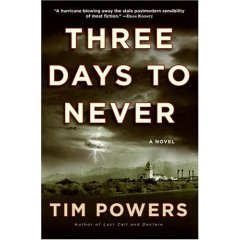 I finished Tim Powers’ new book, Three Days To Never, and I really liked it!
The story centers on a mild mannered English teacher (patterned after Tim himself) and his young daughter. The year is 1987, and the New Age "Harmonic Convergence" of that year is underway. The New Agers come in for a good bit of ribbing from various characters in the novel but–unbeknownst to anybody, including the New Agers themselves–the event causes a slight disruption of world affairs in a hidden, unseen way.
While that’s happening in the background, the English teacher and his daughter are trying to make sense out of a family tragedy: The teacher’s creepy grandmother has just died, leaving him a creepy and mysterious message about what she did and what can be found in the "Kaleidoscope shed" out back of her house.
Y’know, the kind of shed where you carve your initials into the wooden wall and then later they aren’t there?
When they enter the shed, the teacher and his daughter find that the grandmother used the shed to hold TV, a VCR, a video cassette of Pee-Wee’s Big Adventure, and a plaster block with the hand and footprints of Charlie Chaplin, which she stole from in front of Hollywood’s Chinese Theater. What do they have in common? What was she using them for? Why does the teacher’s long-lost father show up after so many years? How does Albert Einstein fit into all this? Why is the Israeli intelligence service–the Mossad–so interested in what’s happening? How about the rival group that used to have ties to Hitler? Or the blind assassin? And what about all those babies lying in the snow, waving their arms and legs for a few seconds before they mysteriously vanish?
To find out the answers to these questions, you’ll have to
(Incidentally, you’ll note that I’ve linked to a page in my new store, where you can buy other of Tim’s books, as well as other fine quality works.)
I found that the book was a very quick and enjoyable read for me. The plot proceeds at a swift pace, and there are nice elements of humor and irony as we proceed to keep a sense of whimsy in what is, essentially, a supernatural spy thriller.
Once I got past some of the major plot point (which I won’t spoil here), I found the book contained a very powerful statement about free will. I found myself liking and appreciating the characters, even the ones who weren’t on the right side (some of them, anyway), and about at least some points in the novel, I found myself contemplating, "Just how much of this goes on in real life?"
So: This book is enthusiastically recommended! Don’t miss it!
Now a few notes:
1) For those who have already read it, please keep the spoilers to a minimum in the combox. We don’t want to give away any of the big surprises (none of which I’ve touched) and spoil people’s fun.
2) Content advisory: Infrequent occurrence of a few cuss words and
one scene where a woman thinks back about her sexual history, but no
on-screen activity.
3) Stay tuned, because later this week I’ll be running an interview that Tim Powers graciously consented to give exclusively to the readers of JA.O!
4) Since I’m putting this up on Labor Day, it’ll be my only post for the day. Order the book and then go have fun!

While wandering the Web sniffing out something to blog about, my nose latched onto an aroma of eggs. Curious, I checked it out. Apparently, in the wake of Pope Benedict XVI’s election, some people were having a bit of good-natured fun with the new pope’s chosen name.
Behold the breakfast of popes: Eggs Benedict XVI.
(Nod to Chew Toys for the image. And speaking of Chew Toys, I must say that I enjoyed this blogger’s blog squib from Despair.com: "Quitters never win, winners never quit, but those who never win and never quit are idiots.")
Benedict XVI, when he was Joseph Cardinal Ratzinger, once said that "humor is in fact an essential element in the mirth of creation. We can see how, in many matters in our lives, God wants to prod us into taking things a bit more lightly."
Given the Pope’s great appreciation for humor, I think he’d also smile over the papal eggs. And then, after saying grace, I’m sure that he’d eat them.

Rosaries have a long and interesting history. They have evolved over the centuries from the earliest days when people used a bowl of loose pebbles to count their prayers to the form in which we have them today. While doing some research on the rosary, I found some interesting links on the history of the rosary.
(For more links than it is possible to include here, I recommend going to Google and searching on key words such as "history rosary.")
A few years ago after John Paul II promulgated the luminous mysteries of the rosary, I wrote an article on the subject titled "Light for the World." It is now online at Catholic Answers’ web site.
AND THE SIDEBAR (which has some information on the history of the rosary).
While the rosary is not one of my favorite personal devotions, as a history buff I am fascinated by its history as both a prayer and an art form.