Pope Benedict Clarifies

On Sunday Pope Benedict said:

At this time, I wish also to add that I am deeply sorry for the reactions in some countries to a few passages of my address at the University of Regensburg, which were considered offensive to the sensibility of Muslims.

These in fact were a quotation from a Medieval text, which do not in any way express my personal thought.

Yesterday, the Cardinal Secretary of State published a statement in this regard in which he explained the true meaning of my words. I hope that this serves to appease hearts and to clarify the true meaning of my address, which in its totality was and is an invitation to frank and sincere dialogue, with great mutual respect [SOURCE].

I’ve highlighted a few phrases from this because of their significance for recent discussions taking place here on the blog.

The first one ("I am deeply sorry for the reactions") does not carry the meaning that what the pope said in his University of Regensburg speech was wrong. This is what one would expect. The pope does not believe that what he said was wrong–and it wasn’t. He therefore focuses his expression of sorrow on the real problem–the reactions that were touched off in the wake of the speech.

This statement is open to several constructions, one of which is the kind of terse feauxpology that we often encounter in our own lives (i.e., the one with the meaning "I’m sorry you flew off the handle, but I don’t think I did anything wrong at all; the fault is thus really all yours"). I don’t think that’s what the pope’s doing here; I think it’s more subtle than that, but the English translation I have access to uses a phrasing that is open to that interpretation. I don’t want to press the English phrasing, though, because expressions of regret are extraordinarily difficult to precisely port from one language to another without some loss or addition of meaning and force. So I’ll have to wait until I find out more about this aspect of the original language text.

The second highlighted statement ("which do not in any way express my own thoughts") rules out an interpretation that seems to be common in the combox from Friday–the idea that in presenting the words of Manuel II Paleologous the pope was endorsing them and speaking them in a kind of macho swordthrust of unpleasant truth for Islam.

While Benedict XVI is quite capable of speaking unpleasant truths, the idea that he was endorsing as his own the un-nuanced remark by Manuel II was–for anyone who is familiar with the details of the pope’s thought–clearly false. The second highlighted statement confirms this. B16 was not endorsing the ideas of Manuel II.

The third highlighted statement ("the true meaning of my words") indicates that the pope perceives the problem as one of incomprehension. It is  not that he spoke the unplesant truth about Islam and Muslims got offended. It is that Muslims failed to grasp–for whatever reason, including the way that his words were reported to them through their own hate-inciting, government-controlled press–"the true meaning of [his] words."

This too distances one from the macho swordthrust of truth to Islam interpretation.

Finally, the fourth highlighted phrase ("in its totality") also points us away from that interpretation. The pope here indicates that the point of the speech was to issue "an invitation to frank and sincere dialogue, with great mutual respect." That is inconsistent with the macho swordthrust interpretation, and the fact that the pope says the speech was an invitation to a dialogue "with great mutual respect" in its totality means–if we are to take the pope at his word–that he wasn’t even trying to get in a little swordthrust on the side.

The pope thus tells us that he was trying to summon people to a profoundly mutually respectful dialogue but that the true meaning of his words was misunderstood and he does not endorse as his own the sentiments of Manuel II and that he is deeply sorry for the reactions that this passage in his speech led to.

The pope also alludes to the statement by the new Vatican Secretary of State, Cardinal Bertone, which he says explains the "true meaning" of what he said. It is thus worthwhile to look at that statement.

In the statement Cardinal Bertone explains concerning the opinion of Manuel II that "the Holy Father did not mean, nor does he
mean, to make that opinion his own in any way." So yet another piece of evidence against the macho swordthrust interpretation.

He further says that "The position of the Pope concerning Islam is unequivocally that expressed by the conciliar document Nostra Aetate: ‘The Church regards with esteem also the Muslims. They adore the one God.’"

He quotes the popes own words to a Muslim audience that "We must seek paths of reconciliation and learn to live with respect for each other’s identity."

And on behalf of the pope he conveys the following:

The Holy Father thus sincerely regrets that certain passages of his address
could have sounded offensive to the sensitivities of the Muslim faithful, and
should have been interpreted in a manner that in no way corresponds to his
intentions. . . .

In reiterating his respect and esteem for those who profess Islam, he hopes
they will be helped to understand the correct meaning of his words so that,
quickly surmounting this present uneasy moment. . . .

From the original speech itself and from the way the Vatican has handled this matter, it is clear that the present situation was unexpected and that the Holy Father did not foresee this reaction to his speech. If he did then he would not be expressing regret that passages in the speech could sound offensive. Instead, he would be saying, "Y’all are just proving my point, folks! You have a violent, barbaric religion that is hate-filled, and you only prove that by the violent histrionics that you go through when someone points this out."

A lot of people might wish that the Holy Father had said this in his response, but he did not, and those who know the thought of the Holy Father on these matters are aware that he never would.

Indeed, as a man of his generation the Holy Father has an enormous concern for the promotion and preservation of peace and the avoidance of violence. It was one of the reasons that he chose the name "Benedict," in part after Benedict XV, a man of peace at a time of great conflict. He wishes his own reign to be in the service of promoting peace, and in particular he has a great concern to de-couple religion and violence.

Thus, in his message for the recent Assissi anniversary–which Cardinal Bertone quotes in the official statement linked above, Benedict himself said the following:

[D]emonstrations of violence cannot be attributed to religion as such but to the cultural limitations with which it is lived and develops in time. … In fact, attestations of the close bond that exists between the relationship with God and the ethics of love are recorded in all great religious traditions.

This mode of language is not easy to completely understand, given the obvious commands to kill that are found in various religious texts, including the Qur’an and the Old Testament, but it is clear that–however the pope might address that issue–he certainly wishes to see religion and violence de-coupled in the minds of everyone so that religion no longer serves as a pretext for violence.

It is thus completely alien to the thought of the Holy Father–and anyone who knows his thought well knows this–to say things like "Islam is irredeemably violent and cannot be changed. It is intrinsically violent and, as long as it exists, it will always be."

Indeed, we had a demonstration of this just last year after the Schulerkreis when statements were made that the pope had privately said just this kind of thing. This was not only strongly denied, but what the pope did say was elaborated to explain that he felt Islam faces a more difficult time than some religions in overcoming its violent past but that this was still possible.

What we are witnessing here, therefore, is Pope Benedict’s NIGHTMARE SCENARIO.

He sees himself as a man of peace (which he is) who wishes to play a role in promoting peace in the world and overcoming the tendency to use religion as a pretext for violence.

That his own words–however true in their original context and understanding–could become the pretext for violence, with churches being attacked and people being killed, can only be a source of intense anguish for the Holy Father.
Sr_leonellaHe certainly would be willing to be martyred himself–but to be the accidental cause of martyrdom for others would for him be an unimaginable horror. The fact that some of the churches that have been attacked haven’t even been Catholic ones–thus having his words serve as the pretext for violence against Christians who aren’t even Catholic–adds insult to injury.

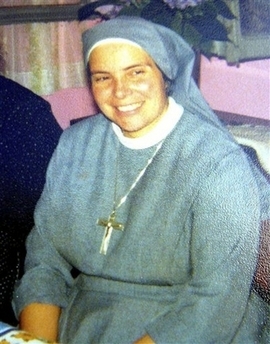
And I can only begin to imagine the pain he feels at the assassination of Sr. Leonella Sgorbati (left), the nun in Somalia who was likely killed as retribution for what the pope said.

Statements like "We will blow up all of Gaza’s churches" or threats to "kill all Christians in Iraq if the Pope does not apologize in three days in front of the whole world to Mohammed" are certainly intensely painful for the Holy Father and it is unimaginable for those who know his thought to suggest that he intended to bring about this situation.

He is strong and resolute in his defense of the truth and willing to say unpleasant things when needed, but to deliberately provoke this situation is simply not Benedict’s way of doing things. His way is the one described above, of promoting a dialogue that seeks to de-couple religion and violence.

This is an intense time of suffering for him and for all those Christians who are at risk of Muslim violence.

Let us therefore unite ourselves with the Holy Father in prayer for peace.
“Anyone Who Describes Islam As A Religion As Intolerant Encourages Violence”

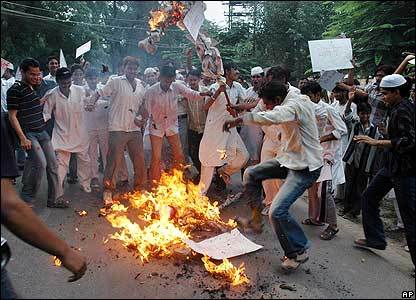
Muslim_anger_at_b16Well, the adherents of the religion of peace are at it again.

When Pope Benedict quoted the words of a man 600 years ago that reflect unflatteringly on Islam, what does the Muslim community do?

It does what you see to the left.

Not all of it, of course. Not all Muslims are violent fanatics. But the Muslim community contains far too many such individuals and–fed on a constant diet of hate and conspiracy theories by their corrupt political leaders who want to direct the anger of the masses away from their own regimes–many Muslims are far too willing to throw a public temper tantrum at the slightest pretext.

Basically, Islamic culture is infected with an ethos of rage and hatred, and it needs to grow up and stop being so thin-skinned.

Consider, for example, the irony of the statement I used as the headline for this blog post. It comes from a Pakistani Foreign Ministry spokeswoman named Tasnim Aslam.

Just what are we to make of this statement? If it were talking about any religion other than Islam, it might possibly bear the meaning that one who portrays the religion as intolerant thereby encourages violence against members of that religion (e.g., fostering anti-Jewish sentiment could stir up violence against Jewish people), but here that reading is scarcely plausible.

It reads instead like a veiled threat: Muslims–or certian Muslims–will commit violence against those who describe them as intolerant.

Which actually appears to be true, but it’s an ironic statement nevertheless: "You wrongly accuse our religion of being intolerant and you may end up dead."

Of course, there is a distinction between the religion itself and the people who practice it, and the pope is fully aware of that. He also didn’t say that Islam itself is intolerant.

Which brings us to the real tragedy of this situation.

The pope was making a speech to a German university on the subject of faith and its relationship to reason, and he took a detour in the speech to touch on one of his pet subjects–that religion must not be used as a basis for violence.

So in the process of taking a detour to say something meant to help break the link between religion and violence, he happened to quote a particularly inflammatory line from 600 years ago that could and has stirred up the potential for religious violence.

And the line isn’t even necessary to his speech! He could have made all the same points without the inflammatory line–and even without bringing Islam into the discussion.

This didn’t have to have happened, and it is hard not to see it as the first (or second) major gaffe of Benedict’s pontificate (the other one being what happened when he visited Auschwitz).

How serious a gaffe is it?

It could get him killed.

Either when he goes to Turkey or when a fanatical Muslim pulls a gun on him in Rome. All it takes is one, after all, and the Muslim political leaders are as likely to use this as a pretext to redirect their populations’ anger as they were when they whipped the Muslim community into a frenzy over the Danish cartoons.

I suggest we all pray about this.

Hard.

MORE HERE.

AND HERE.

AND HERE.

Ziusudra. . . . Big Deal.

A reader writes:

What should I say to someone who says that Genesis
chapters 6 through 9 regarding Noah and the flood is
based on the 2nd millenium B.C. Babylonian story of
Utnapishtim told in the Gilgamesh epic, which in turn
was based on the 3rd millenium B.C. Sumerian story of
Ziusudra?

Don’t forget Atrahasis and Deucalion and Xisuthrus!

They were ancient mariners who survived floods because of superhuman warnings, too!

The fact is that there were just a lot of flood stories in the ancient world–and not just in the Middle East and Mediterranean region.

These stories are reflecting a primordial flood event (or events), and the stories ammount to a whole genre in the ancient world.

It’s clear when reading the early chapters of Genesis, if you know the legends of the surrounding pagan peoples, that what is happening is that the author is correcting popular stories of the day from pagan stories by offering the real (monotheistic) account of what happened and offering an anti-pagan apologetic in the process.

"It wasn’t the water god Ea who warned the flood survivor, it was the God of everything–Yahweh–who did so!"

And since everything asserted by the Holy Spirit is true, everything that is asserted in the story of Noah is true. The Genesis account offers a true account of everything it asserts.

The question of what in the story is an assertion is not always easy to determine, for the ancients’ modes of speech and writing are not the same as our modes. As Pius XII pointed out in Divino Afflante Spiritu,

What is the literal sense of a passage is not always as obvious in the speeches and writings of the ancient authors of the East, as it is in the works of our own time. For what they wished to express is not to be determined by the rules of grammar and philology alone, nor solely by the context; the interpreter must, as it were, go back wholly in spirit to those remote centuries of the East and with the aid of history, archaeology, ethnology, and other sciences, accurately determine what modes of writing, so to speak, the authors of that ancient period would be likely to use, and in fact did use.

For the ancient peoples of the East, in order to express their ideas, did not always employ those forms or kinds of speech which we use today; but rather those used by the men of their times and countries. What those exactly were the commentator cannot determine as it were in advance, but only after a careful examination of the ancient literature of the East [Divino Afflante Spiritu 35-36].

In fact, be sure to read all of sections 35-39 of the encyclical.

Much of the early chapters of Genesis employs forms that are quite different than those in use today, and the Church has acknowledge that the accounts in Genesis of the creation and fall of man in particular contain symbolic elements (CCC 337 and 390), and the same is presumably true of how it would have us read the other material of the primordial history part of Genesis–as expressing the actual truth but in a way that incorporates significant non-literal elements.

That means that we should expect the flood narrative to express the truth in a way that contains significant non-literal components.

What might those be?

Well, as Pius XII pointed out, the ancient writers used the modes of speech and writing that were common in their own day. To figure them out, you have to conduct "a careful examination of the ancient literature of the East," and the fact that there was a flood story genre at the time suggests that we would expect elements that were standard to that genre to appear in the Genesis account of the flood. They were standard parts of the flood story genre and would have been expected by the audience, the same way we expect the sheriff of a western to have a gunfight with the villain. The ancient audience was thus in a position (a better position than we are in) to recognize what elements are likely the author’s way of telling the story because it is required by the genre.

And this doesn’t mean that it didn’t happen that way in history. Sheriffs really did have gun battles with  criminals in the Old West, and ancient flood survivors really would have reacted to their experience in a particular way.

If the answer is "Opening a window, sending out a bird to see if the waters have receded, and offering sacrifices in thanksgiving" then the question is likely to be "What would an ancient flood survivor do, Alex?"

I am particularly unimpressed by some of the parallels mentioned here. The idea that the storm phase of the flood lasted for a certain number of days and nights in several epics can be directly attributed to the role of reckoning time in terms of days and nights in ancient Near Eastern culture. The fact that the survivor offers sacrifice is similarly unremarkable since that’s what survivors of calamities did. As is the idea that the aroma of the sacrifices were smelled by and pleased the divinity, since roasting meat smells good and the smell can be presumed to go up to heaven, like smoke.

These are the kind of things one would expect in any ancient flood narrative, so if the author of Genesis included them in his account of the event then that is nothing more or less than what one would expect. Their appearance is thus unremarkable.

If the author of Genesis knew that the ancient flood survivor was warned by the true God–not a false one–and told the story according to the conventions of the day, based on the culture of the day, then Big Deal.

We’re still left with the question of which of these elements are meant to be taken as factual assertions compared to which are meant as non-literal elements shaped by other instances of the genre, but it’s no surprise to find these elements here.

If I had to respond to the claim that the Genesis flood narrative is shaped in some way by other ancient flood narratives then my response would be, "So what?"

What it asserts is still true–guaranteed by the Holy Spirit. The question is what the actual assertions are versus what are non-literal elements required or permitted by the narrative conventions of the day.

No matter what the answer to the latter question is, the truth of Scripture is in no way threatned by the discovery of ancient texts that merely add more knowledge to our understanding of how these ancient genres worked.

BTW, did you catch the Toho Studios flick where Ziusudra battled Gamera and Godzilla? That was wicked awesome.

More On Adding Wine To The Precious Blood

Recently I wrote about a priest pouring wine into a chalice of the Precious Blood and alluded to the fact that he might add enough that the point was reached where the Real Presence ceases.

Following this, Ed Peters wrote:

And Jimmy, what point is that? We’re not talking about adding water, etc., which at some hard-to-identify point would render what is in the cup no longer "Wine" (yes, you know what I mean), since at no point would this not still have the appearance of "Wine". Little help? Great question and a good start toward it. Thx, edp.

Excellent question!

Obviously, we cannot in this case use the test of when the accidents of wine cease to be present since the accidents do not cease to be present.

That fact might lead one to suppose–and I’m not at all saying that Ed supposes this, those someone might–that one could continue to add wine to the Precious Blood without the Real Presence ceasing at all.

This would not be the historic understanding of the Church.

This can be seen from the document De Defectibus in Celebratione Missae Occurentibus ("On Defects Occurring in the Celebration of Mass"), which is a document that deals with liturgical abuses and used to be printed in the front of every Missal before the reform of the liturgy following the Second Vatican Council.

It so happens that I have just translated this document (and will be putting it online soon, after I polish the translation and have it vetted), but since Ed has raised an excellent question, I’ll share one bit of the draft translation here:

If a fly, or a spider, or something else falls into the chalice before the Consecration, he [the priest] pours out the wine in a decent place, and he puts other [wine] in the chalice, mixes in a little water, and offers it, as above, and the Mass proceeds. If after the Consecration a fly or something of this sort has fallen in, he removes it, and washes it with wine. After the Mass is finished he burns it, and the ashes and the liquid of this kind is poured into the sacrarium [De Defectibus X §5].

The document thus expressly directs priests to wash whatever has fallen into the chalice with wine. This would make no sense if the addition of wine did not cause the Real Presence to cease, since the whole point of washing the thing that fell in the chalice is to cause the Real Presence to cease, so that it can be reverently burned.

The Church–in a document that was part of the Roman Missal for 400 years–thus has understood the addition of wine in sufficient quantity to cause the Real Presence of the Precious Blood to cease.

Which gets us back to Ed’s question: At what point does this happen?

My answer would be that this would happen when, in the opinion of reasonable men, so much wine had been added that what is in the chalice would no longer be judged by the senses to be the same wine that was there before. I’m talking, in this case, about the wine that was in the chalice as a whole, not the taste or color or other properties it has.

It’s difficult to verbalize what I mean since "wine" in this context if functioning as a mass noun rather than a count noun, and we don’t have a good word in English for the particular body of wine that is poured into a chalice, but I can offer a couple of examples that should be illuminative:

1) Suppose that a priest had a chalice with the Precious Blood in it and the accidents of wine in this case were of white wine. But then suppose that (God forbid) he started pouring unconsecrated red wine into the chalice. If he poured in only a drop and then mixed it throughly, it seems to me that a reasonable man would say that he had not substantially changed the accidents that were in the chalice–any more than pouring a drop of water in would substantially alter them. The Real Presence would thus remain.

But if he poured in a large amount of red wine then at some point a reasonable man would say, "That’s not the same wine any more" and at that point the accidents masking the Real Presence would have changed so much that the Real Presence would have ceased.

In this case it would be easy(er) to tell because the color would have changed (and the taste as well), but I think the same thing would hold even if the color and taste and smell don’t change. At some point so much wine is added that it no longer appears to be "the same wine" (meaning the same unit of wine) that was in the chalice.

Thus my second illustration . . .

2) Suppose that the priest had a large vat full of white wine and then put some of this in a chalice and consecrated it. He then (God forbid) took the Precious Blood in the chalice and pours it back into the vat and mixes it thoroughly.

It seems to me that a reasonable man would say that the unit of wine that appeared to be in the chalice is no longer present. It has been mixed into the vat of wine and has no independent status any longer. Consequently that unit of wine is no longer present, and neither is the Real Presence.

Now, at what precise point the Real Presence would cease is not something that can be determined, any more than the precise point that so much water is added that it ceases can be determined. We can say, in general terms, that this happens when so much water has been added that it would no longer appears to be wine, but we can’t specify a percentage of change where this happens. It’s a fuzzy boundary, like the boundary between red and orange on a color spectrum.

In the same way we can’t specify precisely when too much wine has been added to the Precious Blood, but in principle it seems to me that it would be the point where the unit of wine that appeared to be in the chalice is so substantially altered that it no longer appears to be the same unit. It has been mixed into another unit of wine and no longer has independent status.

Incidentally, we know by faith that these accidents are divisible in the sense that you can drink part of it and leave enough of the apparent unit of wine in the chalice that the Real Presence stays. The apparent unit of wine can be diminished through drinking without losing the Real Presence as soon as the first sip is taken, and the sip also retains the Real Presence. Though at some point, so much can be removed that the Real Presence does cease–as would happen if there were only an undrinkably thin film of wine molecules (or apparent wine molecules) that refuses to form a drop were left in the chalice.

But it seems to me that the accidents masking the Precious Blood can be altered in two ways that cause the Real Presence to cease: (1) they can alter in quality such that it no longer seems to be wine at all or (2) they can alter in quantity such that they no longer appear to be the same unit of wine that was consecrated.

At least that’s the best I can make out of the Church’s historic understanding that the addition of wine to the Precious Blood can cause the Real Presence to cease.

PRE-PUBLICATION UPDATE: After writing the above, I decided to check the Summa Theologia to see what Aquinas said, and he says the same thing. He even uses some of the same examples, like adding red wine to white, and speaks in terms of the wine having to be not just qualitatively but "numerically" the same wine that was consecrated, which is what I was getting at by talking about it being the same "unit" of wine that was consecrated.

Forgotten & Forgiven Mortal Sins

A reader writes:

I am aware that if one goes to confession and supplies the requisite contrition, then all sins which the person committed are absolved–provided that the person does not intentionally conceal any mortal sins.

Correct.

Also, I have been told by several priests that this means that if one remembers a mortal sin after confession, they should know that they are forgiven for it so long as they mention it the next time they go to confession.

Correct, though this should be formulated a little differently. You are forgiven if you meant to confess all your mortal sins and just forgot one. Having been forgiven of the one you forgot, you are still obligated to confess it the next time you go to confession. It’s not that your forgiveness of it is conditional on you adopting the intention to confess it next time. That sin has already been forgiven. It’s that you incur a new sin if you refuse to adopt the intention of confessing it.

Now I remember that you did a similar blog topic about this fairly recently, but my question is one that I don’t think you dealt with in that blog.

My question is after one has remembered the mortal sin, how soon is one required to seek out confession?  For example, if I go to confession and mention everything I can bring to mind, but immediately afterward remember a mortal sin, must I go to confession to mention the mortal sin as soon as possible?  Or could I just wait 2 weeks, a month, etc., until I feel like going to confession?  And can I receive communion in the meanwhile?

Since you are not in a state of mortal sin, you can receive Communion prior to your next confession.

As to how long you can wait before the next confession, the fact that you have an already-forgiven-but-not-yet-confessed sin does not create an obligation to go at any particular time, though one might suggest that one should go before one is likely to forget the mortal sin that needs to be mentioned.

Consequently, church law does not require one to go within any particular time frame, other than the obligation to confess one’s mortal sins at least once a year. It would be arguable whether this law applies to forgiven-but-unconfessed sins or not. The purpose is clearly to deal with mortal sins that haven’t been forgiven, so in the absence of clarification that it applies to those that have as well, it would seem that liberty would be presumed on the grounds of it being doubtful whether the law applies to this case (canon 14).

Now, there is language in some Church documents about going to confession "as soon as possible," but this is connected with a different situation, which is described in canon 916:

A person who is conscious of grave sin is
not to celebrate Mass or receive the body of the Lord without previous
sacramental confession unless there is a grave reason and there is no
opportunity to confess; in this case the person is to remember the obligation
to make an act of perfect contrition which includes the resolution of
confessing as soon as possible.

What this canon is talking about is a person who has not been to confession and who can’t go, not a person who has been and just forgot a sin. That person needs to make an act of perfect contrition in order to get back into a state of grace and thus able to take Communion, and making an act of perfect contrition includes the will to go to confession when it is possible (and reasonable) to do so.

The Code formulates this in terms of going "as soon as possible," but what it means by this is as soon as it is possible and reasonable for a person to go. The Church does not expect you to do unreasonable things just to be able to go a sooner. (E.g., driving recklessly in order to get to the church a little faster or demanding that the priest get out of bed to hear your confession.) There is an unstated reasonableness condition in this canon.

This may be where you got the idea about needing to go "as soon as possible," but it does not apply to your case. It deals with those who have an unforgiven sin and can’t go to confession before Communion, not those who went to confession and got forgiven but forgot to mention something.

Your sins already have been remitted by the sacrament of confession. You just forgot something.

This kind of situation happens all the time, and if there were a requirement to go to confession within a particular timeframe, it would be on the books.

Flattening The Real Presence

Blogger Catholic Mom writes:

I’ve been engaging in an online discussion with some folks and the gist of the discussion is they believe Christ is as present when 2 or 3 are gathered in His name or in the faces of the poor as He is in the Eucharist. Therefore, all this fuss about tabernacles and reverence is irrelevant. As long as we are out there ministering to our fellow man we are meeting Christ just as much as we would in the Eucharist.

I can explain that the Eucharist is the True Presence of Christ, Body, Blood, Soul, and Divinity. I am not sure how to describe the presence of Christ we find in the gathering of Christians or when we minister to the poor. I know it is distinct from the Eucharist. How would you verbalize this difference?

It is somewhat difficult to answer this question because in telling us that he is present wherever two or three are gathered in his name, he didn’t give us a lot of detail about what this manner of presence entails. The same is true for the "if you did it for the least of my brethren, you did it for me" passage.

It is clear that Jesus is present in these places in that his divinity is omnipresent, but he seems to mean more than that.

Yet it is also clear that he is not present there in the same way that he is in the Eucharist. The Eucharist is Jesus–just disguised. But it is clear that a poor person to whom we are ministering is not Jesus himself. It would not be appropriate to react to the poor person exactly the way we would react to Jesus himself. For example, it would not be appropriate to offer the poor person the worship of latreia, which is due only to God.

Common sense thus tells you that–whatever Jesus’ mode of presence is in such cases–it is less than the full reality of that presence which is found in the Eucharist. Therefore, one does an injustice to the Eucharist–and to Jesus himself–if one attempts to flatten the uniqueness of the Eucharistic presence and reduce it to the other modes of his presence which Scripture and theology speak of.

To do so speaks of either gross ignorance of the faith or an agenda of some sort that is so strong it overrides what is patently obvious.

If I were to attempt to unpack what Jesus meant in referring to these alternate and lesser modes of presence, the best I could probably do would be to say that Jesus is speaking metaphorically when he makes these statements in the gospels. It is important to point out that a metaphor is not the same as a fiction. Metaphors are ways of expressing a truth that is otherwise difficult to convey, or at least to convey with the same vividness that hte metaphor carries.

Consequently, I would say that–while Jesus’ divine nature is present in such instances since it is omnipresent–he is also "present" in the sense that he spiritually guides and works through  and helps people gathered in his name. Similarly, since we have a duty toward Jesus to exercise charity toward others, when we show charity or fail to show it to the poor we are fulfilling or failing to fulfill a duty toward Jesus and thus our action has reference to him even though we are outwardly acting toward someone else.

But in these cases Jesus’ Body, Blood, and human Soul are not present, as they are in the Eucharist. Jesus uses the metaphor of his presence in these cases not to signify that he is fully present in them as he is in the Eucharist but that he is guiding and working through and helping people or that our actions toward others have to be viewed in relation to our obligations to him.

There may be more to it than this, for we are not privvy to all of the divine mysteries, and Jesus may be present in more mystical ways that I am not able to articulate, but it is clear that Jesus’ presence in the Eucharist is both unique and supreme and not to be flattened onto a par with other modes of presence.

There is absolutely no difficulty demonstrating that from Church documents, as the following indicate.

The Compendium of the Catechism of the Catholic Church says this:

282. How is Christ present in the Eucharist?

Jesus Christ is present in the Eucharist in a unique and incomparable way. He is present in a true, real and substantial way, with his Body and his Blood, with his Soul and his Divinity. In the Eucharist, therefore, there is present in a sacramental way, that is, under the Eucharistic species of bread and wine, Christ whole and entire, God and Man.

While the Catechism itself says:

1373 "Christ Jesus, who died, yes, who was raised from the dead, who is at the right hand of God, who indeed intercedes for us," is present in many ways to his Church: in his word, in his Church’s prayer, "where two or three are gathered in my name," in the poor, the sick, and the imprisoned, in the sacraments of which he is the author, in the sacrifice of the Mass, and in the person of the minister. But "he is present . . . most especially in the Eucharistic species."

1374 The mode of Christ’s presence under the Eucharistic species is unique. It raises the Eucharist above all the sacraments as "the perfection of the spiritual life and the end to which all the sacraments tend." In the most blessed sacrament of the Eucharist "the body and blood, together with the soul and divinity, of our Lord Jesus Christ and, therefore, the whole Christ is truly, really, and substantially contained." "This presence is called ‘real’ – by which is not intended to exclude the other types of presence as if they could not be ‘real’ too, but because it is presence in the fullest sense: that is to say, it is a substantial presence by which Christ, God and man, makes himself wholly and entirely present."

One of the most important discussions of this topic is found in Paul VI’s encyclical Mysterium Fidei, which was written precisely to combat erroneous understandings of Christ’s presence. Sections 35-39 of the encyclical are in particular devoted to the topic, and the pope offers an explanation of different ways in which Christ is present in different things and activities, concluding, under the heading "The Highest Kind of Presence":

These various ways in which Christ is present fill the mind with astonishment and offer the Church a mystery for her contemplation. But there is another way in which Christ is present in His Church, a way that surpasses all the others. It is His presence in the Sacrament of the Eucharist [38].

Latin Mass Bleg

I am currently engaged in a project of translating certain Church documents that are not generally available in English (sorry, but this is not one of the Secret Projects, or I wouldn’t be telling you about it). Chief among these documents are the "front matter" of the Roman Missal as it existed before the reform of the liturgy that followed the Second Vatican Council.

This "front matter" corresponds loosely to the present General Instruction of the Roman Missal (GIRM) and certain other associated documents.

By translating them, I want to not only make available more of the riches of the former rite of Mass to English speakers but also to provide a tool that can be used to track the development of liturgical law between the change in the two orders of Mass.

But I don’t want to waste my time if I don’t need to. Hence this bleg.

I wanted to ask my readers–who are a very well-informed bunch, as is obvious–if they are aware of English translations of the front matter of the previous Roman Missal, particularly the 1962 edition, which was the last before the Council’s reforms began to kick in.

I know that there were English translations of some documents from this period because I happen to have an English translation of the Roman Ritual (not the same as the Roman Missal) that came out back then. I’m wondering if there was a simlar translation (available online or not) of the Roman Missal in its entirety, or just its front matter.

Specifically, the documents I am wondering about are titled in the 1962 edition as follows:

  • Pius Episcopus (servus servorum dei, ad perpetuam rei memoriam)
  • Clemens Papa VIII (ad perpetuam rei memoriam)
  • Urbanus Papa VIII (ad perpetuam rei memoriam)
  • Litterae Apostolicae (moto proprio datae; novum rumbricarum breviarii et missalis romani corpus appprobatur. Johannes PP. XXIII)
  • Sacra Congregatio Rituum (decretum generale; quo novus rubricarm breviarii ac missalis romani codex promulgatur)
  • Rubricae Generales (chiefly concerned with the calendar)
  • Rubricae Generales Missalis Romani
  • De Anno et Eius Partibus
  • Tabula Paschalis Antiqua Reformata
  • Tabula Temporaria
  • Calendarium Missalis Romani
  • Ritus Servandus in Celebratione Missae
  • De Defectibus in Celebratione Missae Occurentibus
  • Praeparatio ad Missam
  • Gratiarum Actio post Missam
  • Ordo Incensandi Oblata

If you are aware of an English translation of any of these (a 1962 edition or an earlier one), in print or online, whether in whole or in part, please let me know by combox or e-mail.

The one exception is De Defectibus in Celebratione Missae Occurrentibus ("On Defects Occurring in the Celebration of Mass"). This document–about liturgical abuses–has already been translated into English and is available on a number of web sites (mostly those of radical traditionalists). I have freshly translated it into English, however, because the existing translation does not seem to be very good. I don’t know what Latin original they were working from (clearly it was not that of the 1962 edition), but this version seems to be a startlingly loose and squishy translation, and I felt that a more literal one was warranted.

This translation should be appearing online soon. I’ll let you know when and where.

Thanks much, folks!

A Hard Situation To Be In

A reader writes:

I have a severe disability that leaves me dependent on my parents for personal care, transportation, etc. My parents are devout Protestants and don’t think Catholics are truly Christians. While I was in college, I began investigating Catholicism and eventually accepted the Church was what she claimed to be. At first, my mother was willing to drive me to Mass on occasion. Later, Mom refused to drive me to any more Masses or RCIA meetings. Due to the generosity of a Catholic classmate, I received RCIA instruction on my lunch hour while at school and another friend drove me to Mass so I could receive Reconciliation, Confirmation, and First Communion. I occasionally attend church with my parents and I’ve lost contact with the classmate since I graduated. The pastor is extremely Anti-Catholic. I find myself growing increasingly bitter and resentful as well as missing the grace of the sacraments, especially Reconciliation and the Eucharist. Here are my questions:

1. Should I continue attending church with my parents?

This is a judgment call. You are certainly permitted to attend with your parents as long as it does not pose a danger to your faith. Whether you should do so would depend, among other things, on how necessary it is for you to keep peace in your household. You are in a better position than I would be to answer that question.

With any judgment call, the thing to do is think and pray about it and then make the best decision one can, trusting God with the results. Even if one makes the wrong decision, making the attempt itself glorifies God and pleases him.

2. Should I speak up when Anti-Catholic statements I know to be false are made in that church? Can you give me advice on handling these situations? The pastor knows I’m Catholic.

This is also a judgment call, and one that has to be handled on a case-by-case basis. What I mean is that it depends on how bad the anti-Catholic statement that gets made is. If it is a minor thing, there is less reason to speak out. If it is a major thing, there is more reason. While we have a general obligation to share the truth with people, this obligation is suspended if people are unwilling to accept it. Thus Jesus told his disciples to shake the dust off their feet if a town wouldn’t receive their message. In the same way, you would want to correct misimpressions about the Catholic faith if you can, but if people aren’t listening to you and you perceive that the situation is just being made worse, the advisable thing to do would be to–metaphorically speaking–shake the dust off your feet and wait for a more opportune season.

If you do address anti-Catholic statements being made at the Church, I would be sure to do the following things: (1) follow the rules of ettiquite that pertain to the situation in the Church (e.g., don’t shout from the pew, "That’s wrong and you know it!"), (2) address the matter politely and in the most face-saving way possible for the person who made the mistake (on the principle that you catch more flies with honey than vinegar), and (3) be armed with the facts. Be ready to show exact quotations from Church documents, or use the resources online at catholic.com.

3. My former priest (he’s since left the parish) told me I was excused from my obligation to go to Mass because it was impossible in my case. I have no reason to doubt him, but just to double check would my situation be considered a valid excuse? I have not asked my mother to reconsider her decision in months. How often should I bring the situation up, and am I committing mortal sin if I don’t? I have no reason to believe things have changed.

You are definitely excused from your Sunday obligation if you can’t get to Mass. You should not worry about that in the slightest. Church law does not require you to do the impossible, or even the gravely inconvenient, and if you have no way to get to church then you are simply not required to do so.

As to asking your mother to take you again, if you have no reason to believe that things have changed then you do not have any obligation at this particular moment to ask. It thus is not a mortal sin if you don’t. Do not scruple about this either. The Church does not want you harming family relationships by asking all the time, and prudence would not want you angering one of your primary caregivers.

That being said, asking every once in a while–how often would be a judgment call, but certianly with a substantial period between requests–would be a good thing to do, though.

4. I am conscious of having committed mortal sin since my last confession. Since I don’t have access to the confessional the moment, is there anything else I can or should be doing besides privately repenting and trusting in God’s grace?

If you are unable to go to confession then repenting and making an act of perfect contrition (turning away from sins based on love of God–the fact that he is infinitely good and thus his will is infinitely good and what we should conform our wills to), with the intention to go to confession when possible, is enough to reconcile you with God.

Though I think there may be something else you can do: I would reach out to the local Catholic community and see what they can do to help you.

I would begin by calling a priest and asking him to come by and hear your confession and bring you the sacrament. You are in the same situation as a shut-in or a person in a hospital who can’t go to church, and priests can and do make pastoral visits to such people. He might not be able to do so often, but you should be able to find a priest willing to help.

Of course, how your parents would react to having a priest in the house is something that you weigh carefully in deciding whether to pursue this option. As long as you are not in danger of death, though, there is no grave obligation for you to get to the sacrament of confession.

Even if it is not possible to have a priest visit, I would still call one–or a church secretary–and ask about finding a ride to confession and Mass. The odds are very good that someone in the local Catholic community would be able–at least sometimes and possibly every week–to help you get to confession and/or Mass.

Of course, there is still the matter of how your parents would react to this, but as long as they are reasonable people–even if they strongly disapprove–then it should be possible to at least use this means of practicing your Catholic faith.

On the other hand, if they have a horrendously negative reaction and start making and carrying out threats (like denying you basic care or committing physical abuse or even just getting into heated arguments constantly) then you would be excused from even making this effort. (NOTE: I have no reason to think that your parents would do such things–and I assume that they are good people and wouldn’t–but there are such people out there.)

I also would join an online Catholic community–like the forums at Catholic.com–and try getting personal and spiritual support that way.

How you deal with much of this situation is a matter of prudence and judgment rather than law. To the extent possible, I would simply do your best to live in a dignified, Catholic manner and avoid arguing with your parents about it. Jesus pointed out that a prophet has no honor among his own country and people, and it usually is very hard to discuss such matters with your parents. They remember changing your diapers, after all, so it’s natural for them to think "Who is she to tell us about religion?" They also are in a difficult situation and are giving you a lot in the form of personal care they provide, and I would do my best to be grateful and loving for that.

I also would offer up the suffering you experience as a result of your condition and situation, both for your own sanctification and for your parents–as well as others in the world, including those who are even less fortunate (such as those in Muslim countries who can’t go to church or they’d be killed by their families).

God bless you for your faithfulness in a very difficult situation. Your fortitude pleases God, and he will certainly reward you greatly. I ask my readers to keep you and your family in their prayers and ask that God would give blessings to you all.

Do Not Give What Is Holy To Dogs

Canonist Ed Peters writes:

Fr. Louis Scurti, a campus minister at William Paterson University in New Jersey, "brings his two dogs everywhere [oh?] and that includes Sunday Mass." His pair of pooches set themselves up in the sanctuary during Mass, "making people feel included" [huh?] and providing a "symbol of domesticity" [double huh?]. Although the apparently untethered canines "have been known to growl" at late-comers, Fr. Scurti assures us that his dogs "don’t remove the sacredness of the liturgy at all."

The dictates of common sense are hard to put into words. If one has to explain to a pastor why his mutts don’t belong in Mass, one goes into the effort with the uneasy feeling that such words might be wasted on, well, someone who needs that kind of thing explained in the first place. But most folks can tell the difference between a liturgy and a living room, and many Catholics are out of patience with priests (granted, in shrinking numbers) who still treat the Mass as their personal property.

GET THE STORY.

Actually, I think that one of the canons Ed mentions–1220–would prohibit what the priest is doing. The canon reads:

Can.  1220 §1. All those responsible are to take care that in churches such cleanliness and beauty are preserved as befit a house of God and that whatever is inappropriate to the holiness of the place is excluded.

The highlighted phrase is meant precisely as a catchall to cover all the myriad "Please don’t eat the dasies" situations that the legislator knows he can’t individually envision. Having dogs in the sanctuary–at least dogs who are not assistance animals–is inappropriate to the holiness of the place, and thus they are to be excluded.

By including the highlighted phrase, the legislator intends "those responsible" (including the priest) to exercise common sense in figuring out what is inappropriate to the holiness of the place and–if the priest in question has defective common sense on this point–then someone higher up (his bishop, the CDW) should explain it to him.

After all, dogs are irrational creatures that cannot appreciate the sacred and therefore do not belong in sacred places.

Our Lord may have been making a point about humans when he said it, but the foundation of the metaphor in the animal kingdom makes the same point with even more force:

"Do not give dogs what is holy; and do not throw your pearls before swine, lest they trample them under foot" (Matt. 7:6).

The Resistance

BsgWhen Season 2 of Battlestar Galactica ended, it was announced that the new season wouldn’t be starting until October, which seemed a long way away.

Well, the time is almost upon us, and SciFi is now ramping up to the new season by releasing a set of ten webisodes that advance the story by bridging Seasons 2 and 3. (CHT to the reader who e-mailed!)

The webisodes are being released twice a week, one on Tuesday and one on Thursday at noon Eastern, and they tell the story of the developing resistance movement, chafing under Cylon rule on New Caprica. In fact, the title of the webisode series seems to be "The Resistance."

Thus far, three webisodes have been released, so there are seven more to go.

YOU CAN VIEW THEM HERE.
(minor bad language warning.)

If you need a refresher on what’s happened in the story so far or haven’t yet watched BSG,

YOU CAN GET A 3-MINUTE VIDEO RECAP HERE (WHICH ALSO HAS A PREVIEW OF SEASON 3).

Incidentally, when Season 2 finished, I made some predictions about what would happen in Season 3.

LET’S SEE HOW ACCURATE I WAS.

This post of JimmyAkin.Org is brought to you by the letter "R," the number "5," and the word "webisode."