There is also an open letter from ND students; I don’t know whether that means current students only or also alumni. The letter is, I think, too modest in scope: It says “There has been overreaction on both sides, and it is important to keep the discussion civil – Uninviting Pres. Obama would be a disrespectful move, and having students turn their back on his speech, as some have called for, would be an immature gesture” and then goes on to ask Fr. Jenkins to make a strong statement affirming the Church’s pro-life stance when Obama comes. I can maybe see settling for this if it’s the best you can get, but I don’t think I’d sign off on the idea that disinviting him would be inappropriately “disrespectful.”
The outcome here may depend in part on how the faculty responds. Remember when Pope Benedict canceled his scheduled speech at Sapienza University in response to protests? Is it impossible (like AmP, I argree it’s unlikely) that orthodox Catholics might score a victory this time?
Earlier this week we got an email from some friends at church with a prayer request from their sister, who sometimes comes to our church when she’s in town. Her employer, Natasha, was seriously injured in a skiing accident.
Later in the day we heard news reports that actress Natasha Richardson, wife of Liam Neeson, had been seriously injured in a skiing accident. It was a little surreal to realize that we had gotten a prayer request from Neeson and Richardson’s nanny, with Richardson simply identified as “Natasha.” (I’m not entirely sure that our friends, pious Irish Catholics, necessarily fully appreciate how famous their sister’s employers are, even their fellow countryman Neeson.)
That personal connection made the news last night of Richardson’s death more real to me than another news story about a tragedy involving famous people. Two young boys, 14 and 12, have lost a mother. Their nanny is a devout Catholic whom we’ve seen around our church. Neeson isn’t devout, though I’ve read that he’s been drawing closer to the Church. He seems to be impressed with the Church’s good works, and has talked about telling his sons about Jesus. He’s narrated CDs on “The Birth of Christ” and, this year for Lent, “The Way of the Cross” to benefit Catholic charities.
Last night we prayed our family rosary for their family. My children certainly know who Neeson is, both as Qui-Gon from The Phantom Menace and the voice of Aslan in the Narnia films. We’ve been praying for Amy Welborn and her sons, so they’re also aware of the recent death of Michael Dubriel. The possibility of losing a parent has become very real to them.
Their uncle, Suz’s brother, died only two years ago, not much older than I am. Their grandmother died the year before.
Recently, when someone asks me “How are you?” I’ve sometimes been tempted to reply, “Employed.” Right now, I’m tempted to reply, “Alive.”
P.S. I see I’ve written about at least one of Richardson’s films, in a review for the USCCB Office for Film & Broadcasting. Other people have told me they know her from the remake of The Parent Trap.
Jimmy–I'm only a casual fan of B5, and haven't shelled out for the script books, so I won't ask you to go into detail about how the Sinclair version differs, but one speculation that's been bugging me for years:
Would the original series have ended with the end of "World Without End" (the Sinclair/Valen reveal)?
Hmmm. . . . I wonder. . . . Is it a spoiler if you reveal what would have happened on a show but didn't?
Update: Hat tip to a friend for reminding me to link to this one (also added to the previous post): Why Embryonic Stem Cells Are Obsolete (U.S. News & World Report)
First, this morning The New York Times posted an editorial on “The Rules on Stem Cells” that, as First Things’s Ryan T. Anderson points out, officially endorses cloning “without calling it that.”
Second, on Friday Slate’s William Saletan posted an editorial provocatively titled “Drill Babies, Drill,” subtitled with the unavoidable question, “If harvesting embryos is OK, how about fetuses?” (Hat tips to Dreher and First Things, among others.)
I know there’s already been some coverage of this, but the full scope of the issue is bigger than most of the coverage out there indicates (hat tips and additional links below).
Within the last month, former president Bill Clinton has done two jaw-dropping interviews at CNN on the subject of embryonic stem-cell research — one with Larry King and one with Sanjay Gupta — that indicate a stunning level of confusion on the basic biological facts of what an embryo is, what stem cells are, what “fertilization” in reproductive biology refers to, and even what can be fertilized or used to fertilize something.
While attempting to reflect on the moral and ethical implications of the issue, Clinton’s apparent ignorance of the basic biological facts was so total as to make his comments incomprehensible even on the level of biology, let alone morality and ethics.
In the first interview, from the February 17 broadcast of Larry King Live, Clinton spoke, almost in the same sentence, about “stem cells” becoming “fertilized” and being used to “fertilize eggs.” And he claims to “feel strongly about this”!
But let me say, I feel very strongly about this. I think that I worked hard on the sequencing of the human genome. We finished it when I was president. Now there are all these practical applications being spun out of it. We’ve identified the genes that were high predictors of breast cancer. We’re getting close on Parkinson’s. We’re even making headway on Alzheimer’s. But this stem cell research, if the stem cells are frozen embryonic stem cells, if they are never going to be used to be fertilized, to bring a life into being, then I think making them available for medical research is the pro-life position and I honestly don’t understand — I would understand it if we were going and raiding stem cell banks, where these stem cells were going to be used to actually fertilize eggs and have babies. But it’s not going to happen. I think it’s very wrong to just throw these things in the trash can.
This excerpt alone is so bewildering as to defy explanation. In the first bolded section, Clinton talks about “stem cells” becoming (or not becoming) “fertilized” (suggesting that a “stem cell” is “unfertilized,” but could be “fertilized” at some future point). But in the second bolded section he refers to stem cells being used to “fertilize eggs!”
Which does he think it is? Are the “frozen embryonic stem cells” he thinks we’re talking about agents or subjects of fertilization? That is, do you “fertilize” stem cells, or “fertilize eggs” with them? (In reality, of course, neither is the case.)
“Raiding stem cell banks, where these stem cells were going to be used to actually fertilize eggs and have babies?” Raise your hand, please, if you have ever heard of anyone having a baby, or even trying to have a baby, by going to a “stem cell bank” to get “stem cells” to “fertilize eggs.”
This strange comment almost makes it sound as if he’s confusing “stem cell banks” with sperm banks — but the earlier comment about stem cells being (i.e., becoming) fertilized makes it sound as if he’s confusing “stem cells” with eggs, or ova.
Where does Clinton think the “stem cell bank” gets its embryonic stem cells? Does he not understand, or is he deliberately obfuscating, that the moral issue with using embryonic stem cells is not “what would happen” to them (i.e., whether they might be used to “bring a life into being”, whether by becoming “fertilized” or being “used to fertilize eggs”) in the future, but how we get them, i.e., by destroying an already existing embryonic life growing from a fertilized egg?
But that’s only the beginning, Last week, Clinton compounded the issue in a second CNN interview with Dr. Sanjay Gupta, in which he refers to conducting embryonic stem cell research using only “embryos” that will never become “fertilized” — six times. What’s more, Gupta let all six references pass without comment!
CLINTON: If it’s obvious that we’re not taking embryos that can — that under any conceivable scenario would be used for a process that would allow them to be fertilized and become little babies … then I think the American people will support this. …
GUPTA: Any reservations?
CLINTON: I don’t know that I have any reservations, but I was — he [Obama] has apparently decided to leave to the relevant professional committees the definition of which frozen embryos are basically going to be discarded, because they’re not going to be fertilized. I believe the American people believe it’s a pro-life decision to use an embryo that’s frozen and never going to be fertilized for embryonic stem cell research, especially since now, not withstanding some promising developments, most of the scientists in this field and the doctors will tell you they don’t know of any other source as good as embryonic stem cells for all the various things that need to be researched.
But those committees need to be really careful to make sure if they don’t want a big storm to be stirred up here, that any of the embryos that are used clearly have been placed beyond the pale of being fertilized before their use. There are a large number of embryos that we know are never going to be fertilized, where the people who are in control of them have made that clear. The research ought to be confined to those. …
But there are values involved that we all ought to feel free to discuss in all scientific research. And that is the one thing that I think these committees need to make it clear that they’re not going to fool with any embryos where there’s any possibility, even if it’s somewhat remote, that they could be fertilized and become human beings.
Once again, it’s hard to know where to begin. Almost as stunning as Clinton’s apparent radical confusion on Biology 101 is Gupta’s failure to comment on the factual misuse of a critical scientific term (from someone “who studied this” in Gupta’s own words) cropping up six times. Once or possibly even twice an interviewer might let a word go, if he thought it was just a slip of the tongue, but six times? (This — Gupta — was Obama’s pick for Surgeon General?)
In passing, I have to note the sheer condescension toward pro-lifers of Gupta’s opening salvo: “First of all, let me just ask you, as someone who studied this, is this going to always be as divisive an issue as it is now? Is this going to be the abortion of the next generation? Or are people going to come around?” Does he have any idea what he’s talking about?
If we had only this interview, one might possibly speculate that Clinton simply meant to say “implanted” rather than fertilized. Six times. Of course, even on that speculation, Clinton would still be dead wrong, on several levels.
For one thing, it is not true that “most of the scientists in this field and the doctors will tell you they don’t know of any other source as good as embryonic stem cells for all the various things that need to be researched.” Especially now that cell reprogramming no longer requires viral integration to create pluripotent stem cells — and evidence continues to mount that adult and cord-blood stem cells, not embryonic stem cells, have all the practical promise and yield the effective therapies — embryonic stem cell research is effectively obsolete.
Beyond that, the idea of frozen embryos lying around (whether in stem cell banks or elsewhere) for which there is no possibility “under any conceivable (sic!) scenario”, “even if it’s remote,” of implantation and childbirth, is dodgy at best. Frozen embryo adoption may be controversial, but the fact that it’s possible at all and does occur makes Swiss cheese of Clinton’s “under any conceivable scenario/even if it’s remote” rhetoric. (The Church is still up in the air on frozen embryo adoption, but she hasn’t rejected it, and she certainly does reject destroying innocent life.) No wonder Clinton acknowledges the question of the “definition” (always a key word with him, isn’t it?) of “which frozen embryos are basically going to be discarded.”
Going further, while it’s not impossible — especially if Americans generally are at least as ignorant on the biological facts as Clinton seems to be — that many Americans would agree that a frozen embryo with no immediate prospects of being allowed to implant and grow might acceptably be destroyed for spare parts and used for research, it is certainly not “pro-life.” (Though it is true that some who might call themselves “pro-life” on abortion, e.g., Mormons, don’t view ESCR in the same light, because they view implantation rather than fertilization as the beginning of personhood. They may even say that life begins “at conception,” but by “conception” they mean implantation, not fertilization. For this reason many pro-lifers prefer to say specifically that life begins “at fertilization” rather than “at conception.” Of course, if most people understand “fertilization” no better than Clinton, it probably doesn’t make things any clearer.)
I could go on, but it’s a moot point, since combined with the Larry King interview it’s clear that Clinton’s confusion goes way beyond mixing up fertilization and implantation. In fact, the similarities of the comments in the two interviews may even suggest that Clinton is using “frozen embryonic stem cells” (in the Larry King interview) and “frozen embryos” (in the second interview) more or less synonymously. That’s right: I suspect Clinton may not understand that an “embryo” is anything more than a collection of “embryonic stem cells,” or that you have to destroy the one to obtain the other for research purposes. He certainly doesn’t seem to understand what is being destroyed, or what stem cells once obtained might be good for (since he seems to think you can “fertilize eggs” with them).
This is a Rhodes scholar and a two-term president, a man who claims to have thought seriously about life issues — who has signed (and vetoed) legislation on life issues?
Having said all that, it must be noted that in one important respect Clinton’s thoughts on ESCR are actually superior to President Obama’s: At least Clinton realizes that ESCR raises serious moral and ethical issues. President Obama’s recent address shows a complete dearth of similar insight.
There’s been a lot of commentary on Obama’s speech. I’ll restrict myself here to a couple of excerpts from Charles Krauthammer, who says that he is “not religious” and does not believe that personhood begins “at conception”:
Obama’s address was morally unserious in the extreme. It was populated, as his didactic discourses always are, with a forest of straw men. Such as his admonition that we must resist the “false choice between sound science and moral values.” Yet, exactly 2 minutes and 12 seconds later he went on to declare that he would never open the door to the “use of cloning for human reproduction.”
Does he not think that a cloned human would be of extraordinary scientific interest? And yet he banned it.
In conclusion:
Dr. James Thomson, the pioneer of embryonic stem cells, said “if human embryonic stem cell research does not make you at least a little bit uncomfortable, you have not thought about it enough.” Obama clearly has not.
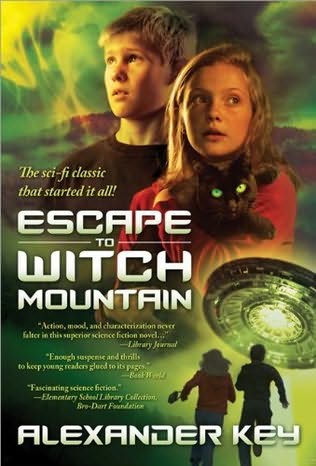
In the Race and Escape reviews I also touch on Alexander Key’s original 1968 book Escape to Witch Mountain, which I first read around the same time that I saw Return to Witch Mountain in theaters. I honestly don’t remember which I encountered first.
What I do remember is that I didn’t encounter the first Disney film until long after I had read the original book and seen the second film — and that, partly because of that, I found the first film disappointing.
The book was much grittier and more serious in tone than the film. In the book, the orphaned heroes have had various brushes with the law (Tony has been in trouble for fighting, and Tia was arrested for breaking and entering, though in fact she had gone into a store after hours to free a cat from a trap). Hackett House, the orphanage where the children are taken after their guardian dies, is more like a juvenile hall, and the matron is a world-weary, suspicious woman nothing like the kindly matron in the Disney film. Bullying Truck isn’t just a bratty twerp, but a serious thug who draws a shiv on Tony and gives him a couple of vicious cuts before Tony can disarm him.
On the other hand, the kids are aided in the book by a heroic Catholic priest, Father O’Day. Young, handsome, forceful, with broad shoulders and a crew cut, Father O’Day is immediately sympathetic to the plight of the kids, believes them implicitly — and isn’t above going out on a limb to help them evade their adult pursuers, even though legally the adults have custody of the children.
O’Day is meant to be pious and devout, crossing himself more than once in conversation with the siblings — a reference that, reading the book as a young Protestant, I literally didn’t understand; I had no idea it referred to the sign of the cross, and might not have known what that was — and imprecating against his “sworn enemy” the devil. One line, though, suggests that he may regard the devil as a non-personal reality: “Don’t think of him as a personage. Think of him as a disease.” (Key apparently described himself as a “freethinker” (source), but may have had some religious sensibilities, and surely meant his portrayal of the priest to be entirely positive.)
Possibly O’Day thought the priest character might help make it clear to readers that the “witchy” book title isn’t meant to suggest that the children’s powers are really occult, though some adult characters in the book do consider them “witch people” and there is even a witch hunt.)
In general, Father O’Day would have been right at home in a Golden Age Hollywood film, but in 1975 he didn’t make the cut. Presumably meant as an homage, the film’s “Jason O’Day” (Eddie Albert) feels to me like adding insult to injury, as if they were making a point of replacing the priest with a religiously unspecified character. (That’s Eddie Albert in the book cover photo above — ironically, since his character doesn’t exist in the book!)
Anyway, Father O’Day was certainly important in the version of the story I first read, and he made an impression on me, along with the Catholicism of J.D. Fitzgerald’s The Great Brain books that I was also reading at the time. (A year or two later, when my family started attending an Episcopal church, I felt that I already knew something of this world from my reading, and had a leg up on my siblings in that respect.)
Incidentally, like nearly all of Key’s books, Escape to Witch Mountain is out of print … and you can’t get it used online for less than about $20. It’s a good read for a kid, but not that good. It’s worth checking out of the library, though.
Oh, I also read the novelization of the second movie as a kid, and liked it pretty well at the time. At Arts & Faith a friend recently remarked on a device added by the novelist: “It used the conceit of an ‘inner Tony’ (the real Tony, trapped inside his own skull) and an ‘outer Tony’ (under the doctor’s control) and gives the inner Tony lots of angst-ridden internal monologue.” I remember that: It was neat, and compensated somewhat for the film’s most nagging weakness: The character of Tony is completely sidelined for nearly the whole story.
Since it debuted six years ago, the Sci Fi drama about a rag-tag space fleet has offered challenging fictional depictions of problems afflicting our planet in the here and now.
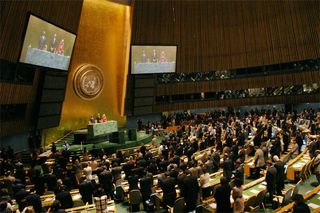
And now a discussion of how those very issues have been handled on the show will take place at the United Nations.
On March 17, there will be a "Battlestar" retrospective at the U.N. in New York and a panel discussion of how the show examined issues such as "human rights, children and armed conflict, terrorism, human rights and reconciliation and dialogue among civilizations and faith," according to Sci Fi.
The "Battlestar" contingent on the panel will consist of executive producers Ronald D. Moore and David Eick, as well as stars Mary McDonnell (who plays president Laura Roslin on the show) and Edward James Olmos (Admiral William Adama).
I just hope that the officials at the U.N. press them hard for details that will allow us to avenge the enslavement of our fellow cylons by their human oppressors out in the stars!
I mean, it might take us a couple thousand years to track down the twelve colonies, given our current lack of FTL drives, but it sure would be worth it to end human oppression.
I just hope that we're all on the same page on this one, here on earth. I'd hate to see this issue divide us and, y'know, lead to a nuclear war or anything.
Hmmm . . .
I think I'm going to go Google "organic memory transfer" now. Maybe I can find a lab working on that.
For a very long time I have held what might be termed the Special Theory of Media Incompetence, which is: The mainstream newsmedia is spectacularly incompetent when reporting stories concerning religion, morality, etc.
It's hard to read a story about one of these subjects in the mainstream media without cringing at the problems with it.
For example, consider the following four-sentence story from the Associated Press that appeared yesterday:
WASHINGTON (AP) – President Barack Obama says human cloning is "dangerous, profoundly wrong" and has no place in society.
Obama made the comments as he was signing an executive order that will allow federal spending on embryonic stem cell research.
Some critics say the research can lead to human cloning. Obama said the government will develop strict guidelines for the research because misuse or abuse is unacceptable.
He said he would ensure that the government never opens the door to the use of cloning for human reproduction [SOURCE].
First, there is the second sentence (green quote) flat-out factual error that the new executive order "will allow federal spending on embryonic stem cell research."
WRONG!
President Bush's previous executive order already allowed the spending of tax-payers' money on ESCR.
What is new is that President Obama's executive order will allow the spending of tax-payers' money on the fresh killing of new babies, as opposed to researching cell lines derived from embryos that had already been killed in the past.
So this is just ignorant reporting by a mainstream media hack.
It would also be easy to be distracted by the reported claim (blue quote) that the president believes human cloning to be "dangerous" and "profoundingly wrong" and ask, "Why on earth would he believe that? If you're willing to munch up babies to get at their stem cells–or even just because they're inconvenient to their mothers–if you're willing to treat human life so cavalierly in the interests of science and expediency–then on what possible ground do you view human cloning as wrong?
Surely such language would be simply that of political expediency rather than an actual moral conviction.
But let's look closer at what actually is being said here.
Is the president really say that he views human cloning as dangerous and profoundly wrong, as the first sentence of the story indicates?
If he did, it would seem there is a significant caveat, because the fourth sentence (red quote) speaks of him restricting the practice of reproductive human cloning (i.e., allowing a cloned human to surv
ive to maturity instead of being killed while still at a gestational stage).
Any way you look at this story, there is a problem.
If the president only said he opposes reproductive cloning but was just fine with human cloning for purposes of experimenting on the unborn then the reporter is at fault for not making this clear. His lede made it sound like the president was opposed to all cloning, and that's not the case.
Also, if the president was explicit in his support of research cloning then the reporter is doubly at fault for making it sound as if the the president is opposed to all cloning when in fact he was explicit about supporting some cloning.
Perhaps the reporter doesn't understand the difference between these two uses of human cloning, or perhaps the reporter was biased, or perhaps both.
Any way you go, I don't know–from the story–what the president actually said or didn't say or what his position on all this actually is (not from the story, mind you).
(I also have no clue why, if the president thinks that it's okay to make babies in petri dishes and that it's okay to genetically screen the ones allowed to come to term–as I assume from other sources that he does–then on what moral grounds would he judge it immoral, the technical problems having been worked out, to use artificial means to produce a genetic twin of an adult and thus deny him the younger twin brother he always wanted to have–but that's another issue.)
So here we have a clear case of mainstream media incompetency dealing with something in the religion/morals area, so . . . a piece of confirmation for the Special Theory of Media Incompetency that I've held for a very long time.
But in recent years, the more I've watched the media work and the more I've been interviewed by it, I've developed a sequel to the Special Theory of Media Incompetence.
I call it the General Theory of Media Incompetence.
It is as follows: The mainstream news media is spectacularly incompetent at reporting stories on virtually any subject.
I just happen to particularly notice its incompetence on the religion/morality ones, because that's my area of expertise.
(Note that I sayd "virtually" any subject. I'm prepared to say that there may be a few exceptions like sports scores or the current average of the sock market–simple, quantifiable things.The kind of thing a chimpanzee could report on by simply looking at a number on a screen and typing that same number a keyboard.)