Nobel Committee Issues Another Ignoble Prize

There’s an episode of The Simpsons in which Homer wins a Grammy Award, and the following dialog occurs:

Homer: Oh, why won’t anyone give me an award?

Lisa:       You won a Grammy!

Homer: I mean an award that’s worth winning.

Then a crawl line scrolls across the bottom of the screen, stating: “LEGAL DISCLAIMER:  Mr. Simpson’s opinions does not reflect those of the producers, who don’t consider the Grammy an award at all.”

That’s how I’m coming to feel about the once-noble Nobel Prize.

One of the most egregious awards they made was last year’s honoring of our president with a Nobel Peace Prize before he’d done anything. (It was awarded on his 11th day after inauguration.)

Even he said he did not feel worthy of the award—not that that stopped him from accepting it, mind you.

And the Nobel folks have a long history of lame decisions.

Now they have added to that legacy with the latest award, in which the culture of evil celebrates itself.

According to the Nobel web site,

The Nobel Prize in Physiology or Medicine 2010 was awarded to Robert G. Edwards “for the development of in vitro fertilization”.

Edwards was one of two doctors who pioneered IVF, though his partner has since died.

Take it away, Christian Science Monitor! . . .

The Nobel medicine prize committee acknowledged the role of British biologist Robert Edwards in developing in vitro fertilization, handing him on Monday the prestigious award for bringing “joy to infertile people all over the world.”

Of course, the Nobel committee didn’t mention that it also brought death to millions of children conceived in a dish and then intentionally not used, some of them spending their entire existence in a freezer, only to be treated later as medical waste.

Between 2 and 3 percent of newborns in many developed countries are now IVF babies. And about 4 million individuals have born so far been through IVF, according to the Nobel committee. The birth of the first “test-tube baby,” Louise Brown, was in 1978.

“What Louise Brown meant was, you held her up, all her parts were there, and she smiled, and that ended the ethics criticism,” says Arthur Caplan, director of the Center for Bioethics at the University of Pennsylvania in Philadelphia.

Well, among culture-of-death, establishment bioethicists, maybe. Their job is to not to actually say no to anything but to rationalize whatever whatever comes down the pike and help society accept it by declaring it ethical.

So where do we go from here?

“The Nobel Prize is for the work Edwards did helping the infertile, but [he could also have] unleashed the most controversial technology I can think of, which is, should we use it to design our offspring?”

At the same time, the prospect of scientists helping to create human life in a lab has raised vexing ethical issues. The foremost question – very real for many IVF parents – is about what happens to fertilized, but unused, embryos.

One unintended consequence of IVF includes an explosion in multiple births – as a result of parents choosing to implant multiple embryos to raise the likelihood of success for an expensive procedure.

FILE UNDER: Dr. Frankenstein’s Medicine Show

What are your thoughts?

Eco-Fundamentalists? Hate, Actually.

Let me say up front that I have nothing against treating the environment in a responsible manner. It’s implied by the commission God gave mankind in Genesis 1. I also try to avoid fights about words, so whether one would call a responsible environmental position “conservationion” or “environmentalism” is a thing that does not need to be fought about.

But there is a very prominent strand in the environmental movement that takes matters to extreme and anti-human limits. In a previous post, I have referred to this position as environmental fundamentalism, to distinguish it from healthy concern for the environment.

I mean, nobody wants to make Iron Eyes Cody‘s iron eyes cry. Do they?

However that may be, the deeply misanthropic views and “convert-or-die” rhetoric of environmental fundamentalism was very clearly on display this week, with the release of a shock video produced by 10:10, an international initiative to get people to cut their “carbon emissions” by 10%.

Here’s the video . . . WARNING: EXTREMELY GROSS AND OFFENSIVE!

Oh, and that is Gillian Anderson of X-Files fame at the end, now sporting long blond tresses.

According to the 10:10 initiative, the script for this video was written by “Britain’s leading comedy writer, Richard Curtis,” who is the director of the 2003 romantic comedy, “Love Actually.” What the video displays, however, is hate, actually. Hatred of those who disagree with you such that you find it funny to ironically lie to them (“No pressure”) and then depict their bloody and explosive deaths in graphic detail (shlurppp!) . . . even if they are children.

The Telegraph’s James Delingpole, “a writer, journalist and broadcaster who is right about everything” puts it well when he says:

With No Pressure, the environmental movement has revealed the snarling, wicked, homicidal misanthropy beneath its cloak of gentle, bunny-hugging righteousness.

Meanwhile, over at 10:10’s “media partner” The Guardian, we read the following from 10:10 founder Franny Armstrong:

“Doing nothing about climate change is still a fairly common affliction, even in this day and age. What to do with those people, who are together threatening everybody’s existence on this planet? Clearly we don’t really think they should be blown up, that’s just a joke for the mini-movie, but maybe a little amputating would be a good place to start?” jokes 10:10 founder and Age of Stupid film maker Franny Armstrong.

But why take such a risk of upsetting or alienating people, I ask her: “Because we have got about four years to stabilise global emissions and we are not anywhere near doing that. All our lives are at threat and if that’s not worth jumping up and down about, I don’t know what is.”

“We ‘killed’ five people to make No Pressure – a mere blip compared to the 300,000 real people who now die each year from climate change,” she adds.

GAH!

Well, the blowback on this one was such that 10:10 swiftly pulled its own video and issued this completely inadequate and insincere half-apology:

Sorry.

Today we put up a mini-movie about 10:10 and climate change called ‘No Pressure’.

With climate change becoming increasingly threatening, and decreasingly talked about in the media, we wanted to find a way to bring this critical issue back into the headlines whilst making people laugh. We were therefore delighted when Britain’s leading comedy writer, Richard Curtis – writer of Blackadder, Four Weddings, Notting Hill and many others – agreed to write a short film for the 10:10 campaign. Many people found the resulting film extremely funny, but unfortunately some didn’t and we sincerely apologise to anybody we have offended.

As a result of these concerns we’ve taken it off our website. We won’t be making any attempt to censor or remove other versions currently in circulation on the internet.

We’d like to thank the 50+ film professionals and 40+ actors and extras and who gave their time and equipment to the film for free. We greatly value your contributions and the tremendous enthusiasm and professionalism you brought to the project.

At 10:10 we’re all about trying new and creative ways of getting people to take action on climate change. Unfortunately in this instance we missed the mark. Oh well, we live and learn.

Onwards and upwards,

Franny, Lizzie, Eugenie and the whole 10:10 team

The casual, breezy tone adopted by Franny, Lizzie, Eugenie, and the whole 10:10 team makes it clear that they just don’t “get it.” Note also how “many people found the resulting film extremely funny, but . . . some didn’t.”

Yeah. Nice defense of your own filmmaking in the first clause. Nice dissing of the people you’re apologizing to in the second. You’re so sincere.

And this is by no means that eco-fundamentalism has revealed its misanthropic face in the media.

Delingpole helpfully provides a link to this threatening videogram delivered by Greenpeace, in which a wee bairn stonefacedly appears to make patricidal and matricidal insinuations:

Charming lad, that.

So . . . nice to see the mask coming off.

What are your thoughts?

Are You Smarter Than an Atheist?

QuizTitle

I am.

At least according to a quiz put out by the Pew Forum on Religious and Public Life.

The quiz has 32 questions, of which atheists in America who took the quiz got an average of 20.9 questions right. American Jews got 20.5 right, American Mormons 20.3 right, American Protestants 16 right, and American Catholics 14.7 right.

I got all of them, but that’s nothing special since this is the field I work in professionally. I’m expected to know my own field. Give me a comparable quiz on another topic and watch the number plummet. I can say with great confidence that if you gave me a 32-question quiz on sports—something very large numbers of people would do very well on—I would be lucky to get even a handful of questions right.

However that may be, what are we to make of the numbers regarding the different groups? Pretty dismal for Catholics, right?

Not necessarily, and it depends on what you mean.

This is not a case of “Catholics don’t know their own faith but other groups do know theirs.” The quiz is not religion-specific. It’s pan-religious. So the majority of questions on the quiz do not relate to the faith of the person taking the quiz, but to other people’s faiths. And therein lies a significant reason for why the numbers line up as they do.

What do the three high-scoring groups have in common? They are all religious minorities in America. That’s significant because a religious minority has special reason not only to understand its own religion (so as to reinforce its intra-group religious identity) but also to understand the religions of those around it (because of the need to understand how to interact with the majority religion that surrounds it). A person in a religious minority has special reason to understand both the basics of his own faith and the basics of the majority faith. A person in the majority faith has special reason only to understand the latter.

A Jew in Israel or an atheist in China would have less reason to know the basics of Christianity than a Jew or an atheist in America.

When you look at the two mainstream American religious groups—Protestants and Catholics—they score both less than the minorities and quite close to each other (only 1.3 questions separating them, which may well be within the poll’s margin of error).

Then there’s selection bias in who chose to take the poll. Perhaps atheists are more motivated to take a (rather long) 32-question quiz than Catholics. Who knows? This is a perennial problem of surveys.

The questions in the poll are also likely to distort results in other ways, too. I counted at least three questions that were Mormon-specific but only two that were Catholic-specific. Who is that going to advantage?

There were also three questions on what public school teachers are and aren’t allowed to do in America regarding religion. That is a subject that atheists will be far more focused on (and thus likely to get right) than ordinary Christians. (It’s also worth noting that Catholics have their own parallel school system and many do not even use the public schools, giving them less reason to be familiar with the details of what is allowed.)

These last questions also aren’t actually about religion but about American politics regarding religion. Something similar applies to another set of three questions regarding what the majority religion is in particular countries (India, Indonesia, Pakistan). Those aren’t questions about religion but about the demographics of other countries. (Hey, everybody! Quick! What’s the majority religion in Gambia? It sure tells you a lot about religion if you happen to know that the answer is Islam, doesn’t it? You’re much more informed about religion if you know that.)

So . . . it’s not the most informative quiz in terms of religious knowledge. Nor is the news for Catholics as bad as the raw numbers suggest. The quiz simply isn’t a test of how much Catholics know about their own faith.

That’s not to say that Catholic religious education hasn’t been a disaster in the last generation. It has been.

That’s not exclusively the fault of the clerical class. Parents in many families did not do their part to see to their children receiving a proper religious education. But when many elements of the clerical class have been actively and deliberately subverting the teaching of Catholic doctrine, it’s going to contribute to the poor state of religious knowledge among Catholics today.

One bit of sort-of-encouraging news from the Pew survey was that 55% of Catholics were able to correctly identify their Church’s teaching regarding the status of bread and wine in the Eucharist. That’s not nearly what it should be, but it’s at least better than the Gallup poll a number of years ago that started the false rumor that it was far less.

This quiz isn’t the greatest, but quizzes are fun, so have at it . . .

ARE YOU SMARTER THAN AN ATHEIST? (Be sure to write down your answers as you go; the answers are given at the end of the last question.)

MORE FROM THE CHRISTIAN SCIENCE MONITOR.

Go Green? No Thanks. I Have A Religion.

Recently over on Facebook (where you can friend me if you like), I posted an item which stated:

Jimmy Akin would like the world to know that he has heard exhortations to “Go Green”/“Be Green”/“Save the Planet” so often that using any of these phrases drastically decreases the chance he will agree to the proposal in question—whatever it is.

I figured that this would generate a good bit of reaction, and it did. In less than a day there were over 100 responses. That was even more reaction than the item I posted about the spider in Madagascar that makes webs 82 feet across or the woman who fended off a bear by hitting it with a zucchini!

A big part of the reason the item got the reaction it did is that a lot of people feel the same way.

Here are some of the responses people posted:

Jimmy, it is so nice to know that I am not the only one.

Yeah. It’s like Chinese Water Torture. It has its merit, but do you have to beat us to death with it?

One trade association I belong to sends me a green e-mail every week like clockwork. It tells me that my clients want me to be green, and are more likely to do business with me if I’m green. I keep telling them that I’m not paying for that much body paint, but they keep sending me the e-mails anyway.

“Go green” and “reduce, reuse, recycle” is stuffed down kids’ throats every chance there is. It makes my kids groan and roll their eyes. How about “go chaste”??? A more-needed message for sure. Did you ever notice no one ever says, “oh kids will never recycle, so we might as well help them waste . . . “

Why did the “Go Green” message leave such a bitter taste on these people’s mouths?

Well, as one saying has it, there are “A Million Ways to Go Green!” And all of them are inconvenient.

Environmentalists have been so successful in pushing the “Go Green” sloganeering through our culture that we are now all continuously bombarded by environmental scolding that is vastly out of proportion what environmental problems exist, so far as the average person can tell.

As a result, environmental activists have acquired the reputation of annoying nattering nannies, of rigid killjoys out to spoil everybody else’s fun. Rather like the reputation Fundamentalists have. And in fact, many have noted that environmental activists treat environmentalism like a religion.

And it’s not the, “I’m comfortable with what I believe, and I’ll tell you why I believe it and also listen to you and we can have a mutually respectful dialog”-type of religion, like you get from the Vatican. Instead, it’s the “Convert or die!”-type of religion—in some cases literally, for certain environmentalist activists put spikes in trees with the deliberate intent of causing physical injury to loggers.

It should be pointed out in all fairness that most environmental activists don’t go to that extreme, but the movement is rapidly acquiring a reputation for being as heavy handed and disrespectful of others’ views as anyone disdained as a “Fundamentalist.”

In fact, now that the term “Fundamentalism” has mutated way beyond its original meaning (a group of theologically conservative Protestants associated with a set of 19th century books known as “The Fundamentals”), now that we have not only “Christian fundamentalists” and “Muslim fundamentalists” and “Hindu fundamentalists,” it might as well be time that we start referring to “environmental fundamentalists” as well.

This actually could be a help for those with legitimate environmental concerns.

I mean, it’s not as if one should be unconcerned with the environment. God gave mankind the mandate to serve as stewards of the natural world, and that concern is legitimate.

That’s why—in my Facebook item—I didn’t say that urging me to “Go Green” would stop me from adopting whatever proposal is under discussion. I have no desire to adopt a rigid contradict-environmentalists-no-matter-what-they-say position. That would be irrational—just like adopting an adhere-to-everything-environmentalists-claim position.

What is needed in this area, as in every area of life, is the ability to think critically, to “Test everything and hold fast to what is good,” in the words of St. Paul (though, of course, he was speaking in a different context).

Unfortunately, experience has shown that many of the claims made by environmentalists are bunk, and many of the recommendations made by them are equally bunk. They will little or nothing to help supposed environmental problems—and they may even hurt.

The reflexive, unthinking exhortations to “Go Green” and “Save the Planet” and thus serve as a kind of marker for unreliable, unproved, and usually unhelpful proposals.

That is why hearing any of these things makes it less likely I’ll agree to the proposal. The appearance of these slogans is a good indicator of the presence of ideology rather than reason, and ideology is a poor guide compared to reason.

Having a way to refer, collectively, to those who have become environmental ideologues—“environmental fundamentalists,” for example—thus could play a useful role in distinguishing legitimate environmental concerns from unthinking ideology.

Naming the problem is part of solving it.

Oh, and as Columbo Would Say . . .

. . . "just one more thing."

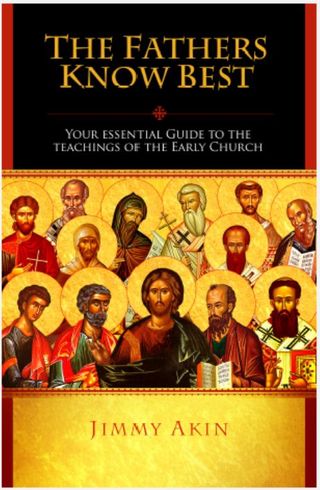
Another thing I've been up to is setting up a blog on the Church Fathers in conjunction with my forthcoming book The Fathers Know Best.

CHECK IT OUT!

I've got a lot of cool stuff planned for it. In fact, just yesterday we taped a series of web videos with little-known facts and surprising stories about the Church Fathers. I'll let y'all know when they're out. Hope you enjoy them! (And the rest of the fascinating material I'm going to get into. :-D)

Here's a sneak peek of a near-final cover design for the book . . .

Frs 

Click to embiggen.
 

Blog Update

Just wanted to say that I'm sorry I haven't posted for a few days. It's been a busy time for me, and one of the things I've been busy with is a significant update for the blog (which may or may not be visible at the time you read this). I've been working with the folks at TypePad to increase the blog's functionality and to solve some issues that have been long-standing annoyances.

Once the new version of the blog rolls out there will still be some fine tuning I need to do, but I wanted to let y'all know what I've been up to and what the plan is.

Hope you find the new functionality useful!

Contact

I always welcome e-mail. Feel free to e-mail me at:

jimmyakinblog@gmail.com

I read all the personal e-mails I receive, and I respond to as many as I can. I can’t promise an answer, but I do what I am able with the time I have.

If you absolutely need an answer, call Catholic Answers Live when I am on the air (typically on Thursdays; check the calendar to find out precisely when). If you get on the air, I guarantee an answer! (Hopefully a correct one!) BTW, if you call right before I come on the air there are likely to be open lines.

Be assured that when people e-mail me with questions, I always anonymize them before answering them on the blog. I want people to feel safe in asking delicate or personal questions, and I treat their privacy with the same respect I want my own treated with. (It’s that whole Golden Rule thing.)

Permaposts

The following are some of the more important posts I’ve done over the years, so they warrant inclusion on this special page. If you’d like to nominate something for permapost status, e-mail me at jimmyakinblog@gmail.com. And thanks for your suggestions!

Please pay special note to the very first permapost!

The Most Important Permapost

Blog Operations

Interesting & Important Topics

Fun Stuff

  • Awaiting first nomination


“Wait! I Don’t Want To Die After All!”

I’ve been thinking about writing a book to help people dealing with end-of-life situations. Between the deaths of my wife and my parents and other family members, I’ve been through enough of them that I’ve had to think hard about the spiritual, moral, and evangelistic aspects of these situations.

If I am able to write such a book, one aspect that I will definitely cover is the need for humility and caution in assessing the sick person’s will to live.

Very frequently these days people end up in situations where they cannot speak for themselves and clearly communicate what kind of care they want or whether they even want care. In such situations, family members are typically consulted, and this can cause a rift inside the family as they try to figure out what their loved one would want.

This is one of the most painful kinds of conversations for family members to have, and it if goes the wrong way, it can permanently injure relations in the family. “You killed Dad!” or “You wouldn’t let Mom die with dignity!” are things that can haunt families for years after the event, permanently turning people against each other. (I am very thankful to say, however, that my own family was able to get through the difficult days without such damage being done—and in spite of the fact that I’m the only Catholic in my immediate family.)

Sooner or later the “Do you want to pull the plug?” question is going to be presented to virtually every family, and it’s good to be prepared for it.

In some cases the patient may have left explicit instructions, but often not. Sometimes family members will remember (or think they remember) things the patient said in conversation about what they would want if something terrible happened. Other times they won’t have such memories and will simply rely on their feeling of what the loved one would want.

Regardless of which of these is the case, there is reason for great caution here. The stakes are, after all, life and death.

But there is another reason for caution: None of these things—from explicit written instructions to the vague feeling of what someone would want—is a good indicator of what they actually would want now that they are in the situation.

Certainly, pre-written instructions are a better indicator than a gut feeling assessed in a moment of crisis. If someone has taken the trouble to write instructions in advance then those instructions are more likely to reflect the settled views of person in question. But the thing is . . . views change. Particularly when we’re put in a dramatically different life situation.

There is also a danger of the loved ones, without fully realizing it, simply taking the easy way out—regardless of what that easy way is for them.

For some people the easy way would be for the loved one not to want to continue treatment. Under the pressure of watching a loved one dying they are emotionally worn out and in pain and they are ready for it to be over. It’s not that they want their loved one to die. But they can’t stand seeing the loved one suffer and want the mutual agony to be done with.

This is a human response.

But it poses a danger of leading the relative to believe what is convenient rather than what is true. In this case what is convenient would be for the loved one to want to discontinue treatment, and so the relative starts feeling certain that the loved one would never want to live this way. That would be preposterous. Of course they would just want to let go and die in peace.

And if there are a few dimly-remembered conversations that might support this view then they will be taken as proof positive. There even might be a little exaggeration used to help convince doubtful relatives who are also being consulted.

But even if that isn’t the case. Even if the person clearly expressed a preference, that preference may no longer apply.

A good illustration of that is the case of the British man in this news story from July:

Richard Rudd was paralyzed and brain damaged after being injured in a motorcycle accident last October and suffering subsequent medical complications. Treated in Addenbrooke’s Hospital in Cambridge, England his family thought they knew he would not want to live.

“We said that knowing Richard, there was no way in a million years that he would want to live with his injuries,” his father told the Daily Telegraph. Rudd had told his daughter that if he suffered a severe injury in an accident like a car crash, he “wouldn’t want to go on,” Rudd’s father reported.

Rudd’s father gave permission for treatment to be withdrawn. As hospital staff gathered around Rudd’s bed, they noticed he was able to blink his eyes for the first time in several weeks.

The doctors asked Rudd three times whether he wanted to continue to live. He blinked “yes” in reply to each of their three questions.

Rudd was lucky, to say the least. No doubt there are vast numbers of people who aren’t.

But his case is illustrative of the fact that someone—when feeling able and healthy—could decide that they don’t want to live if it means the kind of existence Rudd is facing, yet when they’re actually in that situation they decide that they do want to live after all.

Rudd’s case is thus a valuable cautionary tale: We must recognize that past statements are not a good guide to what someone would actually want in this kind of situation. And especially we must not allow ourselves to believe what is convenient for us—the relatives— and what will help ease our own suffering.

This goes both ways, though.

Just as a person can change his mind about wanting to die, so he can change his mind about wanting to live.

There may be—and no doubt are—many people who when healthy and active think, “I’d want them to do everything to keep me alive, no matter what shape I’m in.” Yet, when they get down to the end of live, they may change their mind and say, “You know, I’m ready to go. I’m ready for this suffering to be over.”

In the same way, if they can’t speak for themselves, their relatives may make the same mistake of believing what is convenient rather than what is true. There are people—not as many as their used to be given our society’s growing death ethic—for whom the easy thing would be to keep the loved one alive as long as possible, for any number of reasons. They may find themselves thinking, “Of course this person would want to live! They would want everything done to keep them alive!” And perhaps the person even said this in the past, though now the person would say differently.

The point is that people’s minds can change and that we must cross examine our feelings when we are being asked these questions. We must make sure we are not just choosing what is easy and convenient for us to believer rather than focusing on what is true.

I’m afraid that I don’t have a magic solution, here. I wish I did!

Obviously, committing an immoral procedure—such as deliberately killing the patient or withholding nutrition and hydration that they would be capable of assimilating—is off the table. And, if the patient can’t speak for himself then previously written instructions are the best available guide, followed by clear memories of what the patient said, followed by fuzzy ones, followed by gut instincts. And the default should be in favor of preserving life.

But there is no one-size-fits-all solution to the question of when to end treatment. All too often a judgment call is involved.

The case of Mr. Rudd from England highlights the fact that people’s opinions can change and that we need to be cautious—and prayerful—in making these decisions.

What are your thoughts?