
|
SCI-FI HEADLINES: 1st Artificially-Grown Organ Transplant!
POLL: A Jimmy Akin Radio Feed?
 I’ve had questions regarding whether it’s possible to put links to my appearances on radio shows (Catholic Answers Live, Al Kresta, etc.), in the feed for my podcast, allowing people to download and listen to those episodes.
The answer from a technical perspective is yes. In fact I already did that with a recent episode of Kresta in the Afternoon where I appeared to talk about the (then-)most recent developments in the Fr. Corapi story.
It’s been asked whether I could do that more regularly and broadly, but I want to do some quick research to find out what people’s preferences are, because there are different options for how such a feed might work. If you could, please take a moment to fill out the following poll. (You can check more than one box before hitting “Vote” if you’re okay with more than one option.)
Thanks for helping!
What’s with All the Food?
I thought I'd do a post explaining why there have been a lot of pictures of food showing up on the blog all of a sudden.
Basically, this is something I've been doing on Facebook for some time. Facebook makes it easy to share pictures, and for a while I've been posting images of things I cook.
As many people know, I am an advocate of low carb eating, and so I've been preparing low carb dishes for myself. My Facebook friends have even convinced me to work on a low carb cookbook, so that's what I'm doing. The pictures I'm posting are of the test recipes.
For some time I've wanted to cross post the same material here on the blog that I'm posting in other venues, including Facebook, so that people can access my stuff through their preferred means without having to miss someting.
I've now been able largely to get over the crossposting hurdle, so now what I'm putting up here (and elsewhere) is going up on Facebook and visa versa. (For the most part, anyway. There's no need to crosspost this post to Facebook, because my FB friends are already aware of what I'm doing. Mostly.)
So that's why the pictures of food all of a sudden: They're test recipes for a low carb cookbook I'm working on.
Incidentally, I've made video recipes of some of the dishes, which you can check out on my YouTube channel.
I also post other people's video recipes if I'm basing my recipe primarily on one of theirs. Kent Altena and Cooking with Dog are two of my favorites.
MYSTERY OBJECT REVEALED!
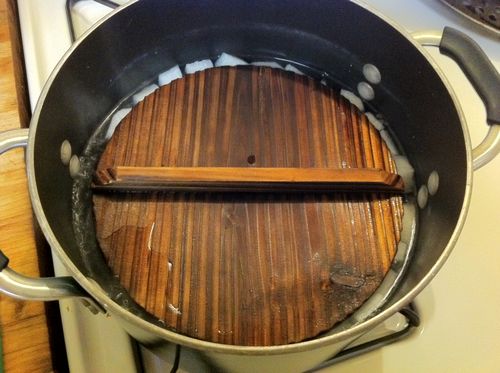
It's a Japanese otoshi buta or "drop lid."
I first encountered drop lids on the Cooking with Dog show, where Chef uses a really cool metal one.
As soon as I saw how it was used, I realized how useful they would be (e.g. keeping eggs or vegetables or whatever you're boiling from floating to the surface and cooking unevenly), so I ordered one.
Most are made from wood (in fact, I couldn't find a metal one to order in English online), but I've been quite happy with the one I got.
You can see it in action here, doing it's thing with boiling mystery vegetable. (Incidentally, that water IS boiling. Another of it's functions is to avoid excessive violence in the water action so the food isn't overly jostled by the boiling.)
Last Thursday’s Q & A Open Forum (7/7/11)
Click Play to listen . . .
VIDEO: Are Humans Inherently Bad?
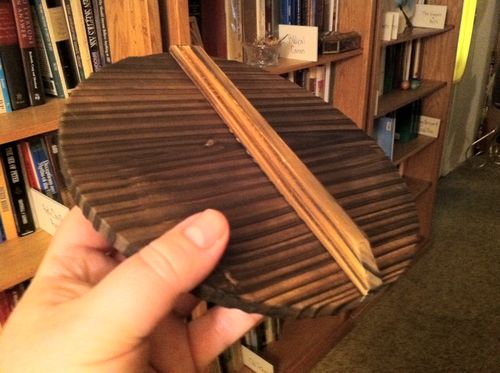
Here’s an interesting thing that came in the mail.
Anyone want to guess what it is?
Join Jimmy’s Secret Info Club!
Howdy, friends!
I hope you’ll join my Secret Information Club and start receiving exclusive material that I’m not going to be making available anywhere else online for free. Not on my blog. Not on my podcast. Not on Facebook. Just for club members.
My plan is to make it fun and informative for everyone!
Here are some of the things you’ll get information on if you join:
- 1st Century Christian Writings That Aren’t in the New Testament
- Absolute Worst Liturgical Abuses
- The Mystery of Purgatory–7 Things Pope Benedict Wants You to Know
- Pope Benedict’s Big Surprise (Hint: It’s About St. Paul)
- Seven Liturgical Terms You Need To Know
- Judas Iscariot: Pope Benedict on This Dark and Mysterious Figure
- Private Revelation–7 Things Pope Benedict Wants You to Know
Sign up now to get in on all the secret information action! Best of all, it’s FREE!
Also, tell your friends, because secret clubs are cool, and mine is one that anyone can join!
Podcast Episode 003: Colonizing Space & Catholicism; Peter Died in Rome; ‘Unbroken’ Line of Popes
Click Play to listen . . .
or you can . . .
 CLICK HERE! |
|---|
SHOW NOTES:
JIMMY AKIN PODCAST EPISODE 003 (7/9/11)
ERIC ASKS ABOUT COLONIZING SPACE
* What if space colonizers can’t bring priests with them? What are the faithful to do?
* Could a space bishop function in communion with Rome if there is little or no contact with Rome (or just really really long delays in messages sent back and forth)?
* What if there is limited or no possibility to produce bread and wine?
* Mass in zero-G?
* How would the liturgical calendar square with days and years of varying length? What about differences in how colonizers experience time due to relativity?
PAUL FROM HAWAII ASKS ABOUT PETER AND THE PAPACY
* What is the evidence Peter died at Rome?
* What is the evidence for an “unbroken” line of popes?
VERSES MENTIONED IN THIS SEGMENT: John 21:18-19, 1 Peter 5:13, 2 Peter 13-15, Revelation 17:1-18, 18:20
LINKS FOR THIS SEGMENT:
* FATHERS QUOTES: http://www.catholic.com/library/Was_Peter_in_Rome.asp
* TOMB OF ST. PETER: http://www.stpetersbasilica.org/Necropolis/MG/TheTombofStPeter-1.htm
* THE FATHERS KNOW BEST: http://shop.catholic.com/product.php?productid=16848&cat=0&page=1
WHAT’S YOUR QUESTION? WHAT ARE YOU GOING TO ASK?
Call me at 512-222-3389!
Promo Code: HAILCAESARVHFUHWLQIRUPDWLRQLVFRPLPJ
Podcast: Play in new window | Download