Okay, Let’s Talk Galactica Finale (Part 2)

Hour1c  Yesterday I said I'd continue this series by talking first about the things I liked and then the things I didn't, but after further thought I decided to go hour-by-hour and talk about both. So here are my thoughts on the first hour of Daybreak.

The episode started with flashbacks to the main characters lives before the fall of the Twelve Colonies.

Fine. Good move. Nice to tie back to the beginning now that we're arriving at the end. Nice to have a little extra insight on where these characters came from.

In principle.

Of course, it's the execution that counts. 

I like the flashback with Baltar's dad the most. Roslin's family members' deaths was also interesting. The Starbuck/Lee/Zak thread that starts in this hour is much less interesting (and finishes poorly in later), and the William Adama "I don't want to do some unspecified thing" eventually pays off okay kinda but isn't that interesting here.

Meanwhile, back in the future, Roslin is dying and Lee is stripping Galactica of spare parts, and everyone is getting ready to ship things over to the rebel base star to serve as the new capitol ship after Galactica (which I think is a really cool idea).

Back at the Colony, though, Cavil is preparing to do horrible medical experiments on Hera to find out how she was created so that the cylons can replicate the process now that the resurrection system is shot. Nice creepy stuff, here.

And after a chance encounter with Hotdog, Adama decides to conduct a rescue mission to get Hera back.

This is a point where I think the writing stumbles. I don't mind them rescuing Hera. They need to do that to make the overall arc of the series pay off (the Opera House scenes, the commercials from season 2 indicating that Hera would "change everything"). That's fine. But I don't think they set it up right.

As the balance of the episode reveals, this is a high-risk mission. Adama bluntly says that it is likely one-way, and that it's volunteer-only, with even the former conspirators from the recent mutiny/coup getting a pardon for their participation (nice touch! and a good way to get Racetrack and Skulls back in the action). All this is fine, too. 

But there's a mismatch: They didn't do enough to establish Adama's motive for undertaking such a risky mission (that could wipe out a significant chunk of surviving humanity) to save Hera.

Perhaps Roslin should have made an impassioned plea based on her visions of the Opera House. Or perhaps someone should have pointed out that if the cylons kept Hera then they might find out how to reproduce and overrun humanity.

Or something.

But it should have been something.

Hour1b

 A moment of sentiment looking at a picture of Hera is not enough to risk a large portion of humanity on a likely one-way rescue mission.

Let's do the math: How many lives are they trying to save? One. How many lives are likely to be lost in an assault on the cylon stronghold? Waaaay more than one. This mission is a Guaranteed Net Loss to the human race in terms of number of lives, and at a point where there are fewer humans alive now than at any point in the series. Therefore, there needs to be something powerfully important about Hera to justify the mission.

But eventually we get the dramatic "Will you go on the mission?" scene on the hangar deck. The build up to this was quite nice, and Admiral Eddie was definitely emoting the heck out of his part, but I think he failed to adequately sell the case for going on the rescue. 

It's interesting that less than half the people agree to go. On the podcast, Ron Moore says that's deliberate: That everyone would want to think they'd sign up for this kind of mission, but in reality many people will think, in essence, "I've got a wife, a kid, my own life to think about, so I'm staying."

I think that's true, and I like having many people stay. That's a realistic dramatic choice. Too often we see unanimous "Lock and load; we're all with you, Captain!" scenes, and having more realism to people's choices is good. But I think that in this case Admiral Adama completely fails to make the case why anybody should go on this mission.

I don't have a problem with the idea of likely one-way missions, but a sacrifice of that nature requires a clear and compelling motive, and the most Adama gives us is "This is a decision I have made for myself."

To my mind, "It's a personal choice" + "This is likely a one-way mission" = "Good luck to you, buddy!"

But then we're not dealing with reality here but the final act of an opera–a space opera–and there can be some operatic license here.

So even though I thought the big dramatic volunteering scene needed a more clear and compelling motive, we finally get to the mission itself, which we the viewers know is important.

So. Racetrack and Skulls jump to the Colony to scout things over, we've got battle plans drawn up and explained to us, and everybody cowboys up for what's about to happen in . . . Hour 2.

Okay, Let’s Talk Galactica Finale (Part 1)

Daybreak So. I am finally getting around to re-writing the Galactica finale review that got eaten by the mist monsters of cyberspace.

Thanks to those who have waited patiently . . . and to the reader who keeps sending emails that just say “bsg finale analysis?” Polite. Succinct. I like that.

So here goes . . . 

The reimagined series of Battlestar Galactica ended with a 3-hour finale called Daybreak. In case you’ve forgotten what happened in it,

HERE’S A SUMMARY OF PART ONE.

AND ONE OF PART TWO.

For those who (still) haven’t seen it, I’ll put the spoilers below the fold. But let’s answer the first, more general question here: Love it or hate it?

Mmmmmmmm . . . neither.

I certainly didn’t hate it, but I didn’t find myself thinking it was the best possible ending, either. I put it in the “Basically liked it but had some stupid parts” category.

So I wasn’t disappointed. I wanted to come out basically liking the ending, and I did. I don’t expect shows to wow me in the final episode with a “Best. Episode. Evah!” experience. That’s too much to ask. The Best Episode Evah is statistically far more likely to come before the series finale, so I don’t go into the ending with my hopes set too high. 

I just want them to tell an engaging story that answers the series’ major questions, ties up the major loose ends, and gives me a sense of closure and satisfaction.

I thought the BGS finale did that, with a few blemishes that I’ll talk about.

To give you a sense of how I think this finale compared to other sci-fi finales, I guess I’d rank them this way (series that got cancelled and didn’t have a proper finale, I won’t cover):

Star Trek: Deep Space 9: * * * * of 5 stars (fire cave sequence needed to be better and Sisko should have become a prophet, per the plan)

Babylon 5: * * * 1/2 (nice closure, but not the series’ best/most exciting, which wasn’t what I was looking for; get to see the main characters 20 years later in their lives; Sheridan’s final goodbye to Delenn, etc.)

Battlestar Galactica: * * * 1/2 (better than B5 in some ways, but also marred by stupid stuff, making them about equal)

Star Trek: Next Generation: * * * (okay; didn’t wow me; didn’t deserve the Hugo it got; felt like an ordinaryish 2-hour episode; drama hampered by the fact that there was no overarching series goal to be resolved, so they had to come up with the fakey “you’re still on trial” thing in an attempt to provide one; it’s such a pity that–although there was still a lot of good Next Gen to come–the series technically jumped the shark with “the best of both worlds” (2nd3rd season cliffhanger (thanks for the correction!); Picard becomes a borg); that really should have been one of the feature films)

Star Trek: Voyager: * * (no post-climax cooling off period; very important for this kind of story; we need to see the returnees starting their new lives and enjoying (or not) the home they’ve struggled so long to get to, not just sighting the planet in the distance; also BTW, this is where the bottom of the barrel starts; if your series finale scored lower than this, you really have something to be ashamed of, no matter how good it was in its heyday–or even one episode before)

Stargate SG-1: * 1/2 (ihh. that was an ending? sit around for a long time and hit the reset button? it wasn’t unending, it was uninteresting as a finale)

Star Trek: Enterprise: * (horrible! abominable! never do this! the holodeck thing was bad enough, but the worthless death of a major character was insane! this episode was so bad that the producers deserve to be doomed to a sisyphean ordeal of constantly struggling to get new sci-fi shows on the air only to have them swiftly cancelled and . . . oh, wait.)

The X-Files: * (gaaahhh! unbelievably bad writing in the final episode! the whole mulder-on-trial thing was a disaster! and that franchise-killing movie you followed it up with was horrible, too! LISTEN, CHRIS CARTER!: BEG, BORROW, OR STEAL WHAT YOU NEED TO DO A THIRD MOVIE IN 2012, TELL US THE STORY OF THE ALIEN INVASION THE SERIES WAS LEADING UP TO, AND THEN PUT THE FRANCHISE DOWN AND BACK AWAY SLOWLY, KEEPING YOUR HANDS IN SIGHT AT ALL TIMES!)

Hrm.

Okay, I have more on this to say than will make a comfortably sized post, so up next will be things I liked about the finale, then things I didn’t like.

In the mean time, why don’t y’all argue about the relative merits of series finales like the ones above? (That’s the whole point of rankings–to quantify an opinion for purposes of discussion, after all.)

Most Recent Favorite Walter Moment

I’ve been meaning to blog about the TV show Fringe in a little over a week, after the season finale, so that if anyone is interested in trying out the show they’d have the summer to catch up (rather than being exposed to all the season-finale spoilers that are about to be broadcast), but I just discovered this nifty share thingie on hulu, and since the episodes are available there for a limited time, I thought I’d share this one particular moment with you.

The moment features Dr. Walter Bishop, one of the lead characters, and the who often gets the best, or at least the funniest, character moments on the show.

Here’s what you need to know for the clip, and below the fold I’ll tell you what I like about it.

Walter is a brilliant scientist. 

Years ago he arrogantly conducted nature-defying experiments that led to tragedy and resulted in him being put in a mental hospital.

Back then, when he was playing God, he didn’t believe in God. Now he does.

He is a humbled man trying to make amends for his past, despite the fact that he often can’t remember the details of what he has done.

Most of the time he is sweet, childlike, humorous, and caring. He also is in need of constant adult supervision.

In this clip we find him trying to cope with the real world–on his own–for the first time in twenty years.

NOTE: This doesn’t seem to work for people outside the U.S. due to copyright issues.

Continue reading “Most Recent Favorite Walter Moment”

The Curse Is Broken . . . Maybe

Conflict Well, I finally got around to seeing the new Star Trek film–the first film I've seen in theaters in I don't know how long.

I know SDG has already covered this topic but . . . this is my blog, so here we go again.

I'll put spoilers in a forthcoming post and just have a few non-spoiler comments in this one.

The good news is that I basically liked the film. 

It was fun.

It met my expectations, which were as follows: (1) I wanted it to be fun, (2) I wanted it to be a viable relaunch of the franchise, and (3) I wanted it to be fundamentally though not scrupulously faithful to the original.

I thought it substantially met those goals, so I liked it.

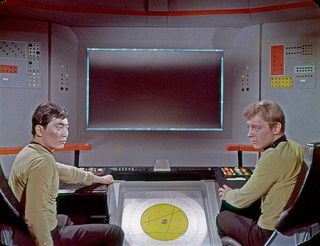
This is not to say that I hadn't been concerned. Some of the stuff seen in trailers had me worried. For example, the Kirk-Spock conflict depicted in the photo. That had me concerned. The film could have mindlessly ramped up the characters' emotions without providing a good reason for Spock's outburst. (Not unlike many episodes of the rebooted BSG, which over-milked the pathos factor). 

Fortunately, there is a good reason Spock is blowing his stack in this picture. The conflict isn't overdone, and it works in context.

I understand that the film may not be to the taste of some die-hard fans of the original series. And that would be true no matter what for the simple reason that no movie is to everyone's tastes.

Personally, while I have a soft spot for TOS, I don't regard it–or any Trek series–as an artistic masterpiece. All of the series have some real stinkburgers as episodes (e.g., just to name one from each, TOS: Spock's Brain, TAS: The Terratin Incident, TNG: Skin of Evil, DS9: Sons of Mogh, VOY: Threshold, ENT: A Night In Sickbay). Some of them have many stinkburgers.

So I don't regard the original Trek as sacrosanct. The recasting doesn't bother me, as long as it's good recasting (and it seemed to be; especially Zachary Quinto as Spock).


Since the original Trek wasn't perfect, the new movie doesn't have to be perfect for me for it to be an okay successor. 


There were things in it that didn't work for me (see forthcoming post). The movie does have plot holes and dumb things.


But on balance it's a fun film. It has lots of spectacle. A good treatment of the established characters (with one notable exception that some object to; see forthcoming post). It has some nice new and sorta-new characters. (In particular, I liked Captain Pike and Scotty's assistant.)


And it has this going for it: It's the best chance for more Star Trek that we're going to get.


Prior to this film, the franchise had gotten really, really stale. In the post-DS9 era the producers made mindblowingly bad decisions. 


Voyager had horrendous problems, with the climax of many episodes simply being characters standing over consoles spouting technobabble in an elevated tone of voice, trying to create drama.


And though they started to turn it around in the third and especially the fourth season, Enterprise as a series was fundamentally blown from the get-go, with the producers not realizing what kind of story they needed to tell (the Romulan War, leading to the founding of the Federation). And that was before we got to the disastrous final episode.


The producers just completely didn't understand what they were doing.


As a result, they wore out the franchise. They painted it into a corner from which nothing could rescue it.


Except a reboot–a fresh start.


It's really hard to see how much more could have been done in the previous continuity and keep the franchise financially viable. 


Theatrical film based on any of the previous series or a combination of them?


Not going to reach beyond the existing, shrunken fan base and thus not going to be financially successful.


New TV show?


In the previous continuity, what's left to do that would reach out beyond the existing, shrunken fanbase? Even telling the story of the founding of the Federation would be too close to ST:ENT (which is why that series' misfire is such a huge debacle; the producers blew their one chance to tell a pivotal story).


Any new ST series based on the old continuity would have almost certainly not made it as many seasons as ENT did.


Relaunching the franchise with a reboot was the logical way to go. (As JMS and Bryce Zabel had pointed out a few years ago.)

So I'm willing to cut the filmmakers some slack. I don't feel that I have to agree with all of their decisions (and I certainly don't expect them to honor every single bit of micro-level continuity from the previous shows–which didn't themselves honor their own micro-level continuity).

If they give me basically fun new Star Trek that holds the prospect of resulting in more basically fun new Star Trek, that'll be good enough.

This means that–maybe–the Star Trek Curse is broken.

The curse, stated in its strongest form, is that all of the odd numbered Star Trek movies are bad and all of the even numbered Star Trek movies are good.

Taken in a weaker form, the curse would be that all of the odd numbered Star Trek movies are lesser in quality and all of the even numbered ones are more good (or mo' better, as they say).

Up to this point, the strong form of the curse is arguable. Whether it's true depends on whether you regard any of 1 (V'Ger), 3 (Search for Spock), 5 (Search for God), 7 (Kirk Dies), and 9 (Insurrection) as technically, on-balance good or not.

But they're certainly not as good as 2 (Kahn), 4 (Whales), 6 (Berlin Wall Comes Down), 8 (First Contact), and 10 (Nemesis–weakest of the even numbered ones).

The curse in its weakened form is true . . . at least up to the newest film.

A lot of people might find the new Trek better than Nemesis, in which case we'd have an odd numbered film (technically, the new one would be Trek 11) that is better than an even one, in which case the curse would be broken.

But perhaps there is a way to reformulate it that would result in its still being true. How about this: Each odd numbered Star Trek film is weaker than the film that follows it.

In that case, the curse may still hold true. Thus far each odd film has been weaker than the one that followed it.

So the curse will hold true if J.J. Abrams and such can produce a sequel to this film that is even better.

Can they do it?

Now that the origin story is out of the way, I think there's a chance they can.

Caprica Pilot

Caprica_city

For BSG fans going through withdrawal, the pilot movie for the prequel series Caprica is now out on DVD.

It hasn't aired on TV yet, and apparently won't for a while–and you'll have to wait till next year for the series itself to debut–but you can see the pilot on DVD.


Below are some thoughts on it. I'll keep the spoilers light, but just to protect those who don't want absolutely anything spoiled, I'll continue below the fold.

Continue reading “Caprica Pilot”