1st Thoughts on the 6th Season of the New Doctor Who

Doctor-who-series6 So the new season of Doctor Who has premiered (in fact, with the release of the third episode this weekend, we're about a quarter of the way through the 13-episode series), and here are a few thoughts:

1) Steven Moffat (the current show-runner and author of five of this season's episodes) continues to impress with his darker, suspense-oriented plots. His new villains–The Silence–are worthy of his old villains, which include the Weeping Angels and the Vashta Nerada (the flesh-eating shadows from Silence in the Library and Forest of the Dead). Moffat is good at delivering creepy villains and compelling horror out of things you wouldn't think could be scary. (An immobile statue of an angel? How can that be scary?)

2) The creep factor on the show has, in general, been really good so far. Not only are The Silence creepy, but the countermeasures used against them and the way they are introduced (e.g., marks on the flesh) are creepy. Many of the creepy elements in Moffat's tenure on the series work a kind of intimate or claustrophobic angle on fear. A statue that can move when you aren't looking at it. You can't let your shadow touch anyone else's or it may get infected with a monster that will consume your flesh. Monsters you forget as soon as you turn away from them. If anyone gets the tiniest knick on their skin, they're doomed to madness and death. This is fear being generated on the small scale, though our own knowledge of how easily we could slip up in such situations. This fear via the intimate and by implication–rather than big explosions, special effects, etc.–is impressive.

3) Moffat has also made time travel far more central to the show than it has ever been before–which is quite a statement since this is a time travel show! Up to now most episodes involved the Doctor landing in a particular time and wrapping up some mystery there before moving on. The time travel was just a way to get us from one setting to another. Moffat has made things vastly richer and multi-layered with the time travel. This emerged very clearly in the 5th season, coming to a head with the mind-bending two-part finale, and it's right here in the 6th season as well, with the two-part opener that portends ominous things about the Doctor's future (and River Song's past).

4) Moffatt's strong character arcs are noteworthy. The complex interplay between the Doctor, Amy, Rory, and River at the different stages of their respective journies is satisfying, and way beyond anything attempted on the show before. Some prior companions have been very memorable (Sarah Jane Smith, Leetah, Rose Tyler, Donna Noble, etc.), and there have been notable character arcs before (Adric, Turlough, Rose, Donna), but nothing like what's going on between the Doctor, Amy, Rory, and River has happened before.

5) Speaking of Rory, it's nice to have him aboard. He's earned his place on the TARDIS. His presence adds a great deal of emotional oomph to the show as he is essentially the everyman, the low character on the exoticness totem pole, and so we understand his reactions on an emotional level that relates more directly to us as audience members.

6) It's still cool, though, to have the mysterious Amy Pond (about whom much yet must be explained) and River Song (who is always a bundle of fun–and provides moments of intense poignancy, as when she realizes that the Doctor's first kiss of her will be the last time she ever kisses him).

7) Matt Smith's portrayal of the comic, frenetic 11th Doctor is pleasing. When I first learned that Matt Smith had been cast as the Doctor I was *profoundly* skeptical–as were many–but as soon as I saw him in action, I realized he was totally fine for the part. At this point, he's delivering one of my more favorite portrayals.

8) Whe the season has all the above going for it, I–of course–do *not* approve of the objectionable moral content that is part of the U.K. fascisto-politically correct regime for children's television (and society at large)–e.g., the final scene between Shepard and Nixon right at the end of Day of the Moon. At least Moffat seems to be less intrusive about this stuff than his predecessor, Russell T. Davies. It's still mighty annoying, even if it is only present in a few throwaway lines.

9) The location shooting in the American Southwest for episodes 1-2 of the season wasn't really payed off in any way. It's pretty scenery, but there isn't much of a reason for it. Perhaps this is more impressive to British viewers, for whom this may have more "wow" factor than for Americans. It would have been better if the scenery had played more of a role in the plot rather than just being window dressing.

10) Also on a down note, the most recent episode–#3, Curse of the Black Spot–had some really huge plot holes. There were multiple parts where I wished I could punch up and fix the script. Some things in it were extremely effective (e.g., don't get cut or you'll die; be careful of everything you touch). Nice close, initimate horror. But there were also massive leaps of logic and plausibility that severely marred the episode. My current thought is that it's the weakest episode since Steven Moffat took over the series.

11) Fortunately, next week's episode is by Neil Gaiman, so it's likely to be really cool!

12) P.S. Stetsons are cool.

Cool Discovery About the Birth of Christ!

Nativity2 A few days ago I blogged about my discovery that the Christmas Proclamation of the Birth of Christ has a not-so-great translation in the United States.

The same day I made that unfortunate discovery, I also made a fortunate one!

As I mentioned previously, we have multiple lines of evidence converging to show that Jesus was born in the year 3/2 B.C.

There are multiple sources from the early Church (around a dozen) that show this to be the case. While there are a tiny number of sources suggesting other years, the overwhelming majority indicate 3/2 B.C. as being the correct time frame for Our Lord's birth.

Most of the sources we have that address the subject are a couple three (four) centuries after the time of Christ and so are open to some question, though the convergence of all of them on this year is quite weighty.

As I was thinking about this, my mind went back to the chronological references in Luke's gospel, and I realized something that caused me to cheer. I'd never done the math before, but as soon as I did, it was obvious!

As is well known, Luke introduces the Annunciation this way in chapter 2 of his gospel:

[1] In those days a decree went out from Caesar Augustus that all the world should be enrolled. [2] This was the first enrollment, when Quirinius was governor of Syria. 

Now, the enrollment under Quinirius has long been a subject of discussion. If you assume it was a census, as many do, then it's going to cause you problems, because there was no census in the appropriate time frame. There was, however, a broad-based registration or "enrollment," that occurred in this period, but that's a story for another post.

But the big point is that Jesus was born during the reign of Augustus Caesar–a point also confirmed by the fact both Matthew and Luke record him as being born during the reign of Herod the Great, who reigned during the time of Augustus (precisely when Herod died during that reign is also a point of discussion–and a subject for another post).

So when did Augustus reign?

In part, it depends on when you count the beginning of his reign. He was the grand nephew of Julius Caesar, and Julius Caesar was assassinated in 44 B.C. Augustus (who at different points in his career was also known as Octavius and Octavian) became his posthumously-adopted heir and successor. In 43 B.C. the Roman Senate awarded him the title "Imperator," which in English is "Emperor." He thus became the first Roman emperor.

Later, after the Battle of Actium in 31 B.C. and the suicides of Mark Anthony and Cleopatra in 30 B.C., Augustus became sole ruler of the empire.

You can thus date his reign either from around 44/43 B.C. or 30/31 B.C.

However you chose to reckong it, Augustus had a remarkably lengthy reign, which finally came to a close in A.D. 14, when he died.

He was then succeeded by his adopted son, Tiberius, who became the second Roman emperor.

Taking a broad view, Augustus reigned from 43 B.C. to A.D. 14, and both Luke and (by implication) Matthew, place his reign in this period.

Good enough. But can we make the date more specific?

If we turn the page and start reading Luke chapter 3, we find the following statement regarding the ministry of John the Baptist:

[1] In the fifteenth year of the reign of Tiberius Caesar, Pontius Pilate being governor of Judea, and Herod being tetrarch of Galilee, and his brother Philip tetrarch of the region of Iturae'a and Trachoni'tis, and Lysa'ni-as tetrarch of Abile'ne,[2] in the high-priesthood of Annas and Ca'iaphas, the word of God came to John the son of Zechari'ah in the wilderness; [3] and he went into all the region about the Jordan, preaching a baptism of repentance for the forgiveness of sins. [4] As it is written in the book of the words of Isaiah the prophet, "The voice of one crying in the wilderness"

The Herod in t.his passage isn't Herod the Great–he was long dead–but the important part of the quote is the reference to the fifteenth year of Tiberius Caesar, who had succeeded Augustus upon the latter's death.

The way things worked in the ancient world, they often counted the first part of a year of a ruler's reign as that ruler's first year, then changing to the second year when the next civil new year began.

To give a somewhat bent example based on our own practice of having the civil new year begin on January 1st (a practice that was not universal in the ancient world), if Ruler X began his reign on September 1st in year Y then the period from September 1st to December 31st would be reckoned as his first year. His "second year" would then begin on January 1st.

Given that parts of years could count as a ruler's first year, the fifteenth year of Tiberius could be either in what we would reckon as his fourteenth or fifteenth year.

So when was that?

Augustus died in A.D. 14, so in Luke 3:1, the Evangelist is giving us a pretty specific reference to A.D. 28-29 (A.D. 14 + 14/15 years of Tiberius's rule = A.D. 28/29).

Fine. What does this have to do with the birth of Jesus?

Luke describes the (apparent) beginning of John the Baptist's ministry in A.D. 28/29, and right here in chapter 3 of the gospel he refers to Jesus' baptism and the beginning of Jesus' ministry. He doesn't say that these occurred in the same year, but he certainly gives that impression–or at least the impression that there wasn't a significant lapse of time between them.

So what?

So this: Luke also records in chapter 3 that, after the baptism and before the testing in the wilderness, that:

[23] Jesus, when he began his ministry, was about thirty years of age . . .

Thus, if we assume that Jesus began his ministry shortly after John the Baptist, as Luke seems to imply, and if John the Baptist began his ministry in A.D. 28/29, and if Jesus was approximately 30 years old at this point, then all we need to do is subtract 30 from the current year to find out the approximate year of Jesus' birth.

Using a modern number line that includes the number 0, one would thus think that Jesus' birth occurred in -2/-1.

But they didn't have the number 0 in the Roman world, and there is no "Year 0" on the B.C./A.D. timeline. The A.D. (Latin, Anno Domini = "Year of the Lord") years are the years counting from Jesus birth (the first year of his birth, the second year, etc.). The B.C. ("Before Christ") years are the years before his birth (the first year before, the second year, etc.). On neither reckoning is there a "Year 0." 

As a result, we need to subtract an additional year to any B.C. dates to account for the lack of a 0 year.

This means that if Christ was born in what you'd think would be -2/-1 then it would really be 3/2 B.C.–the exact same year that we have multiple independent sources from early Church history pointing to.

Only here we have St. Luke himself–an undisputed first century author (who was, based on internal evidence in the gospel and Acts, almost certainly writing from Rome around the year A.D. 62).

That's important and early testimony about when Our Lord was born!

Cool, huh?

What do you think?

Can the Laity Expose the Blessed Sacrament?

A reader writes:

I live in a large parish and we have a community of lay people who manage perpetual adoration. My weekly adoration hour is the first hour after Mass on Sunday. Thus, I am required to place the Blessed Sacrament in the monstrance as soon as Mass ends. Since the tabernacle and the monstrance are in the same chapel, I have to remove the glass pix containing Our Lord from the tabernacle, walk a few feet to the altar, and place it in the monstrance. The only instruction I've been given regarding this process is to do it reverently.

Is it acceptable for a layperson like me who is not an extraordinary minister of holy communion to place Our Lord in the monstrance?

I am pleased to inform you that the situation you describe is, in principle, licit.

According to the document Holy Communion and Worship of the Eucharist Outside Mass, which is part of the Roman Ritual (see The Rites, vol. 1):

91. The ordinary minister for exposition of the Eucharist is a priest or deacon. At the end of the period of adoration, before the reposition, he blesses the congregation with the sacrament.

In the absence of a priest or deacon or if they are lawfully impeded, an acolyte, another [extraordinary] minister of communion, or another person appointed by the local Ordinary may publicly expose and later repose the Eucharist for the adoration of the faithful.

Such ministers may open the tabernacle and also, as required, place the ciborium on the altar or place the host in the monstrance. At the end of the period of adoration, they replace the blessed sacrament in the tabernacle. It is not lawful, however, for them to give the blessing with the sacrament.

92. The minister, if he is a priest or deacon, should vest in an alb, or a surplice over a cassock, and a stole. Other ministers should wear either the liturgical vestments that are used in the region or the vesture that is befitting this ministry and is approved by the Ordinary.

The priest or deacon should wear a white cope and humeral veil to give the blessing at the end of adoration, when the exposition takes place with the monstrance. In the case or exposition in the ciborium, he should put on the humeral veil.

The passages in blue are the ones that relate directly to the situation the reader is speaking of.

The reader is not an extraordinary minister of Holy Communion and thus would fall under the provision for another person appointed by the local ordinary. Normally the local ordinary is the bishop (there are typically a few other individuals in a diocese that also count as ordinaries, but normally the bishop is meant).

Despite this, it is my understanding that various bishops have delegated the faculty of appointing such person to the pastors of parishes. That is undertandable since the pastors have a more direct knowledge of the people who would be undertaking the task and, apart from unique circumstances, would likely be the person whose recommendation the local ordinary would accept and approve.

Consequently, if the reader has the permission of her pastor to expose the Blessed Sacrament, I would assume that either the bishop has delegated this faculty to the pastor or that the pastor has obtained the bishop's permission for the reader to do this.

In fact, the pastor may have delegated the function further, to whoever is in charge of the perpetual adoration program. That's a bit iffier legally, but it falls under the rubric of "If the local system is working, Rome isn't likely to make an issue of it."

If the reader wants to inquire further, that's certainly possible, but I don't see it as being necessary. The situation sounds as being on acceptibly safe to me.

The text also explicitly gives the minister of exposition permission to place the host in a monstrance, so that aspect of the reader's experience is also covered.

Finally, the text mentions appropriate vestiture. This language is typical of what you find in liturgical documents concerning the clothing that various lay-ministers should wear. It's always non-specific, typically with a reference to it being "fitting" and in accord with whatever is locally approved.

That's a deliberate punt down to the local level. It's language that is meant to give the local ordinary the authority to intervene if there is a problem, but it doesn't require him to draw up a specific set of guidelines.

There may be some dioceses in the United States that have norms for this, but I would be somewhat surprised if that were the case. The clothing of an ordinary layperson exposing the Blessed Sacrament is a rather narrowly-specified thing, and typically dioceses don't have policies for that kind of fine-grained detail.

More commonly whatever would locally be considered appropriate wear for Eucharistic exposition would be considered sufficient, and the bishop would consider it necessary to get involved only if someone were regularly wearing something truly inappropriate by local standards.

It thus sounds to me that the situation the reader describes is in compliance with the Church's laws and there is no need to scruple about it.

I hope this helps!

Bad Liturgical News, Folks

Nativity Okay, it's not too bad. I mean, it's actually pretty small in the overall sweep of things. But I was still disappointed to learn about it.

Here's what's up: I'm currently working on a project that involves the life of Christ, and I was writing part of it today regarding the year in which he was born. Now, we have multiple sources from the early Church that indicate he was born in 3/2 B.C. on the present calendar.

We know that because different individuals in the early Church identified the year using the dating systems that were employed at the time, such as what Olympiad he was born in, what year of the City of Rome, and what year of the reign of Augustus Caesar.

To help people relate these dating systems to their own experience, I thought I'd talk about the Proclamation of the Birth of Christ that is announced or sung toward the beginning of Midnight Mass on Christmas. That way people would be able to say to themselves, "Oh, yeah. I have heard of this stuff before," and they'd have the sense of discovering what all that means as I explain the dating systems.

So I looked up the text of the Christmas Proclamation, and (here comes the bad part) it turns out that the translation used here in the U.S. is lame. I mean, really lame. It's an example of contemporary liturgical translation at its worst.

So let's look at the current U.S. translation (warning: pdf!) in comparison to a more traditional translation.

First, the U.S. translation with the parts that are wrong in red:

Today, the twenty–fifth day of December,
unknown ages from the time when God [text omitted by translators] created the heavens and the earth
and then formed man and woman in his own image.
Several thousand years after the flood,
when God made the rainbow shine forth
as a sign of the covenant.
Twenty–one centuries from the time of Abraham and Sarah;
thirteen centuries after Moses led the people of Israel
out of Egypt.
Eleven hundred years from the time of Ruth and the Judges;
one thousand [text omitted by translators] years from the anointing of David as king;
in the sixty–fifth week according to the prophecy of Daniel.
In the one hundred and ninety–fourth Olympiad;
the seven hundred and fifty–second year from the foundation
of the city of Rome.
The forty–second year of the reign of Octavian Augustus;
the whole world being at peace,
[entire line omitted by translators!]
Jesus Christ, eternal God and Son of the eternal Father,
desiring to sanctify the world by his most merciful coming,
being conceived by the Holy Spirit,
and nine months having passed since his conception,
was born in Bethlehem of Judea of the Virgin Mary.
[another line omitted by translators!]
Today is the nativity of our Lord Jesus Christ according to the flesh.

And here's the traditional translation, with the parts that the above translation botched in blue:

The twenty-fifth day of December.
In the five thousand one hundred and ninety-ninth year of the creation of the world
from the time when God in the beginning created the heavens and the earth;
the two thousand nine hundred and fifty-seventh year after the flood;
the two thousand and fifteenth year from the birth of Abraham;
the one thousand five hundred and tenth year from Moses
and the going forth of the people of Israel from Egypt;
the one thousand and thirty-second year from David's being anointed king;
in the sixty-fifth week according to the prophecy of Daniel;
in the one hundred and ninety-fourth Olympiad;
the seven hundred and fifty-second year from the foundation of the city of Rome;
the forty second year of the reign of Octavian Augustus;
the whole world being at peace,
in the sixth age of the world,
Jesus Christ the eternal God and Son of the eternal Father,
desiring to sanctify the world by his most merciful coming,
being conceived by the Holy Spirit,
and nine months having passed since his conception,
was born in Bethlehem of Judea of the Virgin Mary,
being made flesh.
The Nativity of our Lord Jesus Christ according to the flesh.

If you compare the red parts to the blue parts, it's clear what the translators did. 

First and foremost, they wiped out all the specific time expressions in the first part of the proclamation, thus destroying it's character as a concatenation of different ways of expressing the same year. 

Not only do they fuzz out the clarity from these numbers ("untold ages," "several thousand years," referring only to centuries rather than years), they also change numbers (they've got the Exodus in the 13th century B.C. rather than the 15th century B.C.) and add stuff that isn't there in the original, and significant stuff, too:

  • "and then formed man and woman in his own image,"
  • "when God made the rainbow shine forth as a sign of the covenant,"
  • "and Sarah," 
  • "Eleven hundred years from the time of Ruth and the Judges"

Why these things got included is anybody's guess, though note we've worked women into an otherwise male narrative three times (Ruth even gets top billing, though her story comes after the book of Judges in canonical order, and she ordinarily isn't paired with them). They've also included a rainbow, which has not entirely the same significance today that it did in the past.

It's not hard to see a gender/sexual agenda shaping the translation here.

Then the translators go an omit stuff like the reference to the sixth age of the world (what's up with that?) and the mention of the Son being made flesh (the last is probably because the word "flesh" is repeated in the very next line).

I understand part of the motive to change the text of the Christmas Proclamation.

The text itself is part of the Roman Martyrology and is based on the Chronology of Eusebius of Caesarea (a.k.a. "the father of Church history"–he lived back in the 300s and attended the first ecumenical council at Nicaea in 325).

The dates he gives for the earlier events in the Chronology are probably not right, and in any event we wouldn't claim today to be able to establish these dates with the exact precision that he did. In one case–the date of the Exodus–modern biblical scholars have generally dated it a couple centuries after the traditional date.

So rather than confuse people with a bunch of dates that we aren't that confident of, or that are likely not right, I can understand the motive to revise the text.

And if the Vatican chose to make those changes to the Latin original in the Roman Martyrology, I would not have a problem with it.

My problem is with the translators deciding to make the changes on their own–as well as introducing other changes.

So thank God we're going to be getting a new, more faithful translation this Advent.

But here comes the badgood news, folks . . . 

The new translation is of the Roman Missal, not the Roman Martyrology. Since the Christmas Proclamation comes from the Martyrology, it probably hasn't been retranslated at this point and so come Midnight Mass at Christmas, smack in the middle of the glorious new translation, will be this execrable object.

Probably.

I'm still working to verify that.

UPDATE: I have been able to confirm that there is a new translation of the Christmas Proclamation that will be available for use this Christmas. Yahoo!

What do you think?

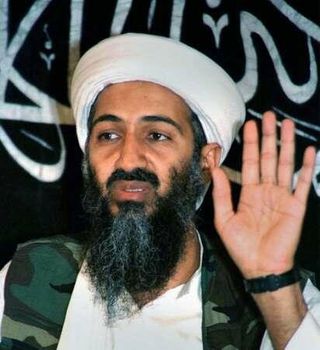
Was Osama bin Laden Chronically Stupid or What?

Osama-bin-laden

It’s been a day, and some more details have become clear about the killing of Osama bin Laden. I thought I’d add a few more thoughts—some of which I didn’t have time to blog yesterday and some of which are in response to what various commenters have posted.

First, was bin Laden chronically stupid or what?

You are the most wanted man in the world, with the world’s most powerful nation on your tail. Okay, so maybe living in a cave isn’t so fun, especially if you have health conditions like Osama was reported to have. And then there are all those pesky predator drones trying to shoot at you out in the hills, so getting under some kind of permanent cover in a more populated area makes sense, but—come on!—the Abbottabad compound? That place positively screams “This is bin Laden’s hiding place!”

It’s built on a hill (strategic defense position), when originally built in 2005 it wasn’t closely surrounded (i.e., was on the edge of town), it’s eight times larger than other local properties, it’s worth a million dollars (in a third-world country where dollars go a looooong way), it has concrete walls 10-18 feet high, the walls are topped with barbed wire, there are two security gates, a seven foot privacy wall around the third floor of the main building, no windows face the road, there are other aerially visible security features and—unlike a mansion built by any other hyper-security conscious rich person in the world—it has no Internet or even telephone service.

Lots of defenses but no way to call for help? Huh? What kind of paranoid millionaire builds himself a pad like that?

Oh, and the locals report the women who live there speak Arabic, and the inhabitants go out of their way to behave weird by never interacting with anybody and by burning all of their trash instead of using the local garbage collection service. And it’s legal owner has no obvious financial means that would allow him to build such an estate.

According to MSNBC,

This home, U.S. intelligence analysts concluded, was “custom built to hide someone of significance.”

That’s kind of appallingly obvious, isn’t it!

Bin Laden’s efforts to remain concealed remind one of the Monty Python sketch, “How Not To Be Seen,” (which is somewhat rude, so be warned).

Yes, having a big macho superfortress with no phone or Internet service will make you a little hard to get at. It probably also strokes your master terrorist-sized ego to strut around in such a place. But it will also make it totally obvious where you are.

It makes it so obvious, in fact, that I wonder why we didn’t identify this place a long time ago—anytime between when it was build in 2005 and now.

I know, I know. It’s easy to connect dots in hindsight. Also, Pakistan isn’t a developed nation and doesn’t have information that’s as easily accessible as here. Further, it’s an uncooperative nation that—while it sometimes helps us, also sometimes deliberately frustrates our anti-terrorism efforts.

I would have thought that our intelligence services would periodically go over our presumably micro-detailed satellite maps of Pakistan and Afghanistan looking for signs of fortresses and then doing a process of elimination.

Such a process of elimination, in this case, might have involved sending in a small, insect-sized robotic probe (like this one, only better [I assume our intelligence services have better ones]) in the dead of night with a button-sized camera (like cell phones have) or a grain-of-rice-sized microphone to see who’s in there—or at least to plant surveillance devices.

For that matter, why not simply, in the dead of night, just lob into the compound a surveillance device disguised as a rock or something and wait to see what it picks up?

But, maybe our technology isn’t quite that good yet (which I find a little hard to believe), or could be too easily detected by anti-bugging equipment bin Laden might have on site, or otherwise might cause him to scamper before we had all our pieces in place.

Or maybe we just gave him too much credit and assumed he wouldn’t do something as stupid as hole up in a monster obvious superfortress but rather choose to stay in a more low-key and harder-to-detect safehouse.

In any event, our guys did finally spot him. He’s dead now, and thus kudos to all of them! I don’t want to be unfair. Hindsight is golden, and all’s well that ends well. Especially terrorist masterminds who get ended. Much obliged, folks! My hat’s off to you! Best of luck with all the nifty new intel you got raiding the superfortress computers and other materials! I hope it all lets you bust up the network good!

The fact that Osama bin Laden was hiding out so close to the Pakistani capital (30 miles as the crow flies; 80 by road), in an upscale, heavily military town which also houses a military academy that is the Pak equivalent of West Point, raises uncomfortable questions about just what the Paks knew about his location.

Monday night I heard an interview with the Pakistani ambassador to the U.S. in which he insisted that they knew nothing of this and that it was just an intelligence blunder not unlike those the U.S. has experienced.

Maybe.

Color me profoundly skeptical.

Given the Pakistani intelligence services’ ties to the Taliban, I strongly suspect that at least some individuals knew where bin Laden was.

Frankly, that’s of secondary consideration at this point. What our leaders need to do is use the obvious discomfort this creates for the Pakistani government to pressure them into helping us find Osama bin Laden’s #2, Ayman al-Zawahiri, and other key al-Qa’eda operatives.

We can let them have their face-saving, “We are your staunch allies against terrorism” bit as long as they get their posteriors in gear and help us root out the remaining terrorist leaders and camps as a show of their “good faith” in the wake of this monumental embarrassment.

If they don’t, and if we get solid evidence that responsible elements in their government did know about bin Laden’s whereabouts then our leaders should deal with them most harshly.

To put it bluntly: Knowingly sheltering Osama bin Laden and his lieutenants from the U.S. is an act of war. It was an act of war for the Taliban back in 2001 (that’s why we went in there, remember?), and it’s an act of war now.

If there are any legal niceties that need to be covered on that score then the appropriate parties in our government should quote Darth Sidious and simply declare, “I will make it so.”

So much for a secular analysis of the situation. Now let’s look at things from a theological perspective.

It has emerged in the last 24 hours that the Navy SEALS (you go, guys!) who were sent on this mission (Operation Geronimo) were instructed that it was a capture-or-kill operation and that bin Laden was given the chance to surrender, which he chose not to avail himself of. It also is reported that the government didn’t seriously expect him to surrender.

The fact that the possibility of surrender was offered to him enhances the moral justifiability of the action, but it was not strictly necessary. If it had been determined that bin Laden must be executed for national security reasons given his involvement in the mass murder of civilians then this would be a defensible application of the death penalty. The precise legal form that such a determination might take (e.g., trial in absentia) could be debated—as could the conclusion of the determination. The point is simply that a surrender offer was not an absolute moral necessity. The fact that they gave it, though, lends additional moral credence to the action.

It is also being reported that the woman who was used or who served as a human shield during the operation may have been one of Osama bin Laden’s wives (he is reported to have at least four, in keeping with what Muslim law permits). If so then he died after trying to hide behind one of his wives.

If that’s so then the U.S. should seriously consider releasing footage of the event (which we apparently possess, or at least may possess) as a way of illustrating to the jihadi world what a wimp and a failure this man was in the end.

(Incidentally, according to reports the government is also looking to release images of the corpse. Those will be gross, but releasing them is probably a good idea since images—even in an age of Photoshop—carry a visceral weight that reports of DNA verification don’t. Bloody photographs would also serve to underscore the humiliating fate that awaits those who attack innocent civilians.)

Now to what strikes me as the central conundrum that many have been puzzling over in the Catholic blogosphere: How to square the impulse to see bin Laden’s body molderin’ in the grave with the impulse to forgive and pray for his soul.

In countless comboxes across the Catholic Internet, people have given voice to both impulses, some openly rejoicing in bin Laden’s death, others expressing regret, and many expressing both sentiments but unsure of how to square them.

Some have pointed to passages in the Old Testament that speak of God as a warrior, a mighty man who slays the enemies of Israel. They have pointed to passages, such as in Esther, where the Jewish people celebrate the destruction of Haman, the enemy of their people. And there are other passages that one could cite as well.

Others have pointed to Old Testament passages that tell us not to rejoice at the fall of our enemies or that God does not rejoice in the death of the wicked but rather wills their repentance. And then there are the “love your enemies” and similar passages in the New Testament.

Many have said they’ve been uncertain how to react—whether to join the celebration at the death of this black hearted villain or feel . . . something else, something less celebratory.

The reality is that all of these perspectives share elements of truth.

Without going into the details of particular passages (at least in this post), several general remarks can be made:

1) We shouldn’t be too quick to embrace the more martial, seemingly bloodthirsty passages of the Old Testament. The Christian faith holds that God led his people, over time, into a progressively more pure understanding of his will. We already see the seeds of universal love displayed in Jesus Christ in the Old Testament, and it comes into full bloom in the New Testament.

2) Neither should we dismiss the Old Testament passages as simply irrelevant. As St. Paul tells us, the Old Testament was written for our example. And while it may represent an earlier phase of God’s revelation to his people that does not fully express all the dimensions of his will, there is truth to be found in even its darkest passages.

3) An important key to understanding the relationship between the two is recognizing that many Old Testament passages speak to the question of justice (or nature), while many in the New Testament speak to mercy (or grace). Both are important aspects of God’s will. Thus we can recognize that it is preferable for the wicked to repent but that if they do not then it is also God’s will that they suffer the consequences of their actions.

4) Even when the wicked have repented, and even when we forgive them for what they have done, this does not mean that there are no consequences from past actions. Our own repentance does not simply obliterate any consequences of our prior misdeeds. Internally—from motives of penance—and externally—from motives of justice for the community—a sinner may still experience punishment and other negative consequences. Thus even a repentant Osama bin Laden would not simply be let off scott free.

5) Based on the way God designed human nature, it is natural to experience positive emotion when the news is received that justice has been done and that safety has been enhanced. It is thus natural to welcome—on an emotional level—the news that Osama bin Laden has paid the ultimate temporal price for his crimes and that he personally can no longer harm us.

6) The love that we are to show to our enemies is not principally a movement of the emotions but an act of the will: An intention to do what we can—even if it is only to wish or to pray—for him and the fate of his soul.

7) The ultimate, objective assessment of the situation is something that only God can make. It likely involves all of the elements previously named: We may rejoice in the things that we may legitimately rejoice in, and we must will the good to our enemies that the Christian ethic requires of us. This means willing the salvation of all if they repent, and it means willing that they repent, but it does not mean willing their salvation in spite of their failure to repent. In the last case, it means willing that they experience what they have chosen for themselves, and what God respects their choice to be as being an eternal rejection of him.

8) Because the foregoing is too complex for us to embrace at any single moment, the human mind in its present state naturally attends to different aspects of it at different moments. At some points we are pulled more toward rejoicing over the things we should rejoice over (e.g., based on justice and nature). At other moments we are pulled toward the things we should will (e.g., based on mercy and grace). This is not unexpected. It is to be foreseen. God does not expect us to hold the whole, complex reality of the situation in our minds at once—either in our feelings or our wills—and so it is perfectly acceptable to alternate between these.

This is why the book of Ecclesiastes states:

There is a time for everything,
and a season for every activity under the heavens: . . .
a time to kill and a time to heal,
a time to tear down and a time to build,
a time to love and a time to hate,
a time for war and a time for peace.

In other words, one can in one moment say, “Yahoo! Osama bin Laden is dead!” and in the next moment say, “Lord, have mercy on his soul!”

What do you think?

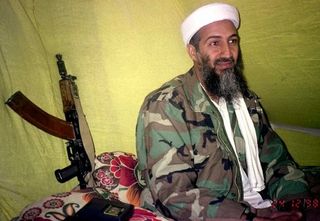
The Morals of Killing bin Laden: Catholic Perspective

Osama-bin-laden-1998-thumb

So it has been announced that Osama bin Laden is dead.

Good.

The twisted, evil mastermind responsible for the deaths of thousands of innocent human beings has been shuffled off this mortal coil.

This provides a measure of justice. Not full justice. That’s in God’s hands. But some justice.

Of course, Our Lord’s command to love our enemies and pray for those who persecute us still applies. We must hope that Osama bin Laden repented at the last second, or that he had been crazy for years and not responsible for his actions, or that God might provide for his salvation in some other way.

And we must remember that Christ himself died to make salvation possible for all men, Osama bin Laden included.

But possibility does not equal actuality. As Pope Benedict has reminded us in various works, evil is real and hell is a real choice. If anyone, judging by outward, human appearances, was ripe for going there, Osama bin Laden was a plausible candidate.

This may have even applied to his final moments. Reports are still sketchy, but it is reported that he died resisting the offensive against his compound, which may mean he was wielding a weapon. It is also reported that a woman who was one of the five people killed in the compound was used as a human shield. This may mean — and future reports may clarify this — that bin Laden himself grabbed the woman himself and tried to use her as a shield while he pointed a weapon at her or at others.

Not the kind of choices one wants to make just before one meets one’s Maker.

After his death, steps were reportedly taken to confirm bin Laden’s identity, including the taking of a DNA sample that is still being processed. Then his body was taken out of Pakistan and buried at sea.

That’s a good choice, actually. It denies future Islamist fanatics of a burial site where they could alternately go on pilgrimage or bomb something.

Of course, they will be trying to bomb things anyway, but they would have done that even if bin Laden were alive. It’s what they do.

The question is: How do you minimize that?

Burial at sea is one measure. Another is found in the response issued today by the Vatican spokesman, Fr. Federico Lombardi, and reported by my colleague Edward Pentin:

Osama Bin Laden—as everyone knows—has had the gravest responsibility for spreading hatred and division among people, causing the deaths of countless people, and exploiting religion for this purpose.

Faced with the death of a man, a Christian never rejoices, but reflects on the serious responsibility of everyone before God and man, and hopes and pledges that every event is not an opportunity for a further growth of hatred, but of peace.

I was surprised that the Holy See had a statement so quickly and that it was so well done. This is what the Vatican needed to say, something that did not appear to let bin Laden off the hook morally but also did not appear to rejoice at his passing and that was an appeal for interreligious harmony and peace.

The statement that a Christian never rejoices at the death of a man is a positive affirmation that the Vatican needed to make. It’s also true in the sense that death as a physical evil is not to be wished upon anybody for its own sake. That is not to say that one cannot be glad that justice has been in some measure served, that bin Laden won’t be masterminding any more plots, etc.

Of course, it would be foolish for the Vatican to point out those things. They would be precisely the things that would inflame anti-Christian anger in the Muslim world and subvert the peace message the Holy See is trying to send.

We will, of course, have to see how well that works out. According to Wikileaks, bin Laden’s lieutenant Khalid Sheikh Mohammad said the organization had a nuke hidden in Europe for use if bin Laden were captured or killed.

Let’s hope that’s bad intel. And let’s pray that if such a device exists that it is quickly found and the plot to use it disrupted.

In fact, let us all pray hard about this and other potential reprisals, both here in the West and in Muslim-majority countries, where Christian minorities are at risk (Pakistan, where bin Laden was killed, is one such country; so is Iraq).

The fact that we may now face reprisals — and the fact that we might even get hit hard — may be cause for people to wonder whether killing Osama bin Laden was worth it.

Let’s hope so. Let’s pray so.

The decision required a judgment call, weighing the potential risks and benefits. History teaches that killing your enemies, and especially their leaders, is a good way to discourage them from attacking you. On the other hand, making a martyr of someone doesn’t always work (cf. Roman Empire, Christianization Of).

There are other moral dimensions to the decision to kill bin Laden. According to some sources the mission was to kill, not capture. That’s a potentially defensible choice based on the heightened risks that would be involved for the personnel responsible for trying to bring about a capture rather than a kill. Also, and even more so, a capture would create a security nightmare by having a live, captured bin Laden as the focus of “Free Osama” reprisals.

A mysterious disappearance would result in the same thing. Even if we didn’t announce his capture, his own people would know he’d been snatched and assume he was still alive.

“He’s dead. He was buried at sea. Move on with your lives” is a better message for the Islamist community.

The big question, still, is what kind of reprisals may be coming and whether bin Laden will long-term be perceived as a martyr or a failure.

Let’s pray.

What do you think?

Prayer Request for a Little Boy

Prayer_1 I would like to ask for prayers for a little boy who is seriously ill. He has been admitted to the hospital and may be admitted to ICU with bacterial pneumonia. He is four years old and is the brother of one of my godsons. I would like to invite prayers for him, his family, the medical professionals who are caring for him, and for all who are in similar situations. Thank you, and God bless you!

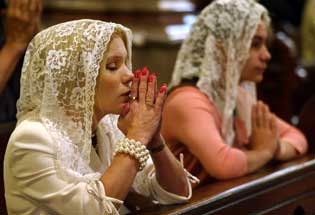
Women’s Head Coverings at Mass: Won’t Say I Told You So, But . . .

Mantillas

Some time ago I did a post (possibly more than one) dealing with the subject of women’s headcoverings at Mass—a practice that was required by the 1917 Code of Canon Law but that then fell into desuetude after the Second Vatican Council and was abolished by the release of the 1983 Code of Canon Law.

I have no problem with women wearing head coverings. In fact, I’m rather partial to the practice, and I fully support any woman’s right to wear one.

But I’m not going to falsify what the law requires concerning them.

My post was occasioned by queries I got from time to time about whether the former practice of women wearing some form of headcovering at Mass is still required.

Some of these queries were prompted by a maker of headcoverings who was trying to gin up business by running ads that quoted the old law as if it was still in effect.

Others, including canonist Dr. Edward Peters and Fr. John Zulhsdorf, also wrote on the subject, pointing out the same thing: The law requiring head coverings ceased no later than the release of the 1983 Code of Canon Law, which abrogated the prior law requiring this (found in the 1917 Code).

Yet that hasn’t stopped people from making spurious arguments to the contrary.

Now Ed Peters has a post in which (after noting Fr. Z’s and my replies and saying some extremely kind things about us) he reports Cardinal Raymond Burke has weighed in on the subject as well.

For those who may not be aware, Cardinal Burke is the prefect of the Supreme Tribunal of the Apostolic Signatura, which “functions as the supreme tribunal [in the Roman Curia] and also ensures that justice in the Church is correctly administered” (John Paul II, Pastor Bonus 121). That means: He heads the highest Church court.

In a letter to an inquirer, Cardinal Burke writes:

The wearing of a chapel veil for women is not required when women assist at the Holy Mass according to Ordinary Form of the Roman Rite. It is, however, the expectation that women who assist at the Mass according to the Extraordinary Form cover their heads, as was the practice at the time that the 1962 Missale Romanum was in force. It is not, however a sin to participate in the Holy Mass according to the Extraordinary Form without a veil.

Ed notes:

Burke’s note is not an “authentic interpretation” nor a formal sentence from the Signatura: It’s simply a calm observation by the world’s leading canonist (not to mention a man deeply in love with the Church and her liturgy) about whether women have to, as a matter of law or moral obligation, wear veils at Mass. Any Mass. And the answer is No.

I’d like to add a couple of remarks to Ed’s concerning Cardinal Burke’s reply. I think it is extraordinarily balanced and well phrased.

His first statement—that the use of chapel veils is not required when women assist at (i.e., attend) the ordinary form of the Mass—is quite true. The 1983 Code abolished the requirement established by the 1917 Code. That much is absolutely clear and straight forward. But what about the celebration of the extraordinary form of Mass according to the Missal of 1962 (i.e., the approved form of the traditional Latin Mass)? Here is where Cardinal Burke’s statement is remarkably well crafted.

He makes two points: First, it is “the expectation” that women attending this form of Mass will wear a head covering, but “it is not … a sin” to refrain from doing so.

Note that Cardinal Burke does not say that the use of a chapel veil is required under the 1962 Missal. This is because it wasn’t the 1962 Missal that contained the requirement. It was the 1917 Code of Canon Law, and that requirement has been abolished. Thus there is no clear legal obligation to do so. The degree to which an obligation that existed in 1962 but that is not mentioned in the Missal would be applicable to the celebration of the Mass according to this Missal today would be, at the least, debatable. According to the 1983 Code,

Can. 14 Laws, even invalidating and disqualifying ones, do not oblige when there is a doubt about the law.

Because of the debatability of such a requirement in the extraordinary form of the Mass today, the law concerning head coverings does not bind (at least until such time as we get further clarification from Rome on the matter).

Thus a woman attending the extraordinary form of the Mass could not be accused of violating the law, much less of sinning.

Nevertheless, it is clear that those who participate in the extraordinary form of the Mass are intending to celebrate it as it was celebrated in 1962, to the extent provided by present law, and that included head coverings. Those regularly celebrating this form of the Roman Rite thus have an expectation that head coverings will be used. Failure to use them could be cause for puzzlement, even if it is not legally required. And the expectation (without legal requirement) may extend higher up the hierarchical chain, though Cardinal Burke does not make this clear.

In any event, it strikes me that Cardinal Burke’s statement is exceptionally well crafted. It acknowledges the clear lack of legal requirement for the use of head coverings (at both the ordinary and extraordinary forms of Mass) while acknowledging the practical expectation but not-legally-required use of them at the extraordinary form of Mass, together with the non-sinfulness of their non-use.

It’s a difficult set of points to make in a short space, but Cardinal Burke’s statement navigates these difficulties well.

If only everyone were so careful on this issue.

What do you think?