Beginning A Low-Carb Diet

A reader writes:

I was on you site and hope you can help me. I need to lose 40 lbs. I am a women 5’7 and weigh 190. My age is 50 . I would like to go on the Atkins diet but for me it is hard to sit down and write a meal plan for every day can you please help me?

Buy the book.

Do not say buy the book. I have a busy life style with foster children and not much time for myself.

Oh, okay.

The good news is that if you want to do the Atkins diet you won’t have to write out a meal plan for every day. You only have to keep certain principles in mind:

  1. Eating carbohydrates causes your body to manufacture insulin, which prevents you from burning fat. If you eliminate carbohydrates then your body will be able to burn fat better.
  2. Your body has three sources of fuel it can burn: carbohydrates, fat, and protein. If you get rid of the carbs then your body will have no choice but to burn fat and protein.
  3. Atkins recommends that you eat no more than 20 grams of digestible carbohydrates per day for your first two weeks on the diet (the Protein Power Diet recommends 30 grams instead if you feel 20 is too restrictive). This will virtually guarantee that you go into fat burning mode.
  4. After the first two weeks, you can increase the number of digestible carbs you eat per day to a higher level (perhaps 40-60 carbs per day) as long as you don’t stop losing weight. If you do stop losing weight (over a period of a few weeks) then reduce the number of carbs till you start losing again.
  5. After you’ve lost the weight you want to lose, you can increase your daily carbs again, so long as you don’t start gaining weight. If you start gaining weight, reduce your carbs till you get back to where you need to be weight-wise.
  6. If you go off the diet completely then you are likely to gain back all your weight. This happens when you go off any diet, so don’t view the diet as a temporary thing but as a long-term change in how you eat.
  7. To figure out the digestible carbs you are eating, look at the number of carbs listed on the product label and subtract those that are due to fiber (which you can’t digest) or which are listed as "sugar alcohols" (technically, you can digest these, but they don’t spike your insulin up). For example: If the package says that a serving has 11 grams of carbs, 4 of which are fiber and 2 of which are sugar alcohols then the total digestible carbs in a serving are 5 grams (11 – 4 – 2 = 5). It’s the total digestible carbs (not total carbs) that you want to keep low. DEGESTIBLE CARBS ARE ALSO SOMETIMES CALLED "NET" CARBS ON PRODUCT LABELS.
  8. The fact that you are counting carbs means that you are NOT counting calories. Eat whenever you are hungry and eat as much as you need to satisfy your hunger (NOT MORE). Just keep the carb count low. You are counting carbs, not calories. This makes the diet much easier than calorie-restriction diets since you can eat whenever you are hungry and thus avoid hunger pains.
  9. The upshot of lowering carbs in this way means that you need to avoid things made from sugar or grain (wheat, rice, corn) or anything starchy (potatoes).
  10. You can eat beef, pork, chicken, fish, eggs, butter, oils, and cheese, though, since these have virtually NO carbs. (Eating meats–which have protein–is better than lots of butter, oils, and cheese, though, since meats will give your body protein to burn so that your body only burns fat rather than the protein stored in your muscles.)
  11. Eating green vegetables is generally good (but not corn, which is a grain, or potatoes, which are starchy).
  12. Eating fiber is good. I recommend drinking a powdered fiber supplement  mixed with water (not a pill)–such as the ones make by Yerba Prima. This will fill you up without adding calories (you can’t digest fiber). DO NOT drink fiber supplements mixed with sugar since the sugar will spike your insulin and hinder your weight loss. If you can get 25 or more grams of fiber a day it will make your weight loss easier, but build up to this level slowly or you may feel bloated while your body gets used to the new level of fiber.
  13. Take a good multi-vitamin EVERY DAY to make sure you’re getting enough vitamins. If possible, take a multi-vitamin designed for people on low-carb diets.
  14. Get some exercise. Just twenty minutes of brisk walking three times a week will really jump up your metabolism and make you burn fat better. (Take the kids walking with you if you need to; it’ll help THEM get exercise they need, too!) Do in-home walking if you want. I recommend Leslie Sansone’s in-home walking DVDs to help keep you happy and motivated. She’s so friendly and supportive of you ask you walk away the pounds. She’ll make you feel good about exercise and not bored by it.
  15. Learn about low-carb substitutes for foods you like. There are TONS of these now. There are good low-carb breads, tortillas, pastas, pizzas, chips, cereals, meal bars, diet shakes, ice creams, candies & candy bars. Just make sure you don’t go crazy with them and eat more digestible carbs than you should. Keep that daily carb-count low. These same low-carb products can be ordred online (do a Google search for them) if they aren’t in your local grocery, nutritional, or health-food stores.
  16. You may have carb cravings for a few days but these generally go away
    in two weeks, and you can eat low-carb foods like the ones mentioned in
    point #15 to stop them.
  17. You may feel tired the first few days on the diet. This is normal, but your energy will snap back in a few days and you’ll feel GREAT–like you have more energy than you’ve had in years.
  18. Once you have settled into a routine, you likely won’t need to count carbs any more. You’ll know instinctively from what you’re eating that you are below your weight-loss threshhold. And you WON’T need to do a daily meal plan or deprive yourself if you start feeling hungy.
  19. Your weight can go up and down a good bit over the course of a day or a few days. Therefore, don’t get discouraged if you see it fluctuating in this fashion. To avoid this, some dieters recommend weighing yourself only once a week so you’ll see less of the fluctuation. What counts is that you are losing weight over the course of several weeks, not that you seem to be losing it every time you step on the scale.
  20. To the extent you can, spread out your consumption of digestible carbs throught the day. This will minimize your insulin reaction to the food you’re eating. Don’t eat one big, high-carb meal if you can avoid it.
  21. For low-carb milk buy the low-carb milk in your grocer’s freezer or use (and, if needed, dilute with water) heavy cream or whipping cream or half-and-half. Sour cream is also low-carb.
  22. For low-carb crunch eat celery, pork rinds (chicharrones), nuts (without honey-roasting! always watch the digestible carbs on the label!–macadamias are the best, though peanuts and almonds are good), or small amounts of raw carrots or popcorn–or specially-designed low-carb chips.

Also, few other notes:

  1. If you have a major health problem, check with your doctor before starting the diet (or any diet).
  2. To smooth your transition into the diet, take 2-3 days to adjust to the low levels of carbs you’ll be eating at first.  Decrease your carbs over these 2-3 days until you’re at the 20 (or 30) grams of digestible carbs per day that the diets recommend.
  3. Consider taking nutritional supplements that will help you lose weight–like chromium picolinate and L-carnitine. Here’s a good book on the subject.
  4. Poke around my diet section for additional suggestions (like drinking flax seed oil, cranberry juice, and lemon juice–or how to make low-carb mashed potatoes or low-carb hash browns). These may be a help.
  5. Buy the book. It really will help. Just treat it as a source of ideas rather than something you have to read from cover-to-cover.
  6. Get a low-carb cookbook or two. The recipe ideas will help keep the diet from getting old and will help you discover low-carb equivalents for your favorite foods. The standard low-carb diet books (like the Atkins book) also include recipe sections to give you ideas. Many low-carb recipes are also available online for free. Just Google "low-carb recipes."
  7. When you have time (amidst your busy schedule), check out some similar low-carb diets, like the Protein Power Diet, the South Beach Diet, and the Fat-Flush Diet. They can give you good tips and recipe ideas, too.

Finally, BE CONFIDENT! You CAN do this!–and without feeling hungry.

I spent YEARS trying to lose weight before my doctor told me about the Atkins Diet, but when I discovered it, it changed my life. I lost a HUGE amount of weight on it, I’ve KEPT THE WEIGHT OFF (despite some slips and plateaus), and I’m fitter and feeling better than I did for YEARS.

You can feel that way, TOO! Go forth and CONQUER!
“Deep-Seated Tendencies”–Some Clarification

A reader writes:

Regarding your remarks on homosexuals and ordinations, I feel you missed a very important point that the document was making.

There is a difference between heterosexual attraction and homosexual attraction. 

True.

The first is natural, God’s plan for us.  The other is intrinsically disordered. 

True.

This difference is relevant even in the celibate state of the priesthood. 

True.

The church wants people of sufficient maturity and psychological health,

True.

as another said, you wouldn’t make a man with vertigo, even casual vertigo, an astronaut.  It’s not worth the risk.

Okay.

Your argument implied that there is no relevant difference between a heterosexual priest with normal attraction to women, and a priest with an equivolent homosexual attraction to men. 

False. My argument did not imply that, though I could have included extra qualifiers to make that clear.

If you read the reply carefully, you’ll note that all of the discussion of heterosexuality occurs *before* I give the list of four different levels of attraction. It is principally for the purposes of fleshing out the range of levels of attractions that a person may experience.

I note in passing which levels, in the case of heterosexuals, are and are not bars from ordination (level 1 is not but levels 4 is). My analysis of which levels of attraction the new document has in mind when speaking of "deep-seated tendencies" occurs *after* the list is fleshed out, and I look at evidence internal to the document to make that determination, dropping the heterosexual analogy now that the list has been fleshed out in such a way that the document can be applied to it.

I am therefore *not* saying that heterosexual seminarians and homosexual seminarians are equivalent in terms of what level of disordered desire serves as a bar to ordination. The document doesn’t go into the question of what levels bar heterosexuals from ordination, nor does it establish the two cases as equivalent in terms of ordainability. Therefore I don’t do that.

You equated tendencies with homosexual acts, which is not what the document is referring to. 

No, I didn’t do this. A tendency is not an act.

If you refer back to the catechism of the catholic church, you’ll see that it refers to celibate individuals with deep-seated homosexual tendencies, at that this is often a trial to them.  The context of that is clearly attraction, not homosexual acts.

This is not the case. The paragraph you are referring to (CCC 2358) does not make any reference to the individuals being discussed being continent (i.e., refraining from sex; celibacy is the condition of being unmarried). The paragraph does not specify whether the individuals in question are continent or not and seems to apply to both (even individuals who *are* homosexually active must be accepted with compassion, etc., for example–and for most of them their homosexual desires are a trial, even if some would deny that in a kind of rationalization).

That being said, the term "tendency" of itself is ambiguous and could refer either to a tendency to act or a tendency to experience certain temptations which may or may ont result in further action. The document is unfortunately ambiguous in this respect, but my sense is that it refers to the latter–to a tendency that results in temptations.

This is why I make "attraction" the keyword for each of the four levels of attraction I mentioned. To distinguish the different levels of attraction from each other, I correlated the strength of the attraction to the consequences that tend, in particular cases, to result from it.

The correlation here is not perfect since the will gets involved–a choice is made to act on the attraction–but at least some kind of correlation to the consequent choice is present. People who are only mildly attracted to someone (homosexually or heterosexually) are less likely to sleep with that person than people who are powerfully attracted. So you can look at a person’s resulting choices as at least a rough gauge of how strong their attractions are.

If a person experiences only mild, momentary attractions that do not result in him stopping to indulge in sexual fantasies then his attractions, in the main, are less than those of a person who stops to fantasize about having sex. If his attractions are even stronger then he may go beyond fantasizing and engage in autoerotic behavior. If his attractions are stronger yet then he may undertake the difficulties of actually seeking and obtaining intercourse with the person.

The thing I’m after, here, is how strong the attractions are. The resulting choices (to indulge in fantasies, to autoeroticize, to have intercourse) are only rough guides to the strength of the attractions.

What I think the document is saying is that people who experience a certain level of same-sex attraction are unsuitable for ordination–whether they are chaste or not–and I’m trying to develop a schema for figuring out what level of same-sex attraction the document has in mind.

I *don’t* think (as I explained in the previous post) that the document envisions people with absolutely *any* degree of SSA as being barred from ordination. If a person has a single moment in which he experiences a twinge of same-sex attraction, that doesn’t bar him forever from ordination. But, having had such a moment, the possibility is there that he will have future twinges.

The document refers explicitly to those having overcome tendencies toward homosexuality for a period of at least three years being ordainable, and it is not plausible to read this as meaning that those who have formerly experienced significant homosexual temptations must then go three years without the slightest twinge of same-sex attraction.

Slight twinges are just not what the document is talking about. What the document has in mind are attractions of a more significant sort.

Unfortunately, since formators can’t hook a seminarian up to a same-sex-attract-o-meter and determine precisely how strong their attractions are (nor can they quantify their own inner life on this matter in a meaningful way), they have to look to phenomenological criteria to gauge their level of attraction by asking questions like: (1) "Do you regularly fantasize about having sex with men or boys?", (2) "Do you often engage in autoerotic behavior while thing about such sex?", (3) "Do you have such sex?"

If the answer to quesitons (2) or (3) is "yes" then the candidate would be judged unsuitable for ordination.

If the answer to question (1) is "yes" then–in my opinion (though the document doesn’t spell this out)–then the document probably would bar the candidate from ordination. Having a regular fantasy life about homosexual sex would seem (to me) to constitute an tendency toward homosexuality of sufficient strength to serve as a bar to ordination under the provisions of the document.

But if the answer ot question (1) is "no" then this is not at all clear to me. I don’t think it’s plausible that the document has in mind momentary twinges. The reasons were as I indicated.

When the document says that certain individuals can be ordained who had "homosexual tendencies that were only the expression of a transitory problem" it does not go on to say that these individuals also must have *never acted* on those tendencies. For all we know, they may have had a homosexual fantasy life, engaged in homoerotic autoerotic behavior, or even had homosexual sex.

This seems to be confirmed by the comments of Cardinal Grocholewsi (the head of the congregation issuing the document) on Vatican Radio regarding those who experienced a transient problem:

"For example, some curiosity during adolescence; or accidental circumstances in a state of drunkenness; or particular circumstances, like someone who was in prison for many years."

Or, in some situations, he said, homosexual acts may be a way to please someone in order to obtain favors.

"In such cases, these acts do not originate from a deep-seated tendency but are determined by other transitory circumstances, and they do not constitute an obstacle to admission to the seminary or to holy orders. However, in such cases, they must cease at least three years before diaconal ordination," he said. [SOURCE].

So people who have actually engaged in homosexual acts are potentially ordinable according to the cardinal who is the principal signatory of the document in question.

But the thing about homosexual act (like illicit heterosexual acts) is that they scar people. They reinforce illicit desires, and people who have had them are in some measure haunted by them. The memories of them and the desires that these memories can stir up come back to people’s minds from time to time.

As a result, it does not seem plausible to me that the congregation is expecting seminarians who have previously had a problem with homosexuality–including homosexual acts ("in a state of drunkenness," "in prison for many years")–are expected to go for three years without the slightest twinge of same-sex attraction.

This suggests (as common sense would) that momentary twinges are not what the document has in mind. To serve as a bar for ordination, something more than this is required–such as a stable homosexual fantasy life, for example (in my opinion).

And as noted in the previous post, the above indicates that we are at least in a doubt of law situation, in which case Canon 14 indicates that the candidate is free under church law (which is what we’re talking about here–not what the law should be but what the law is) to pursue ordination, opening himself trustingly to the discernment of the Church and being completely honest about the extent of his attractions.

Your narrow argument equating tendency with comission of sins seems to end up with the conclusion that as long as one is chaste and orthodox, a "homosexual" could be ordained.

No, for the reasons indicated. The acts are merely used as rough guides to gauging the strength of attractions (tendencies), and I think that a person with regular fantasies about homosexual sex would not be ordinable. (Whether a seminarian with regular fantasies about homosexual sex woud be ordainable is a different question and one for which I do not have information on the Church’s law or practice in that regard.)

Again, it is wrong to equate "tendencies" with the commission of sinful actions.  Tendencies is better read, with the Catechism, as temptations. 

Agreed.

If tendencies meant sin, the catechism could not say that people with deep-seated homosexual tendencies didn’t chose their state, that for most of them it is a trial.  For that to be true, we have to be talking about temptations, not about sinful indulgence.

The Catechism is not dispositive to the intepretation of this document. You have to read the document itself and relevant legislative background, such as the comments of the principal cardinal signatory regarding its interpretation. The Catechism is a tertiary source here at best.

Further, the Catechism paragraph in question does not presuppose chastity, and people who are caught up in sin frequently find that sin a trial–even if they are strongly tempted toward it. This is certainly true of homosexuals.

As a friend of mine was once told by his psychologist sister, "[Name witheld], don’t ever be a homosexual; they lead such miserable lives."

Many homosexuals–even those who are not Catholics–often feel consumed by guilt for what they are doing and wish that they could get rid of their homosexual desires.

Given the referenec to the catechism, it seems pretty clear that deep-seated tendencies has to do with people who have a permanant attraction to men, even if they are chaste and holy. 

"Permanent" is too strong. "Stable" would be better. "Permanent" excludes the action of God’s grace and the potential of reparative therapy. The question is: How strong does the attraction have to be? Momentary twinges don’t seem to be what is envisioned.

This would mean they do not consent to fantasies, want to live chaste lives according to church teaching, etc.   That is not enough.  And that’s precisely what the document says.  Or do you disagree?

I don’t disagree that the document precludes people with stable same-sex attractions from being ordained. In fact, I would go further than you do and say that even if the person doesn’t consent to fantasies about homosexual sex his attractions may still be strong enough to trip the document’s provisions. If he regularly finds himself regularly tormented by fantasies about homosexual sex–fantasies he doesn’t willfully engage in–then his attractions may be sufficiently strong to trip the document’s provisions.

It would strike me that he’d be prevented from being ordained until he’d healed sufficiently that he no longer had a tormening tendency toward such fantasies for at least three years. He needs a level of peace and maturity such that he no longer feels tormented by his resolution to live chastely. He needs to no longer be a "white knuckle" fantasizer but someone who has been able to get past that so that even if he occasionally has memories and disordered desires momentarily stirred up then he can set them aside.

That seems to be all that one could realistically expect of someone who once had a significant if transient problem with homosexual desires or behaviors.

Since the document allows people who have overcome such transient problems to be ordained it seems that one cannot ask such people to ever after NEVER be haunted by memories or have disordered desires momentarily stirred up or have a flash of involuntary fantasy.

And if individuals who have had and overcome such experiences can be ordained despite the fact that they may have momentary twinges of same-sex attraction then, a fortiori, those who have never moved beyond the momentary twinge stage in the first place would be ordainable.

Which was the case with the gentleman who wrote in.

I hope this clarifies matters, and I’d like to thank you for respecting Rule 20 with regard to the original post and e-mailing your disagreement rater than putting it in the combox. This allowed me to prepare a more thorough and thoughtful response than I could have under combox time pressures, which is one of the reasons for Rule 20. Like I say, I don’t mind disagreement; Rule 20 is to help handle disagreements productively in delicate pastoral situations.

“Deep-Seated Tendencies”

A reader writes:

I am a young man discerning the possibility of religious life.  The only issue is that I have a history of homosexual attractions.  Now, I never acted out on them, I don’t indulge in homosexual fantasies, I don’t support the "gay" culture, and to be honest, when I have attractions they are generally pretty mild and really more annoying than anything else. 

I keep trying to put the idea of the priesthood or brotherhood out of my head, especially because of this new document, but it wont go away.  I truly believe that I might have an authentic call.  Fr. Jim Llyod, a priest who works with Courage (you might be familiar with them) wrote this in one of this articles…

"Should a candidate with a flagrant homosexual background, strong same sex urges, and frequent autoerotic behavior be assessed in the same manner as the devout and believing candidate who has little or no same sex experience and minimal Same Sex fantasy life? Factually, both types have applied to seminaries. Does tendency mean the former or the latter?

One point does seem patently clear.  A seminary and the priesthood should not be clinics for sexually obsessed (or repressed) individuals. However, the candidate with the occasional but managed “tendency” could be ordained (and has been) to become an effective and holy priest. Such men, ordained to Christ’s priesthood have largely remained faithful to the Lord, the Church and the priesthood itself.

Ultimately, it is fidelity that matters, not psychosexual orientation. These are not gay priests. They are men of God with a managed SSA quality. The distinction is essential.  Gay is a life criterion. It is a lens through which all things are measured and is a form of political activism."

I gravitate much more towards the latter than the former.  It is important to me to stick with what the Church teaches.  I guess my question is, what does "profoundly deeply rooted homosexual tendencies" actually mean?  Do you think, with the description I gave to you, that I would be excluded from the priesthood?  What about the brotherhood?

The document is now out, which is helpful, but it does not go into a great deal of detail on the difference between those who can and cannot be ordained. This is no doubt due in part to the fact that it is hard to draw a clear line. The Holy See also may want to state the requirements rather generally so that they can be further fleshed out with additional pastoral experience–i.e., just how much inclination towards homosexuality is enough to make someone unsuitable as a candidate for ordination. Having a single moment of same-sex attraction isn’t. Having a constant, compulsive homosexual fantasy life is.

What the document speaks of–in the translation carried by Zenit (which is superior to the rushed one that CNA had and which may or may not be the official translation )–is of those who "present deep-seated homosexual tendencies" versus those who "with homosexual tendencies that were only the expression of a transitory problem." It goes on to speak of these tendencies needing to "be clearly overcome at least three years before ordination to the diaconate."

It seems to me that the foundational question here is what they mean by "tendencies." My suspicion is that they mean something rather strong by this.

Let me give you a parallel example from heterosexual sexuality:

Heterosexual guys frequently have passing moments of attraction to women to whom they are not married, but these don’t (usually) lead to sexual fantasies. There’s a difference between "Wow, she’s hot" and "Wow, let me stop and fantasize about being in bed with her." There is a further step from fantasy to acting outwardly in some respect. For example, moving from having a fantasy to engaging in autoerotic behavior. And there is a step further from moving from autoerotic behavior to actually engaging in sexual relations with the person, which would be actual adultery (for a married man) or fornication (for an unmarried man).

Now: The mere fact that a heterosexual man may have moments of attraction to women he isn’t married to does not mean that it would be fair to say that he has "tendencies to adultery" or "tendencies to fornication." There may be a disordered desire there, but these are just passing moments of attraction that don’t result in deliberate sexual fantasies or worse.

Such passing moments of attraction also don’t singificantly impair a man’s ability to relate to women in a proper way or with his overall affective (emotional) maturity. For a man seeking to live chastely (either being faithful to his wife or remaning abstinent if he is single) they are an annoyance.

They also are no barrier to ordination.

They better not be, because every single heterosexual priest there is has them.

In any event, it would be exaggeration to call them "tendencies to adultery/fornication" since a man who is emotionally mature and committed to chastity will not act on them by seeking to commit adultery or fornication.

(A heterosexual man with a tendency to fornicate would be barred from ordination. We don’t need priests going to bed parishioners.)

Looking at this, we might discern four levels of attraction:

  1. Momentary attraction
  2. Attraction so strong that it tends to result in sexual fantasies
  3. Attraction so strong that it tends to result in autoerotic behavior
  4. Attraction so strong that it tends to result in sexual behavior with another person

If we ask which of these the new instruction envisions when it refers to "deep-seated homosexual tendencies," it seems to me that #3 and #4 obviously would count and #2 probably would count (i.e., someone who regularly fantasizes about homosexual sex even if it tends not to result in autoerotic behavior or homosexual sex).

It seems to me, though, that #1 may not count. The document expressly holds out the possibility that someone may have had homosexual tendencies at one time but overcome them. I suspect that even for such persons there are likely to be momentary attractions they experience later in life, even if these don’t result in homosexual fantasies or worse. My understanding is that homosexual reparative therapy is such that it (at least normally) doesn’t remove forever all such momentary attractions. Even someone who only had "homosexual tendencies that were only the expression of a transitory problem" is likely to feel such momentary attractions later in life.

Since the document expressly holds out the possibility of ordination for those who have overcome these tendencies, it seems to me that the document may not envision passing moments of same-sex attraction as significant enough to serve as a bar to ordination.

At least, it isn’t presently clear that that’s what the document has in mind. (The Holy See may always clarify later.)

It seems to me reasonable to suppose that mild, transient attractions do not count as "deep-seated tendencies to homosexuality." This means, at a minimum, that we have a doubt of law situation. When one encounters a doubt of law situation, liberty is presumed–for as our old friend, Canon 14, tells us:

Laws, even invalidating and disqualifying ones, do not oblige when there is a doubt about the law.

So: If, as you say, you’ve never acted out on your attractions, don’t regularly fantasize about homosexual sex, and experience only mild, passing same-sex attractions that are an annoyance then it seems to me that you would be free to explore the possibility of ordination.

Whether your attractions are such that they truly would be a barrier to ordination would be something that you and your formators to discern. You would need to be honest and open with them about these attractions, seeking neither to minimize nor overemphasize the extent of them. You want to give them an accurate picture so that a properly-informed determination can be made.

This seems to be what the document means when it says that the candidate "must offer himself trustingly to the discernment of the Church, of the bishop who calls him to orders, of the rector of the seminary, of his spiritual director and of the other seminary educators to whom the bishop or major superior has entrusted the task of forming future priests."

I also have a question about whether a vocation in a religious order (either as a priest or a brother) is the right thing for you. Joining a religious order would mean putting yourself in a large, same-sex community, and I wonder if that would potentially exacerbate the attractions. It might or might not. Your pre-novitiate period would probably tell you that.

Since the ink on this document is not yet dry and since ancillary materials that could shed light on its interpretation are not yet avilable to me, I could be wrong about the above, but reading the document itself and trying to figure out what it likely means, it does not strike me that at present you would be prevented from exploring ordination.

Hope this helps!

20

WOO-HOO! The Adventures of Brisco County Jr. On DVD! (Maybe!)

BriscoIt appears that The Adventures of Brisco County Jr. may FINALLY be coming to DVD!

YEE-HAW!!!

TVShowsOnDVD.Com reports:

After years of rumors and finger-crossing, The Adventures of Brisco County Jr. will likely come to DVD in 2006. Warner Bros have given me the go-ahead to post the news that it’s strongly being considered for release next year. They haven’t started on the project yet, so they can’t say with 100% certainty that it’s coming, but things are looking good for our boy. We posted news that this was coming before, but that was secondhand info and obviously wasn’t reliable.

This is a show I’ve fought very hard to get on DVD, so I’m excited by the news that it’ll be coming out. It’s currently the 3rd most popular unreleased show on the site, and Bruce Campbell fans are diehards and throw their support behind the actor; I think the release will be successful. We’re very much "in-the-loop" on this title, so stay tuned for more news when we get it [SOURCE].

For those who may not be aware, The Adventures of Brisco County Jr. was an outstanding saddlepunk series that Fox aired back in 1993. It’s a lot like the old 1960s series Wild, Wild West–only good (or better).

I didn’t wach Brisco when the show was first on because of the way Fox advertised it. (I.e., as a Western done "Fox style"–wink, wink, nudge, nudge–implying a lot more sexual content than the show actually had.) And apparently a lot of other people didn’t, too.

Fox wasn’t really behind the show and debuted it in the 8 p.m. Friday Death Slot, which is guaranteed to kill programs in short order (as happend to Star Trek Enterprise in its last season) due to the fact audiences are unusually low at that time, making it hard to get ratings.

It aired just before The X-Files (and, you’ll note, when the latter started to get popular the network moved it out of Friday night and onto Sunday–a high TV-audience night).

Brisco lasted only a season, but what a season it was!

I discovered the show when TNT was airing it Saturday mornings, and it was good enough to pull me away from watching cartoons (which was an accomplishment).

The show had tremendous potential, and it’s really a shame that the network didn’t give it more of a chance. It seems to have been a couple of years ahead of its time, because the exact same kind of anachronistic in-joking that the show did was later used to great effect on Hercules and Xena, both shows that were extremely popular in their day.

The program tells the story of a bounty hunter named (are you ready?) Brisco County Jr., who is hired by wealthy San Francisco robber barons to hunt down a particular gang of criminals who (coincidentally), killed Brisco’s father, lawman Brisco County Sr.

That much is more of less standard Western fare, but the show injected numerous sci-fi elements, including the mysterous "orbs’ (metallic devices that look like floating ocean mines) that came from the future and had mysterious powers, like endowing people with superstrength, turning bad characters good, and consuming and trapping evil androids.

The show also featured a lot of anachronistic, forward-looking humor, like a character named "Aaron," who was a knockoff of Elvis Presley and who had invented "day-glasses" (glasses with darkened lenses) to protect his eyes from the sun.

Or Brisco’s rival (and later partner) Lord Bowler, an ultra-macho ex-Buffalo Soldier who’s secret dream was to move to the Napa Valley and plant a vineyard (hence: the origin of California’s Napa wine industry).

Or John Astin (formerly Gomez Addams) playing Prof. Wickwire, a crazy inventor who comes up with (are you ready?) crazy inventions–like rocket-propelled trains and things like that.

Brisco County Jr. himself is played by Bruce Campbell (better known as Ash from the Evil Dead trilogy, which is comedy horror rather than comedy sci-fi western).

Anyway, it’s a great show, and I wanted to give a head-up to other Brisco fans out there that the long wait for (legitimate) DVDs may FINALLY be coming to an end!

Will keep you posted!

MORE BRISCO MEMORIES.

Matres, Non Permittite Infantis Vestri Adolescere Esse Armentarii

B16 recently gave a speech in Latin encourating people to learn (of all things) Latin.

Maybe he gave it in Latin so that people would have to learn Latin to find out he was encouraging them to learn Latin.

Anyhoo . . . he also encouraged the teaching of Latin through new techniques, which I AM ALL FOR. The pedagogy in many Latin books (like Collins’s AWFUL Primer of Ecclesiastical Latin) is horribly out of date and seems designed to make learning the language hard on students.

I’d love to see a Latin textbook modelled off of Bill Mounce’s (excellent) Basics of Biblical Greek or an audio course for Latin based on the Pimsleur method.

Unfortunately, none of those things exist.

I’ve noodled around with writing a Latin textbook, but thus far it hasn’t come together for me. I’ve been able to simplify a lot of Latin instruction using a largely inductive method of teaching, but the Latin noun endings system is such a bear to try to teach in that fashion (or any fashion) that I’m not satisfied with the results yet.

Hopefully the pope’s impetus for better Latin pedagogical methods will serve as the impetus for better Latin pedagogical methods.

To go along with new teching methods there are also a lot of new Latin words to be taught. One of the things that

THIS ARTICLE ON THE POPE’S SPEECH

notes is that the group he was talking to

has also published a dictionary, the Lexicon Recentis Latinitatis, containing more than 15,000 neologisms translated into Latin.

For those who ever wondered about the Latin equivalent for "computer," "terrorist" or "cowboy," there are now answers.

"Instrumentum computatorium" is the way the Latinitas Foundation refers to computers.

Those who sow violence and terror are called "tromocrates (-ae)"; while characters in Westerns are called "armentarius."

Some of the words of the Lexicon Recentis Latinitatis can be consulted on the foundation’s Web page.

CHECK OUT THE LIST
(Thanks to the reader who e-mailed.)

“Set PHaSRs On Blind!”

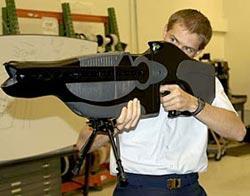
PhasrYessirree, you’re lookin’ at an honest-to-God PHaSR, right here!

A Personnel Halting and Simulation Response system, that is.

It was recently unviled by the Air Force as a form of non-lethal crowd control and, like the phasers on Star Trek, is a laser-related weapon. (It also looks suspiciously like certain 24th century type III marine combat phaser rifles.)

It shoots a pulsed beam of green laser light that is intended to temporarily blind ("dazzle") the targets it is trained on, making it useful for crowd control and dazzling potentially dangerous motorists who are approaching military checkpoints too fast (i.e., as if to ram through them or suicide bomb or something).

Similar white-light-based systems are already being used in Iraq to stop potential terrorists careening toward military checkpoints, but the new system may be more effective.

An important aspect of the PHaSR system is that it does not (or is not supposed to) cause permanent blindness. Permanently blinding laser weapons do exist, but they are banned under a 1995 U.N. protocol and so are not used.

The PHaSR system seeks to avoid permanent blindness by automatically sensing the distance to the target and (apparently) adjusting the strength of the laser beam it emits (though the military is presently a bit cagey on exactly how this works).

It also uses two different frequencies of light in case the target is wearing goggles to block one frequency.

SWEET!

Now if they’d just develop zatnikitels. You just can’t beat that "one shot stuns, two shots kill, three shots disintegrates" functionality.

GET THE STORY.

P.S. Y’know, this only raises the question of why they never used a sub-stun setting to dazzle people on Star Trek.

Happy Turducken Day?

A reader writes:

I’m Canadian, but I did spend 6 years living in Los Angeles, CA and I do have an American girlfriend so this year I decided to celebrate American Thanksgiving.  The Canadian version is actually in October on what you guys celebrate as Columbus Day.

So for my US Thanksgiving feast I decided to finally make a turducken.  In case you haven’t heard of it, a turducken is what you get when you stuff a chicken into a duck and then into a turkey.  Of course that’s the short version of the preperatory phase.  I took some pictures of the process and a friend of mine was kind enough to post them on his websit.  The last photo is a cross section with labelling.  The stuff between the birds is sausage stuffing and cornbread stuffing.

This particular bird took 10 hours to cook at 225F until the internal temp reached the target of 165F.  I invited 14 friends over to help us feast and we still had half the bird left.  Anyway, though you might find the pictures interesting.

Y’know, I’ve read about turducken, but I’ve never known anyone to actually make it. Amazing.

It’s a good thing turkeys are native to the New World or there’s probably have been a prohibition on this kind of thing in the Mosaic Law.

GET THE PICTURES. (WARNING! Pictures of cooked and uncooked food!)

What To Tell The Children

A reader writes:

I feel like I know you, having listened to you on EWTN many times.  I have a question for you, if you’d indulge me.

I am Catholic, my wife Protestant.  We were married within the Catholic Church, and God bless my wife, she has done a great job in helping to raise them Catholic.  (She always goes to Mass, is very supportive of their education within the Catholic schools, etc. etc.).  The kids are between 7 and 14 years old.

My wife’s sister is lesbian, and is now undergoing artifical insemmination so that she can conceive a child.  We’ve never broached the subject of her lesbianism with the kids, but with the potential addition of a "cousin", I have no idea what or what I shouldn’t say to the kids. 

My gut reaction is to be brutally honest, but I think they would come out hating their Aunt (which would indirectly hurt my wife). 

My wife feels the same as I do regarding the fact that both homosexuality and artificial insemmination are morally wrong, but she feels guilty because she also "can’t be there" for her sister as she attempts to go through pregnancy. 

I’ve always kept my sister-in-law at arms length, in the sense that we don’t visit her at her home, although we do visit together at public places (restaurants, etc), or in my in-laws home. 

I also don’t have any idea of how I’ll handle this new "niece" or "nephew" if it comes to pass; I don’t want to penalize the child for the mistakes of the mother, but I feel this articifial insemmination is an abomination.

This is a very difficult situation, and I feel for you.

It also is your sister-in-law who has created the situation. Your wife therefore should not feel guilty about the limitations that the situation creates for her ability to "be there" for your sister-in-law. The situation is of your sister-in-law’s designing, and she is the one responsible for the difficulties that ensue.

The question is: What practical steps need to be taken in a situation like this. Ideally, if possible, one would want to dissuade the sister-in-law from undertaking this course of action, though that may be impossible at this stage for any number of reasons.

If she goes through with the procedure and has a child then you would want to do several things:

  1. Continue to do your best to love her (i.e., will her good and do what you can to encourage her good), for she continues to be a woman who God loves and for whom Christ died.
  2. Love the child she gives birth to (i.e., will the child’s good and do what you can to encourage the child’s good), for the same reasons.
  3. Love your own children (i.e., will and encourage their good) for the same reasons *AND* for the reason that you have an obligation under divine law to care for them and promote their good.

All though all of these parties are equal in God’s eyes, your responsibility is strongest toward your children. Promoting their good is therefore your primary obligation. It therefore is not "penalizing the child" if you determine that certain measures must be taken to protect your own children. You can will and promote the good of all the children involved (your sister-in-law’s child included) as best you can; the situation may simply limit what can be done due to the needs of your own children.

What measures you may need to take is judgment call that you and your wife will have to make based on your knowledge of your own children, what they are ready for, and what they can handle. They are obviously old enough that something will need to be said to them, but they are not so old that they are clearly ready to hear all the facts. Which children are ready for what is something you would know much better than I since children are so different (and especially when you’ve got an age range like 7 to 14, which might turn into 8 to 16 by the time the child is born, depending on how quickly your sister-in-law becomes pregnant).

That being said, it does not seem to me that you necessarily need to bring up the subjects of either lesbianism or artificial insemination.

It seems to me that it may be possible to simply say "Aunt So-and-So is having a baby even though she is not married." You can then explain that it is wrong for her to do this–that it is God’s will that all babies be born in families with a mother and father who love them–but that even though this is wrong Aunt So-and-So and her child are both people that God loves and that we must love them and do our best to help them, too. (E.g., by praying for them.)

That may be all you need to say. If the children ask who the father of her baby is, you can say (truthfully) that you don’t know. (And omit the fact that Aunt So-and-So doesn’t know either.)

Stressing the love aspect is important, both for now and because it
will help the children when they finally do learn the truth of the
situation. You will have framed it in terms of God’s love all along, and that may make it easier for them to keep the reality in proper perspective.

I’d also have a talk with your sister-in-law, explain what you are going to tell the children, and ask that she *and her partner* respect your decision by not giving them more information than you feel they are ready for. For example, if one of the kids were to ask her who the father of the baby is, you would want her to say something like "I’d rather not go into that. Let’s talk about something else." Similarly, you’d like your sister-in-law to present the baby to your children as "my child" not "our (I and my partner’s) child."

If she does agree, it is likely to be several years (and your kids would thus
be older) before the situation would have to be further clarified. (Also, you and your wife should be the ones doing the clarifying; not your sister-in-law, her partner, or her child).

If she and her partner don’t agree to that I would then reluctantly conclude that her access to your children must become even more further limited than it is.

Again, I’m sorry to hear about your situation, but I hope this helps.

20