Tritiocanonicals?

A reader writes:

I know that the word deuterocanonical means "included in the second canon". I also know that the word is something of a misnomer since there has really only been one canon that is universally definitive, and there have been a lot more than two canons that have not been universally definitive. I have been told once by someone whom I can not now remember that the canon of the Council of Trent is closed, that there can never be such a thing as "tritocanonical books". So I remember being a little surprised some months ago when I read the decree from the Council which listed the canon that it contained no exclusive language, i.e., that it said, in effect, "these books are holy and to be received", rather than "these books and only these books are holy and to be received".

Just the other day, I was reminded of my surprise when I read this discussion of the deuterocanonical books from the Proemial Annotations of Volume I of the Old Testament of Douay, the 1635 edition from before Challoner’s revision:

"True it is that some of these books … were sometimes doubted of by some Catholics, and called Apocrypha, in that sense as the word properly signifieth hidden, or not apparent. So St. Jerome (in his prologue before the Latin Bible) calleth divers books Apocryphal, being not so evident, whether they were Divine Scripture, because they were not in the Jews’ Canon, nor at first in the Church’s Canon,  but were never rejected as false or erroneous. In which sense the Prayers of Manasses, the third book of Esdras, and the third of Machabees are yet called Apocryphal. As for the fourth of Esdras, and the fourth of Machabees there is more doubt."

Is it just me, or is Cardinal Allen here saying that these books may someday be "tritocanonical"? If this was true in 1592, could this still be true today? If not, then why not?

Please note that this issue seems different to me from the one you discussed HERE, which was primarily about a hypothetical newly discovered text. This issue is about texts which, before the 17th century, were part of or appended to almost every Christian version of the bible ever published.

As I mentioned in the post you linked, it appears that the places where the Magisterium has infallibly dealt with the canon are not phrased in such a way that they definitively close the canon. While they do infallibly include the deterocanonicals in the canon, they do not appear to infallibly repudiate the possibility in principle of ever declaring other books to be canonical.

Also as I mentioned before, I don’t think that there is any practical chance of a newly-discovered book being added to the canon, due to the lack of a tradition supporting its authentity and inspiration.

But you have named the one circumstance that could, conceivably–even as a long-shot–result in a book being added to the canon.

I don’t know what Cardinal Allen may have had in mind. It does sound like he was open to the idea of books such as the Prayer of Manasseh being declared canonical, though perhaps he was only clarifying the word used for such books ("apocryphal") without seriously entertaining the idea that they might one day be declared canonical.

But I can see a (hypothetical, long-shot) path by which such books might be declared canonical.

The fact is that some of the books that are referred to by Catholics as apocryphal (the Prayer of Manasseh, 1-2 [3-4] Esdras, 3-4 Maccabees, etc.) are accepted as canonical by other groups of Christians, notably in the East. That being the case, suppose the Catholic Church were to achieve visible union with one of these groups. How would the canonicity of these books be handled?

My guess is that they would be handled the way that other sensitive theological issues get handled in such unifications: The existing churches in the Catholic Church would not be bound to accept them but the newly unified church would be allowed to retain them.

This would be analogous to the way that there is a theological difference between the Latin church and some of the Eastern Catholic churches regarding when the consecration of the elements takes place during Mass. According to the standard theology of the Latin church (which I personally am strongly convinced is correct), the Real Presence appears at the point where the wods of institution are said ("This is my Body. . . . This is my Blood"). However, according to the theology common in some Eastern Catholic churches, the Real Presence appears earlier, when the Holy Spirit is invoked upon the elements to transform them, a point known as the Epiklesis.

Similarly, there is a theological difference concerning who performs the sacrament of marriage. According to standard Latin church theology, it is the parties themselves, but according to some in Eastern Catholic churches, it is the priest.

These theological differences are permitted within the scope of Catholic orthodoxy and, should the need arise, the question of which theological opinion is correct could be addressed definitively by the Magisterium. As long as that need is not pressing, however, the Magisterium is content to allow the differences to exist as trying to settle the question could produce graver harms, including potentially inaugurating a schism. While it would b enice to have every point of theology infallibly settled, the Church has deemed it appropriate to allow us to live with a certain amount of theological uncertainty regarding matters that occupy subordinate positions in the hierarchy of truths.

The same could be true–hypothetically–regarding the canonicity of certain books of Scripture. In fact, there was a long period of time when the Church did live with a degree of uncertainty regarding some of the books not infallibly recognized as canonical. This was because the books were of a subordinate position in the cnaon and issue of their canonicity was not pressing.

If the Catholic Church were to reunite with, say, the Russian Orthodox Church, and if the Russian Orthodox Church accepts 2 Esdras as canonical, it could be judged a matter that should not prevent the full visible union of the churches. Members of the Russian Orthodox Church-now-in-union-with-Rome would be free to continue honoring 2 Esdras as canonical, but members of the Latin church would not be required to do so.

This kind of solution I consider to be likely–IF–and that’s a significant IF–such reunions take place (which I pray they do; I’d love to see at least one such union in my lifetime).

Now let’s push it a step further: Following such a union, could the current (early 21st century) churches of the Catholic Church come to recognize such books as canonical?

Yes.

Upon the development of the kind of situation described above, it would be clear that Catholics previously in union with Rome would be free to hold the canonicity of such works, just as a member of the Latin church could–if he were so convinced–licity hold Eastern Catholic theological positions today.

It seems to me, then, that there would be a path for recognition of the canonicity of such books in the Latin and other current Catholic churches, but two things would have to happen first: (1) a long period of time would have to go by in which the canonicity of these books slowly became generally recognized in these churches and (2) there would have to be a canonical crisis at some point forcing a decision on the matter.

So I’d see a three step process to the infallible recognition of the canonicity of these books:

1) Reunion with a church that holds them to be canonical
2) A widespread acceptance of their canonicity in the previous churches in union with Rome
3) A canonical crisis to force the issue

There is also a fourth condition that would have to be met:

4) These books have to be inspired, for otherwise the Holy Spirit will not allow the Magisterium to infallibly recognize their canonicity

Independent of whether condition (4) is the case, I don’t expect to see (1)-(3) fulfilled in my lifetime for any book, unless we get an immortality pill soon.

But it is at least possible that this could happen one day (assuming condition 4 is met).

I’d note that this process finds a mirror in the early Church. While we don’t speak of the New Testament as having "deuterocanonical" books, we certainly could do so, because there were books of the New Testament whose canonicity was disputed in some churches in the early centuries. What happened was, as canonical consciousness grew, those New Testament books which were regarded as canonical in some regions eventually came to be recognized as canonical in all regions. If a sizable enough group of people regarded a book as canonical then it tended to become more favorably regarded as canonical elsewhere, until consent was universal. What we’re talking about above is essentially the same process, played out over a much larger timescale.

And such a process could also alleviate a particular nagging issue: the book of Jude quotes from the book of Enoch in a way that sure makes it sound like the book of Enoch (1st Enoch, that is) is inspired. Since the Ethiopian Orthodox Church regards Enoch as canonical, the above route could bring wider recognition of the canonicity of this book, solving the tension created by Jude’s use of it.

That’s not something to be automatically wished for, though. The edition of 1st Enoch that is used by the Ethiopian Orthodox Church has lots of stuff in it that would generate new tensions, and they accept other books that would generate even further tensions if their canonicity were received.

I’m just sayin’.
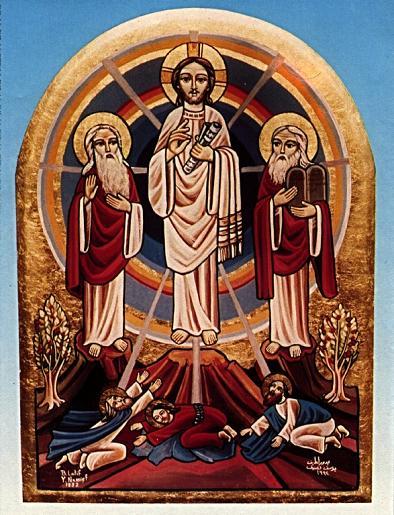
 

How Do He Know?

TransfigurationA reader writes:

At the transfiguration it says that Jesus was talking with Moses and Elijah.  Moses and Elijah have been deceased for a considerable amount of time.  There are no portraits of either man anywhere.  Jesus is still alive, so the Holy Spirit has not descended on the Apostles yet.  So, How was Peter able to recognize that Jesus was talking to Moses and Elijah?

We really can’t do more than speculate on this one since Scripture doesn’t give us the answer, but I can envision a number of possibilities:

1) They heard the figures identified by a heavenly voice; it just doesn’t record this fact in Scripture.

2) The just knew–like in a dream–who the figures were. The fact that the Holy Spirit had not been generally given as he was on Pentecost is not really an issue for this since God can make exceptions if he wants and the Holy Spirit is said to have been active even in the Old Testament prophets; he simply had not bee poured out in the way that he was on Pentecost.

3) They may have had symbols associated with them that identified them. For example, in the icon above Moses is shown holding the Ten Commandments. I know if I saw a vision and there was an old guy with a beard talking to Jesus and he (the old guy) was holding the Ten Commandments, I’d think of him as Moses. Maybe Elijah’s mantle gave him away or (hypothetically) maybe he seemed to descend in a whirlwind or something like that.

4) It says that they conversed with Jesus, so maybe it was made clear from what they said. Perhaps Jesus referred to them by name or perhaps Moses and Elijah made references to things they had done during their earthly lives (e.g., "Back in my day the people were really ornery, too! Why I hadn’t even gotten off the holy mountain before they’d gone and made a golden calf for theyselves!").

Or maybe it was a combinatoin of these. We really can’t say, though personally I’m partial to the just knowing it like in a dream theory, followed by the conversation and symbol theories.

Condoms During Pregnancy

A reader writes:

When pregnant, I have am prone to receiving a type of bacterial
infection that can cause pre-term labor, and my first child was born
several weeks early because of it. 

During my second pregnancy, I read
that many doctors recommend the use of condoms during pregnancy to try
and reduce the transition of the bacteria, because the male germ cells can aggravate
the condition (this is not related to a sexually transmitted disease.)
My midwife recommended this practice as well, although there have not
yet been studies to see if it is effective. 

I solicited opinions on a
Catholic e-mail list as to whether or not the use of condoms during
pregnancy under these conditions would be licit.  I assumed that it
would be.  If I’m already pregnant, I am obviously not trying to
contracept, right? 

I was surprised that the opinion fell the other way,
feeling that the "unitive end" of the marital act would be frustrated if
a barrier were between us.

Could you give me your opinion on the subject?

I can, but let me do so in the below-the-fold section of this post so that people don’t have to look at the discussion who do not want to read it. (I’ll also keep as clinical as I can).

Continue reading “Condoms During Pregnancy”

The Salvation Of Atheists

A reader writes:

Can a sincere atheist get saved? I’m convinced he can, since God won’t punish somebody for not knowing something he genuinely never knew, but it seems to me that his salvation requires that his choice be made after his death, since presumably he never saw the choice while he was alive. I think anybody has to at least say, "God, whoever or whatever you are, forgive my sins and take me to be with you." This lets in Moslems and (I suppose) Hindus and what-have-you — Christ has a long reach —  but the real athesit wouldn’t ever have occasion to say that.

I keep thinking of the bit in 1 Peter 3, where Christ preaches to the "spirits in prison." Since they needed preaching-to, it seems that their consequential decision was not yet made, but there they were in some Purgatory-like situation.

I always agree with Protestants — mostly while discussing Purgatory — that a person is saved or damned at his death, with no second chances, but now I wonder if people who truly never had the occasion to choose God while alive get that choice after they die. I suppose they might each have got a clear sight of it during their lives, and rejected it, but a lot of atheists seem to be completely honest.

The idea that someone at least has to say something like, "God, whoever or whatever you are, forgive my sins and take me to be with you" is found in the book of Hebrews, where we read that

without faith it is impossible to please him. For whoever would draw
near to God must believe that he exists and that he rewards those who
seek him [Heb. 11:6].

Based on this, many have conjectured that belief in God is an indispensible prerequisite for salvation and thus that atheists are damned.

There is a question, thoug, about whether the author of Hebrews means his statement to be an absolute statement about salvation that admits of no exceptions or whether it is meant in a looser sense that could allow some without an explicit belief in God to be saved.

This was a matter of discussion in Catholic theology prior to the Second Vatican Council, but Vatican II seemed to answer that, in addition to Jews and Muslims and others who believe in God, it was possible for people who do not believe in God to be saved:

Nor does Divine Providence deny the helps necessary for salvation to those who, without blame on their part, have not yet arrived at an explicit knowledge of God and with His grace strive to live a good life [Lumen Gentium 16].

"Those who . . . have not yet arrived at an explicit knowledge of God" would seem to include not only members of non-Abrahamic religions but also atheists.

The constitution Gaudium et Spes also stressed the universal possibility of salvation:

[S]ince Christ died for all men, and since the ultimate vocation of man is in fact one, and divine, we ought to believe that the Holy Spirit in a manner known only to God offers to every man the possibility of being associated with this paschal mystery [Gaudium et Spes 22].

The question is: In what way does God offer this possibility of salvation? Is it something that comes to people after this life if they never heard the gospel during it or is it something that comes in this life?

The passage that you refer to in 1 Peter is one that has often been taken as suggesting that there is a kind of second chance after death for at least some people, and it is easy to see why. The passage reads:

For Christ also died for sins once for all, the righteous for the
unrighteous, that he might bring us to God, being put to death in the
flesh but made alive in the spirit;  in which he went and preached to the spirits in prison, who formerly did not obey, when God’s patience waited in the days of
Noah, during the building of the ark, in which a few, that is, eight
persons, were saved through water [1 Peter 3:18-20].

If the preaching that Christ does in this passage is the preaching of the gospel so that they may be saved then it would seem that there is a second chance after death for at least some people (i.e., those who died in the Flood). On the other hand, this may not be what Peter is referring to. He might mean something else. Possibilities could include:

1) The preaching is that the time of release has come. In this case it might be that the spirits who disobeyed in the past–although saved–were held in a kind of purgatorial prison and that now that Christ has died their time of purification is over and they will be going to heaven.

2) The preaching is a bare declaration of Christ’s coming, with no offer of salvation. In this case it would seem to be a vindication of God’s justice and/or mercy in the face of those who refused it. In other words: "God would have saved you from your sins if you had turned to him, as he has now proven by sending his Son to die for the sins of the world. You refused to repent and turn to God, so your condemnation is just."

3) These aren’t human spirits at all and so aren’t subject to redemption. They might be the spirits that Jude refers to as "the angels that did not keep their own position but left their proper
dwelling [and] have been kept by him in eternal chains in the nether gloom
until the judgment of the great day" (Jude 6). Peter might then be linking the non-human spirits with the sins that brought on the Flood. In this case Christ might be preaching to them the fact that he has now come and redeemed mankind, despite their attempt to so corrupt mankind that it would be completely wiped out and destroyed.

In each of these cases, there would be no second chance after death.

Because of the ambiguity in the passage–as well as the general impression that Scripture gives that we have only this lifetime to make our peace with God–it has remained a perpetual conundrum for Bible interpreters.

For its part, the Catholic Church has seen death as the definitive moment at which each must choose for or against God. The Catechism of the Catholic Church states:

Death puts an end to human life as the time open to either accepting or
rejecting the divine grace manifested in Christ [CCC 1021].

I haven’t been able to verify an infallible definition of this point (though there may be one; something in my memory is saying that I’ve seen a claim that there is one, though I’d have to see the original source document to see if this particular point was defined). If there is no definition then it could be possible that there is a post-morten second chance for at least some, but the overall tenor of Catholic theology–with its focus on death as the definitive moment of life–is against it.

It strikes me that it would be easier to account for the salvation of atheists along the lines of an implicit openness to God.

In other words, if an atheist sincerely says to himself, "I want to do whatever is right–that is the controlling axiom of my life; whatever is ultimately true and good, that is what I intend to follow" then this atheist has fundamentally opened himself to God such that if he knew the truth of God’s existence he would believe in and follow God. Due to his circumstance, though, he is unaware that God is what is ultimately true and good.

Thus any atheist who could say, "I don’t think that God exists, but if I was shown convincing reasons to believe that he does then I would go and get baptized immediately and become one of his devout followers" then this person’s heart is such that God will not hold his ignorance against him and will allow him to be saved.

On the other hand, if an atheist says, "Even if there is a God, I’ll still refuse to believe in him and I’ll spit in his face when I die" then this person is toast.

Between the two would be atheists who display some openness to God but who also to one degree or another resist compelling reasons to believe that he exist when they encounter such reasons. These individuals would seem to be in an ambiguous condition. If their openness to believing in and following God is their more fundamental motive then they would be open to his grace and be saved. If their resistance to believing in or following God is their more fundamental motive then they would be closed to his grace and thus lost.

Or that’s how it seems to me.

It’s still a matter for debate.

Identical Twins & Souls

A reader writes:

I’ve been discussing the issue of ensoulment and personhood with some people
and a person brought up an interesting question: When it comes to identical
twins, which come from the same fertilized egg, when do the two souls and
thus the two persons come into existence? 

I was under the impression that
the Church held that God creates each soul at the moment of conception, but
the splitting off of twins suggests that in this case, he might create the
souls later at the point of division.

Or is it possible that he creates two
souls to share the zygote until they split? 

Anyway, I figured you might be
a good person to ask this question.

I thought I’d answered this on the blog before, but Googling my archives didn’t turn it up, so here goes . . .

The soul is the substantial form of the living human body, and so any time you have a new living human body, you have a new soul (the resurrection doesn’t count, since that’s not a new body; it’s a resurrected old one).

It is very difficult to see how a single living human body could have two substantial forms. Indeed, classical metaphysics would say that this is impossible by definition, so I’m not inclined to go that route in explaining what happens in twinning.

Normally a new living human body comes into existence at conception, so that’s normally when the soul comes into existence as well, but the phenomenon of identical twinning indicates that the situation is more complex than that.

It would seem that there are two possibilities. Either

1) Twinning occurs in such a fashion that Embryo A fissions off a new embryo, Embryo B, without losing its identity as Embryo A. (This is analogous to the way in which a Adult A could have a clone of himself made from a skin cell without losing his identity as Adult A.)

2) Embryo A fissions in such a way that neither resulting embryo can be said to be the same entity as Embryo A, so there are two new entities, Embryo B and Embryo C. (Imagine taking Adult A, splitting him down the middle, and regrowing the missing part of the body on each resulting half so that neither resulting individual has a greater claim than the other to being Adult A.)

In case (1), it would seem that Embryo A received his soul at the time of conception and Embryo B received his soul at the time he fissioned off from Embryo A since that was when Embryo B’s body came into existence.

In case (2), it would seem that Embryo A received his soul at conception and that Embryo A was a short-lived individual who died when he fissioned into Embryo B and Embryo C, both of whom received their souls at the point of fissioning.

Now, just for the sake of completeness, let’s talk about the opposite of twins: chimeras.

As before, there are two scenarios:

3) Chimerism occurs in such a fashion that Embryo A is so large that it absorbs Embryo B without becoming a fundamentally different entity. (This is analogous to Adult A having a heart or kidney transplant from another adult; the minor addition of cells from the other adult does not turn Adult A into a fundamentally different person.)

4) Chimerism occurs when Embryo A and Embryo B merge in such a way that the resulting entity is neither one of them but is a fundamentally new entity, Embryo C. (This is kinda like the Tuvix episode of Star Trek: Voyager, only on the cellular rather than the DNA level.)

In the case of (3), Embryo A received his soul at conception and continued in existence. Embryo B also received a soul at conception but then died when he was absorbed by Embryo A.

In the case of (4), Embryo A and Embryo B both received their souls at conception and both died when they fused into Embryo C, who received a soul at the point of fusion.

If you want to be extra complete, you can posit the case of identical twins who then fuse to become a (genetically undetectable) chimera, and you can run the combinations on that one yourself, them being a combination of scenario (1) or (2) with scenario (3) or (4).

You could also think about what would happen if a chimera then twinned. Or if twins chimerized and then twinned again, etc. It’ll all just be combinations of (1)-(4), though.

Because of difficulties in determining when a new individual has come into existence, it could be hard or impossible to distinguish between scenario (1) and (2) or between scenario (3) and (4)  in practice, but these would seem to be what is happening, even if we cannot make the determination in a particular case due to the limits of present doctrinal development on the subject of individual identity.

I’ve Been Book Memed

Georgette of Chronicle of a Meandering Traveller has hit me with a book meme, so here goes:

1. One book that changed your life:

THE NEW TESTAMENT DOCUMENTS: ARE THEY RELIABLE? by F. F. Bruce This book helped me, as a very young and liberal Christian, learn to take the New Testament seriously and thus turned me toward Christian orthodoxy.

2. One book that you’ve read more than once:

THE
CASE OF CHARLES DEXTER WARD by H. P. Lovecaft

3. One book you’d want on a desert island:

THE
WORST-CASE SCENARIO SURVIVAL HANDBOOK by Joshua Piven and David Borgenicht

4. One book that made you laugh:

THE
HITCHHIKER’S GUIDETO THE GALAXY by Douglas Adams

5. One book that made you cry:

Sorry. That’s private.

6. One book that you wish had been written:

ST. PAUL ANSWERS MY QUESTIONS: AN INTERVIEW ACROSS TIME by Jimmy Akin

7. One book that you wish had never been written:

THE QUR’AN by Muhammad.

8. One book you’re currently reading:

THE
ANUBIS GATES by Tim Powers

9. One book you’ve been meaning to read:

CHRIST
THE LORD: OUT OF EGYPT by Anne Rice

10. One book that you bought but haven’t read:

THE
SEMANTICS OF BIBLICAL LANGUAGE by James Barr

Per my usual meme-mutation policy, I hereby meme anybody who wants to be memed.

READ GEORGETTE’S ANSWERS TO THE MEME.

ED PETERS ALSO GIVES HIS.

More On Embryo Adoption

A reader writes:

I’m one of your blog readers, and I’ve got a dilemma/question.  You recently
posted your thoughts regarding the issue of adopting frozen embryos.  You
pointed out that the Church has not taken a formal stand on the issue as of
yet.  A lively discussion ensued in the combox.  My wife and I had one
lovely daughter using this method.  Since the birth of our daughter, we have
converted from evangelicalism to Catholicism, and want to submit ourselves
to the teachings of the Church in this (and all) matters.  We are
contemplating attempting the procedure again, and have reserved a set of
embryos in preparation. 

My wife has raised a potential moral concern that I
have not seen addressed anywhere.  Part of the transfer process involves
drugs that regulate a woman’s cycle for several months prior to the
transfer, in order to be able to transfer the embryos at the woman’s most
fertile time. 

My wife argues that these drugs are technically a form of
birth control, since they prevent pregnancy until the time of transfer.  She
thus believes that taking these drugs as part of the process would be
illicit. 

I have countered however that even if the doctor would agree to an
unmedicated transfer (unlikely), this might reduce the chances that the
embryos would implant, leading to their demise.  The good that could be done
(providing the best chance for the embryos to live) outweighs any potential
evil from the short period of "birth control". 

Further, since we are
infertile anyway (unfortunately, I am sterile), the fact that she may
receive drugs that would act in a contraceptive manner is moot.  I argue
that the intent of the Church’s ban on birth control is not a problem with
the chemicals themselves, but rather that the Church doesn’t want to inhibit
the potential of conception.  Since we can’t have children anyway, that
isn’t an issue. 

My wife counters that God could work a miracle by curing my
sterility, and we shouldn’t hinder that possibility by even a short period
of possible contraception.  I then counter that she’s being too idealistic .
. . We are meeting with the doctor soon, and need to make a decision.  Would
you care to comment on this issue?

I’ll be happy to provide what insight I can.

First, as you note, the Church has not made a determination of the moral status of frozen embryo adoption and there are orthodox Catholic moralists on both sides of the issue. Until there is an official determination, individuals may pursue their own conscience regarding the morality of the action provided they do not violate other, established principles in the process. This does not mean doing whatever you want, though. It means doing the best to inform your conscience on the matter even in the absence of a Church declaration (e.g., reading arguments for and against the relevant positions, doing a novena if the reading doesn’t convince you one way or the other, etc.)

What you’re asking here is whether there is another established principle–i.e., that contraception is immoral–that would be violated by doing the procedure in the proposed way.

While you are correct that saving the lives of the embryos is a very grave matter, one should not think in terms of this good outweighing the evil of contraception. Contraception is one of those things that is always and intrinsically wrong and is not permissible no matter what the circumstances. It cannot be done as an end in itself, nor can it be done as a means to a good end–even a very good one.

That said, there is the question of whether the use of hormones to regulate your wife’s fertility cycle would constitute contraception in this case.

In the Church’s official documents (starting with Humanae Vitae, though the passage is also quoted in the Catechism of the Catholic Church, number 2370), contraception is defined as:

every action which, whether in anticipation of the conjugal act, or in its accomplishment, or in the development of its natural consequences, proposes, whether as an end or as a means, to render procreation impossible

From this definition, it would appear that the use of hormones to regulate a woman’s cycle in order to facilitate implantation does not involve contraception.

It is true that, by regulating her cycle, there will be infertile periods, but these periods are not being created in order "to render procreation impossible," which is a sine qua non of contraception. If you’re not trying to render procreation impossible, what you are doing is not contraception. It’s something else.

Such non-contraceptive use of hormones can, however, have a contraceptive effect. This is the case with women who use hormones to treat a medical condition and the hormones simultaneously prevent them from getting pregnant. Such usage is permitted under the law of double-effect as long as the usual conditions for this law are satisfied (e.g., the contraceptive effect is not an end in itself, the contraceptive effect is not a means to the therapeutic end, the condition being treated is serious enough to endure the contraceptive side-effect, there is not a better treatment for the condition). Some debate whether couples should have intercourse during such treatment due to increased possibility of miscarriage, though this is something that the Church has not yet addressed one way or the other.

In your case, the use of hormones to regulate your wife’s cycle in order to achieve pregnancy would not be contraceptive. It would create infertile periods, but these are undesired and the fact that you are infertile renders the question moot. Catholic moral theology would not hold that it is necessary to withhold medical treatment in this area in hope of the miraculous happening any more than it would be necessary in any other area to withhold medical treatment in hope of the miraculous happening.

Some moralists might disagree with elements of the reasoning above but, since the Church has not yet addressed the matters at hand, we are left to try to figure out such matters for ourselves, informing our consciences as best we can by reading different perspectives on the matter, weighing the arguments they use, entrusting the matter to God in prayer, and then following our best determination.

Hope this helps!

20


Valid Scapular Enrollment?

A reader writes:

A friend of mine recently asked a question on a web message board.  Because you are the master of all rules, laws and technicalities, I was hoping you might be able to answer this question

I decided to ask a priest to enroll me in the brown scapular. Here’s what happened:

If anyone is familiar with the enrollment prayer, the priest must bless the scapular itself once, and the person wearing it twice (at separate parts of the prayer). The priest jumped over blessing the second time:

V. By the power granted to me, I admit you to a share in all the spiritual works performed with the merciful help of Jesus Christ by the religious of Mount Carmel. In the name of the Father and of the Son and of the Holy Spirit. (Make the sign of the cross)

At this point the priest said the right words but failed to make that sign of the cross over me (although I did it myself). So how specific is this priestly enrollment prayer? Am I enrolled and being paranoid? Or should I have it re-enrolled?

So, just what is it that makes an enrollment valid?

The brown scapular is a sacramental rather than a sacrament. As a result, it works the way the Church intends it to work. Unlike the sacraments, it does not have an essential form and matter that has been passed down to us from Jesus Christ, so the Church is free to establish whatever requirements for enrollment in it that the Church wants.

If you read the text of the enrollment, it does call for the sign of the cross to be made at three points, but the Church has not said that the sign of the cross is essential for validity. Indeed, the sign of the cross gets made in all kinds of ceremonies without affecting their validity one way or the other. In Mass, for example, the sign of the cross is made several times, but if the priest omits it, it does not serve to invalidate the transubstantiation of the Eucharist in Mass. The sign of the cross is a reverent action that is called for in the Mass, but it is not required for validity. The same is true of the other sacraments. In none of them, even though the sign is called for, is it part of the essential matter or form of the sacrament and so omitting it (e.g., anointing a sick person by just dabbing them rather than signing them) does not affect validity.

If something isn’t essential for validity in the sacraments then, unless the Church specifically indicates otherwise, it isn’t going to be necessary in a sacramental, either. Based on the example that the Church sets with the use of the sign of the cross in the sacraments, we should understand its use in the sacraments in a similar light. Thus unless, in the case of a particular sacramental, the sign of the cross is indicated to be essential then it should be regarded as non-essential.

The Church does not intend the sacramentals to be contingent on the performance of minor details since the Church knows full well that priests and lay people will mess things up, and it doesn’t want people scrupuling about this. As long as the essential core of the rite is performed, that is what counts.

In the case of the brown scapular enrollment, the essential part of the rite for enrollment is the words quoted above: "I admit you to a share in all the spiritual works performed with the
merciful help of Jesus Christ by the religious of Mount Carmel." If the priest says that then the person is enrolled. It’s what’s known linguistically as a performative utterance since the uttering of the words performs the act in question. A more commonplace example of a performative utterance would be "I invite you to my party"–by saying it, you do it, and by saying "I admit you" the priest admits the person.

The added element "In the name of the Father, and of the Son and of the Holy Spirit" (during which the sign of the cross is called for) thus seems to be a qualifier that expresses the spirit in which the admission is done, but it is not essential for the admission itself to take place. What’s essential is the "I admit you" with an indication of what the person is being admitted to.

As long as the priest said those words–or words with equivalent meaning–the person has been admitted and does not need to be re-enrolled.

Hope this helps!

Greek New Testament . . . No Imprimatur

A reader writes:

I’ve been reading your blog occasionally and have noticed that you seem to be knowledgeable in a variety of areas (not just in apologetics),

Naw, I’m just curious about . . . y’know . . . stuff.

so I thought I’d ask you a question I’ve been having trouble getting answered elsewhere.

Okay, shoot!

I’m thinking of studying Greek in order to read the New Testament in its original language.

Good for you! I recommend William Mounce’s Basics of Biblical Greek as a starting point.

However, so far as I know, there are no editions of the Greek New Testament currently available that have ecclesiastical approval.

Yeah, I don’t know of any, either.

What are the Church’s regulations for reading/studying non-approved editions of Holy Scripture? Canon 825, §1 seems to indicate that it’s not permitted, but I’m not sure.

Ah, actually the canon you cite does not prohibit reading or studying such Scriptures. Here’s the canon in question:

Can. 825 §1. Books of the sacred scriptures cannot be published unless the Apostolic See or the conference of bishops has approved them. For the publication of their translations into the vernacular, it is also required that they be approved by the same authority and provided with necessary and sufficient annotations.

§2. With the permission of the conference of bishops, Catholic members of the Christian faithful in collaboration with separated brothers and sisters can prepare and publish translations of the sacred scriptures provided with appropriate annotations.

As you can see, the canon places the legal burden on the publisher of a book of sacred scripture. It is the publisher of the volume, not the reader, who has the responsibility to make sure that the needed approval is gathered (assuming it’s a Catholic publisher to begin with; Catholics are not bound by canon law).

For a reader, there is no prohibition on reading material that has not been granted ecclesiastical approval. There is a general moral requirement that one not read material that would be damaging to one’s faith or morals, but I am unware of any editions of the Greek New Testament that would do that. Not even the Jehovah’s Witnesses, as far as I know, have had the chutzpah to alter the original Greek text (though they have laced it up with erroneous glosses).

There really isn’t that much difference between different editions of the Greek New Testament, and what differences there are tend not to cut across confessional lines. It’s not like there’s a "Catholic Greek New Testament" versus a "Protestant Greek New Testament." The differences concern mostly minor manuscript variations that are neither Catholic nor Protestant.

For this reason, Catholic scholars tend to use the same editions of the Greek New Testament as Protestant scholars, notably the Nestle-Aland/United Bible Societies text, which is considered one of the better critical editions, though the differences between this and other editions are very small and would not be of concern to a person just learning the language.

The absence of confessional differences in the text of the Greek New Testament is one of the reasons that it’s hard to find an edition that has been given ecclesiastical approval. There may be some, and I did some poking around online looking, but I haven’t found any.

My advice would be to use any edition of the Greek New Testament that comes to hand. As a tool for learning the language, that’s all you really need.

And, as I said, I’d use Mounce if possible as an intro text.

Good luck!

Blog Day Off

I’m sorry, but I’m afraid I’m going to need a blog day off today.

This morning I received word of the unexpected death of a friend (not a person who I’ve mentioned on the blog before;  they’re all fine) and when I got home last night I was still absorbing the shock and didn’t have the emotional energy to write blog entries for today.

Blog service should resume tomorrow.

Thanks for understanding.