In The Mail

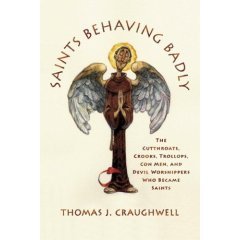
Saints_behaving_badlyI recently received an advance copy of a book called Saints Behvaing Badly by Thomas Craughwell and I’ll offer my thoughts on it soon, after I’ve had a chance to go through it.


The book looks at the human side of saints–the side that is often diminished or dimmed in pious saint stories.

The fact is that the saints were often human, all too human as the phrase goes, and while some might consider it impious to point this out (and while it would be impious to dwell on it obsessively), it also can be inspirational to realize that the saints were indeed imperfect but nevertheless were able to overcome and display heroic virtue.

In that sense, looking at the imperfections of the saints can play a useful and encouraging role for those of us whose salvation is not yet won.

In the meantime,

CHECK OUT THE BOOK.

Sounds From Hell

A reader writes:

What is the church teaching on location of hell and the duality of it Abraham’s bosom vs. hell fire.

I am curious because I recently came across some audio claiming to be the sounds of hell emanating from a 9 mile dig in Siberia". I am also wondering what you could tell me about this story and any of the others I mentioned.

I have surfed and read numerous sites opinions and even heard that we,  the Americans have a similar story form the 60’s. Then I read about Jacques Cousteau hearing screaming voices coming from beneath the seabed of Cuba.

I also recently learned of the deep sea worms that were discovered living in 180 plus degree tempereatures and read about what Jesus said "where their worm dieth not, and the fire is not quenched" (Mark 9:43-48).

Finally I read about the "paradise" side of hell, Abraham’s bosom and then fire and brimstone Hell.

The Church allows a great deal of liberty in the interpretation of Scripture. For the vast majority of passages–including the parable of Lazarus and rich man (the one mentioning Abraham’s bosom)–the Church basically allows one to interpret the text in the way one feels that the evidence best supports, as long as one does not contradict a doctrine of the faith.

While stories about hearing what sounds like sounds of hell are scary and interesting to think about, I find it very unlikely that there is any truth to them, for several reasons:

First, departed souls don’t have physical form and thus would not naturally be able to make noise. No body, no throat, no lungs.

Second, the depiction of hell as "down" in Scripture is a metaphor. Hell isn’t really "down" any more than heaven is "up." The two are not physical places in this universe. You couldn’t go to heaven with a space ship or to hell with a backhoe. Heaven and hell are depicted as inaccessably high and inaccessibly low because they are places that are inaccessible to humans–we can’t physically go there in this life–and so Scripture metaphorically uses inaccessible places (up in the sky, under the earth) to depict where they are.

(Incidentally, note that though the two places are not in this universe, they can receive physical bodies–for the saved and the damned will have their bodies after the resurrection, just as Jesus and Mary do in heaven now.)

Third, if you think about the physics of sound (i.e., acoustics) then it would quickly be clear that voices don’t penetrate rock and earth very far. Even if you had a lot of voices, they wouldn’t be able to penetrate rock and earth very far at all as recognizable screams. That’s one reason we can’t find trapped miners that easily and can’t hear them until the material trapping them is very thin. Consequently, it is unlikely that Jacques Cousteau could detect the sounds of screaming under the ocean floor unless hell was very, very close to the surface.

Same thing goes with voices from holes in the ground. Voices–particularly recognizable screams–just don’t travel that far. Hell would have to be very, very close to the Earth’s surface.

We’ve done so much exploring that, if hell really were a physical place close to the Earth’s surface then we would have found it by now. Consequently, if you hear voices shouting from a hole someone has dug in the ground you should think "trapped miners" or something like that, not "damned souls."

About the imagery of fire and worms connected with hell, this is an extension of picturing it as "down" and a place of suffering. People in ancient Israel buried their dead, and they knew that worms get involved after burials (given the fact they didn’t have hermetically sealed coffins back then, or even coffins at all), and so it was natural to picture worms as one of the torments of the damned.

Similarly, being burned by fire is about the most intense torment that a human of the ancient world could imagine (since they didn’t know about sinking electrodes into the brain’s pain reception center), making it a fitting symbol of the natural of the ultimate torment of damnation.

I couldn’t rule out the idea that there is some role for the fact that if you go down deep in caves that it starts to get hot (due to the magma inside the Earth) in the development of this imagery, but I think by far the larger role is just the fact that being burned by fire is the most intense form of torment the ancients knew.

As to the relationship of paradise/Abraham’s bosom to hell, you should be aware that the terms for hell in Scripture do not (most of the time) pick out the unique place of the damned. In the Old Testament the word is sh’ol (not SHEE-ol!) and it just describes the place of the dead, both good and bad. Same thing with the Greek word hades. Even the English word hell originally just meant the place of the dead, not the place of the damned.

Because these words were used as a catchall for the place the dead went, it was presumed that the righteous dead were comforted in sh’ol/hades, while the unrighteous were being tormented there. That’s the background to the parable of Lazarus and the rich man, where both Lazarus and the rich man are in the land of the dead but are experiencing different fates: Lazarus is apparently at a banquet with Abraham and is leaning against his bosom (the was John leaned against Jesus’ bosom at the Last Supper; the ancient Israelites ate dinner reclining at a low table) while the rich man is being tormented across a gap of some kind.

Since Christ has now opened the gates of heaven to the dead, the righteous dead are in a glorified state now that goes beyond the comfort they had previously, though what this means in terms in terms of how they are spatially related to the damned is something we can’t say–or possibly even imagine–at this point.

Three Days To Never

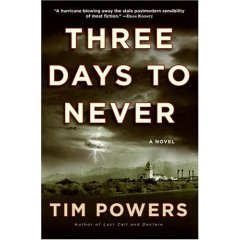
ThreedaystoneverI finished Tim Powers’ new book, Three Days To Never, and I really liked it!

The story centers on a mild mannered English teacher (patterned after Tim himself) and his young daughter. The year is 1987, and the New Age "Harmonic Convergence" of that year is underway. The New Agers come in for a good bit of ribbing from various characters in the novel but–unbeknownst to anybody, including the New Agers themselves–the event causes a slight disruption of world affairs in a hidden, unseen way.

While that’s happening in the background, the English teacher and his daughter are trying to make sense out of a family tragedy: The teacher’s creepy grandmother has just died, leaving him a creepy and mysterious message about what she did and what can be found in the "Kaleidoscope shed" out back of her house.

Y’know, the kind of shed where you carve your initials into the wooden wall and then later they aren’t there?

When they enter the shed, the teacher and his daughter find that the grandmother used the shed to hold TV, a VCR, a video cassette of Pee-Wee’s Big Adventure, and a plaster block with the hand and footprints of Charlie Chaplin, which she stole from in front of Hollywood’s Chinese Theater. What do they have in common? What was she using them for? Why does the teacher’s long-lost father show up after so many years? How does Albert Einstein fit into all this? Why is the Israeli intelligence service–the Mossad–so interested in what’s happening? How about the rival group that used to have ties to Hitler? Or the blind assassin? And what about all those babies lying in the snow, waving their arms and legs for a few seconds before they mysteriously vanish?

To find out the answers to these questions, you’ll have to

GET THE BOOK!

(Incidentally, you’ll note that I’ve linked to a page in my new store, where you can buy other of Tim’s books, as well as other fine quality works.)

I found that the book was a very quick and enjoyable read for me. The plot proceeds at a swift pace, and there are nice elements of humor and irony as we proceed to keep a sense of whimsy in what is, essentially, a supernatural spy thriller.

Once I got past some of the major plot point (which I won’t spoil here), I found the book contained a very powerful statement about free will. I found myself liking and appreciating the characters, even the ones who weren’t on the right side (some of them, anyway), and about at least some points in the novel, I found myself contemplating, "Just how much of this goes on in real life?"

So: This book is enthusiastically recommended! Don’t miss it!

Now a few notes:

1) For those who have already read it, please keep the spoilers to a minimum in the combox. We don’t want to give away any of the big surprises (none of which I’ve touched) and spoil people’s fun.

2) Content advisory: Infrequent occurrence of a few cuss words and
one scene where a woman thinks back about her sexual history, but no
on-screen activity.

3) Stay tuned, because later this week I’ll be running an interview that Tim Powers graciously consented to give exclusively to the readers of JA.O!

4) Since I’m putting this up on Labor Day, it’ll be my only post for the day. Order the book and then go have fun!

Eggs Pope Benedict

Eggspopebenedict

While wandering the Web sniffing out something to blog about, my nose latched onto an aroma of eggs. Curious, I checked it out. Apparently, in the wake of Pope Benedict XVI’s election, some people were having a bit of good-natured fun with the new pope’s chosen name.

Behold the breakfast of popes: Eggs Benedict XVI.

(Nod to Chew Toys for the image. And speaking of Chew Toys, I must say that I enjoyed this blogger’s blog squib from Despair.com: "Quitters never win, winners never quit, but those who never win and never quit are idiots.")

Benedict XVI, when he was Joseph Cardinal Ratzinger, once said that "humor is in fact an essential element in the mirth of creation. We can see how, in many matters in our lives, God wants to prod us into taking things a bit more lightly."

Given the Pope’s great appreciation for humor, I think he’d also smile over the papal eggs. And then, after saying grace, I’m sure that he’d eat them.

The Telling Of The Beads

Oldrosary_1

Rosaries have a long and interesting history. They have evolved over the centuries from the earliest days when people used a bowl of loose pebbles to count their prayers to the form in which we have them today. While doing some research on the rosary, I found some interesting links on the history of the rosary.

(For more links than it is possible to include here, I recommend going to Google and searching on key words such as "history rosary.")

  • A blog devoted to early rosaries is titled, appropriately enough, Paternosters. The blogger, Chris Laning, describes the blog as "a journal about historical rosaries, paternosters and other forms of prayer beads, focusing on those in use before 1600 AD [sic]."
  • Laning also maintains a web site devoted to historical rosaries titled Paternoster Row, which is the name of a street in London where a craftsmen guild of rosary makers used to ply their trade (source).
  • Kevin Orlin Johnson has a book on the rosary that looks quite intriguing. It is titled Rosary: Mysteries, Meditations, and the Telling of the Beads.

A few years ago after John Paul II promulgated the luminous mysteries of the rosary, I wrote an article on the subject titled "Light for the World." It is now online at Catholic Answers’ web site.

GET THE ARTICLE.

AND THE SIDEBAR (which has some information on the history of the rosary).

While the rosary is not one of my favorite personal devotions, as a history buff I am fascinated by its history as both a prayer and an art form.

Whatta Maroon!

Man! I read what had to be the stupidest editorial I’ve read in some time yesterday.

It appeared in USA Today, and the headline I saw it under (though not the actual headline when I clicked on it) was "The Seductive Mythology of the Blogosphere."

"Okay," I thought. "Perhaps it’ll be a critique of the blogosphere that has something valuable to say."

NOT!

The author–someone named Bruce Kluger–seems to be one of the most insular, perspectiveless individuals I have seen commenting on the blogosphere, and he writes a triumphalistic piece about how the blogospher ain’t all it’s cracked up to be because (are you aready?) "the bloggers" got Joe Liberman denied the Democratic nomination yet "the bloggers" aren’t likely to be able to keep him from retaining his seat in the Senate, thus proving "the bloggers" relative impotence when it counts.

Oh yeah, and the blogosphere also ain’t all it’s cracked up to be because the movie Snakes on a Plane didn’t perform better than most horror movies, despite "the bloggers" best efforts to promote it.

Excuse me, but where has this guy been?

He must be reading a rather polarized selection of blogs if he can speak of "the bloggers" as if they were monolithic supporters of the effort to deny Liberman the Democratic nomination. He’s acting as if the Kos Kidz and their ideological ilk are the whole of the blogosphere, but there were countless conservative bloggers out there arguing that it was a boneheaded move it was for the nutroots to go after Liberman when he was virtually sure to retain his seat. It would only make the Democratic Party look more extreme to the public and potentially alienate Liberman at a moment when the Party needed him particularly badly.

Whatever else may be said about this matter, the blogosphere was not trying to oust Liberman. One segment of politically liberal bloggers was trying to do so, but Mr. Kluger is apparently so myopic that he confuses a single copse of trees for the whole Amazon rainforrest.

Same thing goes–and probably moreso–for his ridiculous argument that the blogosphere couldn’t boost Snakes on a Plane into blockbuster status. There was no monolithic blogosphere effort made here, either.

Now, it’s quite true that the blogosphere has limited power (albeit the power to topple a Dan Rather or to smoke out a "Secret Senator" trying to kill legislation that would allow greater public scruitiny of government waste). The fact is that most people aren’t bloggers and that most people don’t (yet) read blogs on a regular basis. Those points are quite fair.

But to speak as if the blogosphere was a monolithic entity that acts concertedly–as opposed to simply a community of people with widely divergent ideas, interests, and ideologies–is simply reflective of the most blinkered, uninformed journalistic stereotyping imaginable.

I know the press loves simple stereotypes that it can pour people into, but this is simply unconscionably bad journalism.

The irony is that Mr. Kluger himself is a blogger–at least some of the time–at the HuffingtonPost.

If this is the kind of ideologically bubble-bound, "my circle of friends represents the whole universe" low-wattage analysis that goes on at HuffPo then . . . maybe that’s why I don’t read HuffPo.

And maybe it should have rammifications for my willingness to click on USA Today editorials as well.

Memento Mori

Francis_1

"Remember, O man, that you are dust and to dust you shall return." –Ash Wednesday liturgy

A few weeks ago, Jimmy mentioned the unexpected death of a friend. This person was also a friend of mine and a colleague here at Catholic Answers. Let’s call him T. Although T. had been ill for quite a while, his death came as an unexpected shock. I had known him for over five years and had worked closely with him for several of them. His death was particularly difficult for me since he and I had had a couple of meetings earlier in the week before he died and it was stunning that it seemed that he was there one day and gone the next.

In the weeks following T.’s funeral, another colleague who was quite close to T. was allowed by T.’s survivors to go through T.’s apartment and collect any religious items that he thought might find a good home with Catholic Answers’ staff members. When the announcement was made that the items were available in the library for the taking, I hotfooted it over to see if I could find something by which to remember T.

What caught my eye immediately was a large handsomely-framed print of the painting you see on the left side of this post.  (You can click on the image to enlarge it.)  To me, it appeared to be a monk holding a jar. Since it was a rather large picture, I wasn’t sure if I wanted it but I took it back to my office to decide. I figured that I could always return it to the library if need be.

The back of the print said that it was a painting of St. Francis of Assisi by the seventeenth-century Spanish painter Francisco de Zurbaran, a master from Spain’s Golden Age. A colleague in the next office who came over to look at it pointed out that St. Francis wasn’t holding a jar; he was holding a skull! Right away then I knew that this was a painting from the memento mori genre, an artistic genre in which the subjects are intended to remind the viewer of death.

Some research on the painting revealed that De Zurbaran was very interested in the memento mori genre and did more than one painting of his namesake saint contemplating death.

CLICK HERE FOR IMAGES.

It might seem strange to think of St. Francis of Assisi contemplating death.  In the popular imagination, he is a happy-go-lucky friar who liked to preach to birds and commune with nature.  In the minds of some, he might even be considered a prototype for the radical Sixties hippies.  But St. Francis himself would not have considered it strange for an artist to portray him in such a seemingly "morbid" manner.

"May Thou be praised, my Lord, for our sister, bodily death,
whom no man living can escape.
Woe to those who die in mortal sin:
blessed those whom she will find in Thy most holy desires,
because the second death will do them no evil."

The quote above is taken from St. Francis’s Canticle of Brother Sun.

Once I realized what I had, my decision was made. There could be no more significant memento of T., one that would remind me of him and remind me of the ephemeral nature of this life and the need to be always prepared for the next.

Please take a few moments and pray for the repose of T.’s soul and for the final perseverance of all who will die today.

"Watch therefore, for you do not know on what day your Lord is coming. … Therefore you also must be ready; for the Son of Man is coming at an hour you do not expect" (Matt. 24:42, 44).

The Martyr’s Dilemma

A reader writes:

Can you address the Church’s position on forced conversions in light of the Fox reporters  who were forced to convert to be released?  Would I condemn myself if I did something like that in similar  circumstance?  Would martyrdom be my only choice?

This is a situation that many Christians have faced in world history–ever since the first century–and many still face it today. In fact, the 20th century was an unprecedented time of Christian martyrdom.

The fundamental parameter governing the moral evaluation of convert-or-die situations was provided to us by Jesus Christ himself:

So every one who acknowledges me before men, I also will acknowledge before my Father who is in heaven; but whoever denies me before men, I also will deny before my Father who is in heaven [Matt. 10:32-33].

The context here is specifically that of persecution being used to bring about denials of the Christian faith:

Beware of men; for they will deliver  you up to councils, and flog you in their synagogues, and you will be dragged before governors and kings for my  sake, to bear testimony before them and the Gentiles.

Brother will deliver up brother to death, and the father his child, and
children will rise against parents and have them put to death; and you will be hated by all for my name’s sake. But he  who endures to the end will be saved [vv. 17-18, 21-22].

The principle is that denying Christ in the face of persecution is a grave sin and thus if done with adequate knowledge and consent it will be a mortal sin. Whether or not a particular person mortally sins in such a situation thus depends on the amount of knowledge the had of the sinful character of this act and the question of how deliberately they chose it. 

In cases of persecution, the extreme fear or pain (as in the case of torture) that a person may be under may deprive him of adequate consent and thus we cannot be sure, in any particular case, whether a person who denied the faith committed a mortal sin. We may thus always hope for the salvation of those who denied the faith under duress.

The Christians in the early centuries often faced persecutions and devoted quite a bit of though to the subject of what one’s responsibilities are if a persecution begins. Their writings devote significant attention to this question.

It was decided, for example, that if a ruler begins a persecution that Christians are not required to turn themselves in. (It was also found that those Christians who did turn themselves in to the authorities were often the first to crack under pressure because they had done so in a momentary fit of zeal that did not reflect a stable attitude of mind.)

The non-obligation to turn oneself in may be seen in Jesus’ statement from the same speech quoted above:

When they persecute you in one town, flee to the next [v. 23].

Christians therefore can legitimately avoid the occasions of persecution. They don’t have to boldly go down to the local persecutor’s headquarters and start preaching. It is legitimate for them to do what they can to avoid persecution as long as they do not deny the Christian faith.

In subsequent centuries, further theological reflection has elaborated what is and is not required in disclosing information about oneself, and the Catechism explains that:

The right to the communication of the truth is not unconditional. Everyone must conform his life to the Gospel precept of fraternal love. This requires us in concrete situations to judge whether or not it is appropriate to reveal the truth to someone who asks for it.

Charity and respect for the truth should dictate the response to every request for information or communication. The good and safety of others [or oneself–jimmy], respect for privacy, and the common good are sufficient reasons for being silent about what ought not be known or for making use of a discreet language. The duty to avoid scandal often commands strict discretion. No one is bound to reveal the truth to someone who does not have the right to know it [CCC 2488-2489].

If, therefore, a Muslim terrorist has kidnapped you and is threatening to kill you if you are a Christian and insist on remaining one, you would be morally able to use silence, misdirection, and mental reservations to protect one’s life. One can never deny the truth–that Jesus Christ is the Son of God–but one can use morally legitimate means to preserve one’s life as long as the truth is not denied.

This does not mean, however, that the use of these means is obligatory. A person will win for himself a very large martyr’s crown if he tells the terrorist, "I am a Christian and I will not deny my Savior no matter what you do."

A person who resorts to legitimate silence or discreet speech to avoid death will not win that crown, but he will not commit mortal sin either.

What forms of silence and discrete speech are legitimate will depend on the specific questions that the terrorist is putting to one and would have to be evaluated on a case-by-case basis.

It is good not to spend too much time imagining what we ourselves would do in such situations and worrying about whether our response would be adequate. The reason for this is that we do not now have the graces that God would give us in such a situation. Grace is frequently delivered in a just-in-time manner, and God will be sure to give us graces when we are being travely tested that we do not currently possess.

Thus St. Paul tells us that God will always provide a way for us to bear up under temptation (1 Cor. 10:13), and Jesus himself–again in the Matthew 10 discourse–says that when faced with persecution,

When they deliver you up, do not be anxious how you are to speak or
what you are to say; for what you are to say will be given to you in
that hour; for it is not you who speak, but  the Spirit of your Father speaking through you [vv. 19-20].

If this applies to those who have been delivered up to hostile authorities, it applies even more to those of us who are not presently faced with the situation. The thing to do, then, is not to worry about what would do. It is to resolve now that we will trust in God to give us the grace then to get through the situation.

The same thing, incidentally, applies to any case where we are spending time worrying about whether we might crack under pressure and give in to sin in the future: Resolve now to rely on God to get you through it then and don’t allow yourself to be anxious.