And Then There Were Two

Nametag2Recently I did a post about square dance "dangles" and how I had just received my first one.

For those who may not have seen that post, dangles are small items hung from a dancer’s nametag that signify various things, such as offices the person holds or has held, special dances that the person has attended, or just things that the person finds fun. The latter are known as "fun dangles."

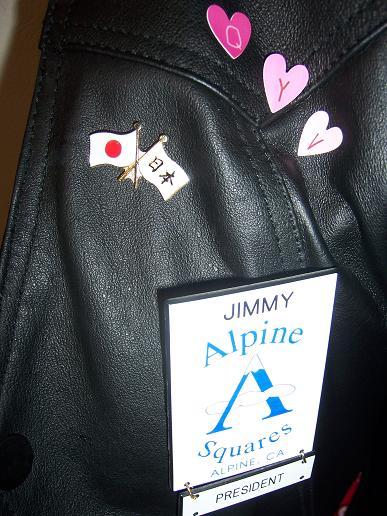
Sometimes pins are used for the same purpose, and I recently received a pin (pictured), which now also adorns the vest I wear when I’m dancing.

The occasion on which I received it was a recent International Friendship Dance that was held here in San Diego between local American dancers and a group of dancers from Japan.

Some of the Japanese dancers were giving out pins to commemorate the event, and I was lucky enough to receive one. The pin has two flags on it, one of which says (in Japanese) "Nippon," which is the Japanese word for Japan, and the other of which is the Japanese national flag.

It was a very well attended dance. We had almost fifty squares (a square is eight people) crammed into the auditorium. The room was so packed that squares were jammed right up against each other, and there were even squares dancing in the foyer to relieve a bit of the pressure.

Most of the dancers, of course, were Americans, but at least three squares were visitors from Japan. The local Japanese dancers who live in San Diego (there are several) were also there, and it was nice seeing them serving as a bridge between the two dance communities.

Most of the dancers didn’t speak each others’ languages, but some did, and I got a chance to practice a little of my Japanese (which is very rudimentary), saying "Kon ban wa" ("Good evening") and "Sumimasen" ("Excuse me") and things like that, to the delight of the Japanese folks I was dancing with.

There were three callers at the event, all of them with international reputations: Ken Bower of California, Bob Baier of Texas, and Mac O’Jima of Japan.

Before the dance I was curious to see how well the two groups would be able to dance together. I knew that when Modern Western Square Dancing is done in other countries (and it’s done in quite a number of them!) it’s always called in English, so in theory the two groups should be able to dance together, but one can never be certain.

It turned out that everything worked just fine. The Japanese dancers had no problem following calls from the American callers, and Mr. O’Jima’s English was exceptionally good. He had a little L/R blur in his accent (to be expected since Japanese doesn’t have the distinction, just like English doesn’t distinguish between two P sounds that–say–Hindi does), and I noticed he had a little singular/plural issue since Japanese doesn’t inflect words for this either (thus he’d say "Join all your hand and circle to the left" instead of "Join all your hands and circle to the left"), but his English–including his accent–was really, really good. At times, his accent sounded a bit Scottish to me, and I wondered if his English teacher was from Scotland or somewhere in the British commonwealth.

Mr. O’Jima also complimented my pronunciation of Japanese, FWIW.

All three of three of the callers were outstanding. Ken Bower and Bob Baier related a story about when the two of them had visited Japan for a friendship dance over there, and some confusion had arisen over Ken’s name. At one point (if I have this right), someone said "Kon ban wa" to Bob Baier, who misheard and replied, "Ken Bower? Oh, he’s not here right now." (I got a real kick out of that since I’d been saying kon ban wa to people all evening, and the similarity had never occurred to me.)

BTW, here’s a YouTube with Ken Bower (who is a super nice guy) being interviewed about the dance:

So that’s the story of how I got my second square dance dangle/pin/thingie.

(Incidentally, the hearts you see on the vest were temporary stickers from a recent Valentines Day dance around the same time, where there was a "king of hearts" competition in which the lady dancers awarded them to the male dancers of their choice. I got four. The winner got six, if I’m not mistaken.)

Showmanship!

It’s not the number of balls the juggler uses; it’s the way he uses them.

Just goes to show what you can do with three tennis balls and probably the best music the Beatles ever wrote.

It also goes to show the difference between humans and every other life form on earth. Only we could do anything even remotely like this.

CHT to the reader who e-mailed!

“Vell, He’s Just Zis Guy, You Know?”

Br_guy
I’m sure that’s what his private brain care specialist would say about Br. Guy Consolmagno, who’s part of the Vatican’s crack astronomy team or "Astro Force."

CHT to the reader who e-mailed THIS STORY from the Concord Monitor about Br. Guy.

EXCERPTS:

"Science is a way of praising God," he said in an interview yesterday afternoon.

As the Vatican’s curator of meteorites, Consolmagno sends meteorites where requested for exhibits or experiments. The crown jewel, he said, is a fist-sized meteorite that landed on and killed a dog in Nakhla, Egypt, in 1911. It was once a part of Mars. [FLASH! MARS ATTACKES EARTH DOG!] He also conducts his own research, has traversed Antarctica collecting meteorites and takes daily walks in the [Castel Gandolfo] palace gardens. [MARS ATTACKS ANTARCTICA! ARE PALACE GARDENS NEXT?]

Consolmagno said every physical scientist starts with three inherently "religious assumptions": The universe exists and is not a figment of the imagination. The universe is dictated by discoverable rules. And discovering those rules is something that’s worth doing.

That third tenant is tied to intuition. When a scientist, even without data, pursues a hypothesis based on intuition, he blends faith and science.

"You say, ‘That is so elegant that I’m willing to bet two years of my life following this up,’ " he said. "That is something that comes from the soul. That’s not something that a computer can work out."

The second tenant may be a statement of fact today. But hundreds of years ago, the basic laws of science had not yet been discovered.

"It’s interesting to note that those people, the first scientists, were all monks, they were all clerics," he said. "And their sense that the universe makes sense came from, first of all, their belief that God created the universe in a logical way."

Consolmagno said many Catholics have been taught that Catholicism and science don’t mix, though they always have. The Big Bang theory that the Earthuniverse originated in an extremely dense and hot space and expanded was developed by a Belgian priest. Though many people believe that Galileo was shunned by the Church for saying the sun was the center of the universe, he was close to many church leaders. Consolmagno said church officials don’t advocate for a strict interpretation of the book of Genesis, which includes the Christian creation story.

"The cosmology of Genesis is not only not the cosmology of the 21st century. It wasn’t even the cosmology of the second century," he said. "The Romans knew that the world looked different from a flat plane with a bowl over it and water above and below. And that didn’t seem to bother them."

The conflict between evolutionary science and creationism in the United States comes from the Protestant tradition, not the Catholic one, he said.

"American Catholicism is in a Protestant culture," he said. "We borrow a lot of our attitudes, along with a lot of our hymns, and not always the best of either."

"The Heavens proclaim the greatness of God," he said. "That’s why we study the heavens."

GET THE STORY.

Apostolic Exhortation Next Tuesday?

Catholic News Agency is reporting:

After over a year of work, the Holy See will release the post-Synodal Apostolic Exhortation on the Eucharist, titled “Sacramentum Caritatis,” on Tuesday, March 13th.  The document, which flows from the 11th Ordinary General Assembly of the Synod of Bishops, held in October of 2005, has been highly anticipated in ecclesiastical circles.

A press conference for the document’s release will be held in the Press Office of the Holy See, led by Cardinal Angelo Scola, patriarch of Venice and relator general of the 11th Ordinary General Assembly of the Synod of Bishops, and Archbishop Nikola Eterovic, secretary general of the Synod of Bishops.

The document is rumored to be a profound reflection on the Sacrament of the Eucharist and may call for a proposal and plan for liturgical reforms, including a greater use of the Latin language, Gregorian chant, classical polyphonic music.  According to one source, the document may also call for “more decorum and liturgical sobriety in the celebration of the Eucharist, excluding dance and, as much as possible, applause.”

SOURCE.

All I can say is, "It’s about time! The apostolic exhortation from the Synod on the Eucharist has been inexcusably delayed." (And not through B16’s fault; the holdup has been on the part of others, and even B16 has obliquely complained about it.)

Actually, that’s not all I can say. I can also say that I’ll be very interested to read it, and I would not be at all surprised if the items highlighted in blue turn out to be in the document, though we’ll have to see.

Also note that, if the title dof the document is correct, Pope Benedict is continuing his theme of love. The title translates as "The Sacrament of Love" or "The Sacrament of Charity."

UPDATE: Catholic News Service is reporting:

Meeting pastors from the Diocese of Rome Feb. 22, Pope Benedict said he was about to sign the document, which he hoped would "help in liturgical celebrations, in personal reflection, in preparing homilies and in the celebration of the Eucharist."

He also said he hoped it would "serve to guide, enlighten and revitalize popular piety," especially eucharistic adoration.

Tomb Of Jesus Nonsense

TombMany people on the Internet are ably demolishing James Cameron’s opportunistic documentary regarding his ostensible discovery of Jesus’ tomb.

There’s so much material out there that it’s difficult to process it all (at least in the time I have available), but I said that I’d offer some thoughts of my own on the subject, and so I’ll do so. I’ll also provide links to work being done by others.

Let’s start with some principles that should be widely agreed upon, even by those who do not believe in the Resurrection.

1) Jesus was a Galilean.

2) Jesus’ family was poor (as illustrated by the kind of offering they gave at the Temple at Jesus’ birth).

3) Jesus was crucified by the Romans.

4) There were significant tensions between the early Christian community and the Jewish community (as illustrated by the executions of St. Stephen and St. James the Just and by St. Paul’s own admitted persecution of the Church).

5) Early Christians made a big deal out of the claimed Resurrection of Christ.

6) In a first century Jewish context, that would mean that his tomb was empty.

7) Early Christians also made a big deal about the claimed Ascension of Christ.

8) Early Christians made a big deal about the Church as the mystical/metaphorical Bride of Christ.

9) Nothing remotely like the story envisioned by James Cameron and his colleagues is recorded in early Christian or Jewish or pagan literature about the early Church.

If we accept these premises, how likely is it that Jesus had a wife and a son and was buried in a middle class tomb in Jerusalem with multiple other family members spanning several generations?

Not very.

Let’s watch the dominos fall:

The first domino to go over is the fact that Jesus was a Galilean. He was Jesus of Nazareth. His family’s home was in the north, in Galilee. Why would they have a family tomb in Jerusalem? An individual might be buried there if he happened to die there (as with Jesus being [temporarily] interred in Joseph of Arimathea’s tomb or when James the Just was martyred in Jerusalem). That would be expected since they buried people the same day, and there wouldn’t be time to get a body down to Galilee. But the family’s tomb would be in Galilee, since that’s where most members of the family would die.So it’s implausible to begin with that Jesus’ family would have a tomb in Jerusalem.

Now the second domino falls: They were dirt poor. They just didn’t have money. The lower-class status of the family is attested to both inside and outside of Scripture (including later records about kinsmen who demonstrated that they had never been anything other than working men by displaying the callouses on their hands). So how could they afford a middle or upper-middle class tomb even if they had a tomb in Jerusalem?

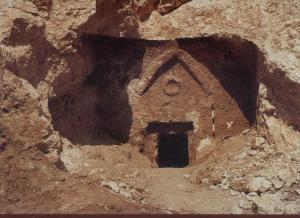
In particular, why would they build an ornate one? See the picture at the top of this post? Notice the geometric designs above the door of the tomb? That’s ornamentation, and it takes money to have rock carving like that done. Again, this isn’t the kind of tomb poor people would have.

The ornamentation also calls attention to the tomb, causing dominos three through six to keel over. The early Christian community and its claims about a Resurrected Messiah were very annoying to the local non-Christian communities, both Jewish and Roman. To non-Christian Jews, the Christian message was a betrayal of the faith as they understood it. It was heresy. It was something to be stamped out.

To the Romans, and increasingly with time, the Christian community was also troublesome. Partly it was troublesome because it stirred up contention within the Jewish community (which itself was headache enough for the Romans at the time). Partly it was troublesome because it came to be perceived as a treasonous group that did not honor the state religion nor form part of the tolerated religion of Judaism. And if you buy the theories common in liberal critical circles that the authors of the New Testament tried to shift the blame for Jesus’ death from Roman leaders to Jewish leaders then there’s an extra reason for the Romans to be annoyed with the early Christian community. Even if you don’t (as I don’t) buy the idea of blame transferrence, put yourself in the position of a Roman governor and ask: "Do I really want a local cult worshipping as a god a man who we Romans put to death?" For the Romans too, there was motive to undermine Christian claims.

So when Christians are running around saying that Jesus’ tomb is empty and that he’s been raised from the dead and that this only proves that he’s the Son of God, if you’re a non-Christian Roman or Jew then you’re going to have a powerful incentive to say, "Wait a minute! Jesus’ tomb is RIGHT OVER THERE in what will become the Talpiyot neighborhood of Jerusalem! And look, his bones are right here in this ossuary conveniently labeled ‘Jesus son of Joseph’ in this conveniently-ornamented-and-thus-advertised tomb that the rest of his family is using!"

Matthew 28:11-15 is also noteworthy in this regard:

[S]ome of the guard [over Jesus’ tomb] went into the city and told the chief priests all that had taken place.And when they had assembled with the elders and taken counsel, they gave a sum of money to the soldiers and said, "Tell people, `His disciples came by night and stole him away while we were asleep.’ And if this comes to the governor’s ears, we will satisfy him and keep you out of trouble." So they took the money and did as they were directed; and this story has been spread among the Jews to this day.

To the ears of any sensitive reader, but especially to an apologist, the nature of this passage is immediately apparent: It’s counter-apologetics. Matthew is pre-emptively doing apologetics against a claim that was current among non-Christian Jews in his day. It doesn’t matter if you believe that Matthew was right, or even if you believe that Matthew was Matthew (rather than a "Matthean community"). What’s happening here is that the leading non-Christian explanation for the empty tomb is being debunked.

As an apologist for the Christian position–like Matthew–you don’t want to raise alternatives to the Christian explanation in the reader’s mind if you don’t have to. Thus you don’t raise the idea of Jesus’ disciples stealing his body unless you’ve got a real, live objection out there that you need to offer a counter-explanation for (i.e., the chief priests bribed the soldiers to say this). You don’t even want the reader’s mind moving in that direction if you can avoid it.

So the fact that Matthew (or the "Matthean community") takes the trouble to raise and then debunk the idea of the disciples stealing the body shows that this was the leading explanation  in the non-Christian Jewish community of why the tomb was empty. (And why Matthew–rather than Mark or Luke or John–deals with this, since Matthew’s gospel was most clearly written for a Jewish audience: This was the audience in which this explanation was common.)

But there would be no reason to concoct this explanation if Jesus’ bones were, in fact, lying in a clearly labelled ossuary in a publicly marked tomb that was in multigenerational use by members of his family in Jerusalem. If you’ve got the body then you don’t need to make up the story about his disciples stealing it.

Domino seven–the early Christian preaching of the Ascension–also tips over against James Cameron’s case. It provides the Christian explanation for where Jesus’ body is: It ain’t on earth! It’s up in heaven! He’s been exalted to the right hand of God in accord with his status as Messiah and Son of God. So if you’ve got that oh-so-conveniently-identifiable tomb right there in Jerusalem, why don’t you use this to dethrone the Ascension claim by pointing out (in excellent Latin if you’re a Roman) Habeas corpus!–"That you have the body!" Right there! In that ossuary!

And then there’s domino #8: The Church as the Bride of Christ. This image would never have arisen if there was a Mrs. Jesus living right there in Jerusalem. Look at what happened in other religions where the founder was married. Do we know about their wives? Well, let’s see . . . Moses was married to Tsipporah and then later to an Ethiopian woman. Muhammad was married to Khadijah and then later to Aisha and Sawda and Zaynab and . . . well, let’s just say that he was very enthusiastic about marrying women. Joseph Smith Jr. was married to Emma Hale and Lucinda Pendleton and Louisa Beaman and . . . uh . . . let’s just say he was enthusiastic about marrying women, too.

We know about these women because they were honored figures as wives of The Founder, and if Jesus had a wife then (a) we would know about it and (b) the whole Church-as-the-Bride-of-Christ metaphor would never have come into existence.

And then there’s the fruit of marriage: offspring.

Now, Dan Brown wants to sneak a forgotten daughter of Jesus by us, but we tend to know about even the daughters of religious founders. Muhammad’s daughter Fatima comes to mind.

It would be much harder to sneak a forgotten son by the eyes of history. For example, Moses had Gershom and Joseph Smith Jr. had Joseph Smith III.

It’s not just hard to sneak sons past because patriarchal cultures focus more on sons, it’s also because of this: In traditional societies, the son is looked on as the father’s natural successor.

The son may not end up as successor, but we still tend to know about sons because of their role as potential successors. If a son dies before he can assume office, it’s viewed as a great blow to the community because it destabilizes the leadership and triggers a struggle for succession. That struggle gets recorded. Or, if the son doesn’t die, a succession struggle may break out anyway, and it, too, gets recorded. Thus when Joseph Smith Jr. was killed after shooting at the people who had come to lynch him (no passive martyr he), there was a succession struggle in the early Mormon community after which Joseph Smith III ended up out of power (later forming the Reorganized Church of Jesus Christ of Latter Day Saints, now the Community of Christ) while Brigham Young ended up in charge of the main Mormon establishment.

And we know about this because succession struggles are the things history is made of and so they get recorded.

So if Jesus had a son named Judah (or anything else), we’d know about it. We know a lot about the politics of the early Church, and we’d certainly know about a succession fight involving the son of Jesus. We’d have all the arguments of the winning side about why their side was right and the son of Jesus was not his legitimate successor.

This is especially the case when you realize that Jesus’ surviving male family members were active in the leadership of the Church, like James the Just, who became bishop of Jerusalem. But it was his "brothers" who played these leadership roles, not his son.

Thus the ninth domino falls: The fact that nothing like Cameron’s version was recorded by anybody–including those hostile to the Church who would want to discredit it–underscores the utter implausibility of the whole idea.

Then there are the specific arguments brought forth by Cameron and his crew in favor of their hypothesis, but those have been ably rebutted by others.

SEE HERE.

AND HERE.

AND HERE.
(CHT to the reader who e-mailed the last!)
John Paul II Prayer Cards and Relics

Catholic News Service writes:

ROME (CNS) — The Rome diocesan office charged with promoting the sainthood cause of Pope John Paul II continues to distribute the official prayer cards for the cause and the only authorized relics, an office spokeswoman said.

"We receive dozens of requests each day and the distribution continues," she told Catholic News Service Feb. 26.

The relic is a small piece of one of the white cassocks worn by Pope John Paul.

The free cards and relics can be requested by letter, fax or e-mail, she said.

The e-mail address is: Postulazione.GiovanniPaoloII@VicariatusUrbis.org; the fax number is: (39-06) 6888-6240.

The mailing address is: Postulazione Giovanni Paolo II, Vicariato di Roma, Piazza San Giovanni in Laterano 6A, 00184 Rome, Italy.

I requested mine!

Don’t forget to put USA (or whatever your country is) at the bottom of your address!

Evangelization Vs. Abstinence

A reader writes:

A person is going out with some co-workers for a dinner.  Normally
the co-workers go out to clubs the person would not go to –but in
this case it is a normal place for dinner so that this person can
attend. 

Problem is that a number of the co-workers are Catholics who
do not practice their faith.  The person desires to go in part of
this reason –to evangelize in friendship (and they already said
yes).  But it is on a friday of Lent and it is likely that they will
not abstain from meat. 

The problem is that these kind of events
often are paid for via ‘group payment’ they divide up the cost and
tips among them (it would be strange then to ask to pay
separately) .  Question: is there any problem with this material
cooperation in paying in small part for wayward Catholics?  Or any
problem with showing approval or something?

It is in handling questions like this that I ask myself, "What would Pope Benedict do?"

It seems to me that Pope Benedict would say that calling someone back to the practice of the faith is of transcendent value compared to the subject of a non-practicing Catholic eating meat on Friday in Lent. In other words, having the person hear a message of friendship and the gospel is more important than him hearing a message of the particulars of when we’re supposed to abstain from meat. If you can only give one message to him–as is likely the case here–then give him the really important one.

It may be true that they’re committing a lesser objective sin (breaking the abstinence that is required from Catholics), but everybody you meet, no matter who they are, are committing some kind of sin. The important thing is doing what you can to help them, and it seems to me that the friendship evangelization you are talking about will benefit them more than either talking to them about abstinence from meat or not going and not having the opportunity to evangelize.

The fundamental norm that guides situations like this is the good of souls, and helping people back to the faith when you have the opportunity to do so will do more good than focusing on lesser points (which they likely won’t care about any way if they aren’t practicing their faith) or missing the opportunity altogether.

The friendship evangelization strategy also treats the cause rather than the symptom. If you can help get them back into the active practice of the faith then the abstinence issue will take care of itself. Making an issue of abstinence now might even impede their return to the faith by getting them sidetracked on lesser matters instead of what they need to really be focusing on.

So I’d go and take the opportunity to evangelize in friendship. I wouldn’t raise the subject of abstinence. If they happen to raise it–noticing perhaps that I don’t have meat on my plate–I’d just shrug and smile and not make any bigger deal of it than that.

If they press further, I’d even be inclined to say, "Friday abstinence is something I do to practice my faith, but let me tell you why my faith is important to me in the first place."

As to the check, I would pay my ordinary share and not scruple about it beyond that. I’d put it under the rubric of "If someone forces you to go one mile with him, go two instead." Further, there’s nothing that says you’re paying for the part of their meals that consists of meat. You’ve just decided as a group to split the check evenly, and what each person decides to order is up to him.

If you must scruple, though (and I would encourage you not to), then order stuff that’s more expensive than the average meal, and that will cause others to contribute to your meal rather than visa versa.

Seriously, though, I wouldn’t scruple in this area. Just go and be of what spiritual service you can to your friend, making sure that you major in the majors and not the minors.

Hope this helps!

20

The Nature of the Second Coming

A reader writes:

I am a Protestant who has recently been awakening to a newfound appreciation for the Catholic Church and her teaching.

For four or five years now my views have been solidly of the "full preterist" persuasion (heretical – yes, I know).  Lately I’ve distanced myself somewhat from these views. Here’s where I am now: I still cannot read the Biblical passages which explicitly refer to the return of the Lord as referring to a yet future event.  The Olivet Discourse, and much (though I would not say all) of the Apocalypse seem to me to be about events that were quickly closing in on the Apostolic church.  That said, I believe that we are definitely living "between the times" in that the kingdom of God is a present but mysterious reality which has yet to reach its fullness, and I believe that Christ is the bringer of this fullness.  I also believe that everyone (past/present/future) has been and/or will be judged according to there deeds, and that Christ is the bringer of this judgment.

So, now to the question(s).  What does it mean to confess with the Catholic Church that Christ will return?  Must it mean that I picture Him coming bodily on a cloud and doing certain things (I think a lot of Protestants have Him throwing fireballs at people)?  Or rather, in confessing this could I be confessing Him to be the future bringer of the fullness of the kingdom and judgment, but maintain an element of mystery as to how this will actually look (perhaps it will be bodily and on a cloud but like I said, I read no Biblical passages which make me think it MUST be this way).  What is the dogma of the Church on the meaning of "He will come again?"  I ask this question humbly and honestly because if my faith were to continue along the path it seems now to be on I would not want to be dishonest or less than genuine in anything that I confess (I mean, if you have to qualify the hell out of something can you really say you believe it?)

I want to thank the reader for his openness to Catholic thought and for his honesty and conscientiousness about wanting to make a sincere profession of faith and not deprive doctrines of their meaning via reinterpretation.

For those who may not be aware, "full preterism"–sometimes also referred to as "pantelism" (by its critics)–is, so I understand, the position that all biblical prophecy has already been fulfilled, including the Second Coming and the resurrection of the dead. Obviously, these would have had to have been fulfilled in ways that differ markedly from the way Christians have historically understood them. This position, being contrary to the Creed’s confession of both a future Second Coming and a future resurrection, is materially heretical. Consequently, I’m glad to hear that the reader has begun distancing himself from it.

Regarding passages like the Olivet Discourse (Matthew 24-25) that deal with the Second Coming, I would urge the reader to consider this possibility: If you look at the passage in question, much of the material does indeed refer to events that occurred in the early Church and, to my mind, in the first century. This includes some of the passages speaking of a coming of Christ, but not to all of them. There is a distinction to be made between the various ways that Christ "comes" to his people (in blessing or in judgment; just as Scripture speaks of God "coming" to his people in these ways) and the final, definitive Second Coming.

The Olivet Discourse begins with Jesus predicting the destruction of the Temple and then the disciples ask him two things: (1) When will this happen? (2) What will be the sign of your coming and of the end of the age?

What follows is a discourse in which Matthew organizes the prophetic teachings of Christ, including drawing together material that is found at various places in Luke. It seems to me that, in reflecting on this material, there is a marked difference between the material in chapter 24 and that in chapter 25.

The chapter 24 material is much more concrete and specific, whereas the material in chapter 25 is expressly parabolic, involving the parable of the ten virgins, the parable of the talents, and the parable of the sheep and the goats.

I would hypothesize that the material in chapter 24 answers the disciples first question–"When will these things (the destruction of the temple) be?"–and the material in chapter 25 deals with the Second Coming, which is by its nature an event that cannot be described in the kind of concrete terms that we find in chapter 24. It’s too far outside the realm of human experience, making it more suited to parabolic treatment.

Whether the reader finds this interpretation convincing is not essential, though. The Church does not mandate a particular interpretation of these texts. What it does insist on is that there is a future Second Coming that will involve a radical rupture in the present world order and usher in a new and eternal state.

A significant text which seems to bear on this future coming (as opposed to other, non-definitive "comings," such as a coming in judgment on Jerusalem in A.D. 70) is found in Acts 1:

6: So when they had come together,  they asked him, "Lord, will you at this time restore the kingdom to  Israel?"
7: He said to them, "It is not for you to know  times or seasons which the Father has fixed by his own authority. 
8:
But you shall receive power when the Holy Spirit has come upon you; and
you shall be my witnesses in Jerusalem and in all Judea and Sama’ria
and to the end of the earth."
9: And  when he had said this, as they were looking on, he was lifted up,  and a cloud took him out of their sight.
10: And while they  were gazing into heaven as he went, behold, two men stood by them  in white robes,
11:
and said, "Men of Galilee, why do you stand looking into heaven? This
Jesus, who was taken up from you into heaven, will come in the same way
as you saw him go into heaven."


This seems to indicate that Christ’s future, definitive coming will in one respect be an inverse of the Ascension. That is, just as Christ manifestly and bodily ascended into heaven, at his final and definitive coming he will manifestly and bodily descend from heaven. It is this manifest bodily descent that seems to mark the Second Coming in distinction from all other conceivable comings of Christ (e.g., coming in a vision, visiting blessing or judgment on a people without bodily descending from heaven, coming in the Eucharist in bodily but not manifest manner).

The fact that Christ will be reunited with us in a manifest and bodily fashion at the Second Coming does not mean that the event must be understood reductionistically, as it is sometimes understood in Fundamentalist circles, as if Jesus will return to the earth like an astronaut returning from space (but without the space capsule). The event will represent such a massive rupture with the present world order such that the laws of space and time as we presently understand them are likely to no longer apply.

For example, Scripture speaks of the day of judgment in ways that strongly suggest that the current rules of space and time will not apply. It is hard to imagine, for example, that Jesus will actually judge billions of people in a 24 hour period, reviewing their smallest deeds and making them publicly known to everyone ("what you have whispered in the ear will be shouted from the housetops"), literally dividing billions of people onto his right and left, etc. If we really do have a whole-life review and experience not only our own review and judgment but have awareness of the content of others’ reviews and judgments then this strongly suggests we will occupy a mode of existence that is so vastly different from our current experience that it can scarcely be conceived at present, and certainly the language used to describe it in Scripture must be handled with a significant degree of caution about the mystery that is being described.

Ultimately, the precise mechanics of the Second Coming, the resurrection of the dead, the final judgment, and the eternal order on the new heaven and the new earth must be left up to God. While we have indications of what aspects of these will be like, and while we know they will be bodily and future events, their precise constitution is something that we likely cannot even conceive at present, and the Church does not attempt to settle these matters in detail.

So I would say that much of what the reader is presently thinking is in line with Catholic thought. He acknowledges that there is a future and definitive aspect to these realities. What I would recommend that he contemplate (as he may already be doing) is that these realities will have a bodily dimension, even if it is a mode of bodily existence that presently exceeds our ability to imagine.

Hope this helps!