I’m Not Sure That I Approve of This Post

History_channel_logo But it's brilliant.

And hilarious.

And disturbing.

And ironic.

And it definitely awakened my inner TV plot-analyzer instincts.

And the author is right. The History Channel really should try to "add artistic verisimilitude to an otherwise bald and unconvincing narrative."

GET THE STORY.

(CHT: Instapundit.)

I also agree with what the author says about Babylon 5 and Doctor Who (mostly).

Did Obama Lie on Abortion and Healthcare?

Remember how President Obama promised that his health care legislation wouldn’t cover abortion?

Remember all that stuff with the Stupak amendment, which was later abandoned?

Remember how the deal in abandoning the Stupak amendment involved a presidential order that would keep federal dollars from going to abortion?

Remember how pro-life legal experts said the presidential order wasn’t worth the paper it was written on?

Remember all that?

Well, now comes this news:

The Obama administration has officially approved the first instance of taxpayer funded abortions under the new national government-run health care program. This is the kind of abortion funding the pro-life movement warned about when Congress considered the bill.

The Obama Administration will give Pennsylvania $160 million to set up a new “high-risk” insurance program under a provision of the federal health care legislation enacted in March.

It has quietly approved a plan submitted by an appointee of pro-abortion Governor Edward Rendell under which the new program will cover any abortion that is legal in Pennsylvania.

There is still some legal sleight of hand involved:

The section on abortion (see page 14) asserts that “elective abortions are not covered,” though it does not define elective—which [National Right to Life legislative director Douglas] Johnson calls a “red herring.”

The proposal specifies coverage “includes only abortions and contraceptives that satisfy the requirements of” several specific statutes, the most pertinent of which is 18 Pa. C.S. § 3204, which says abortion is legal in Pennsylvania. The statute essentially says all abortions except those to determine the sex of the baby are legal.

“Under the Rendell-Sebelius plan, federal funds will subsidize coverage of abortion performed for any reason, except sex selection,” said NRLC’s Johnson. “The Pennsylvania proposal conspicuously lacks language that would prevent funding of abortions performed as a method of birth control or for any other reason, except sex selection—and the Obama Administration has now approved this.”

So what do you think? Did President Obama lie?

New Rules on Sex Abuse–What Will the Vatican Announce?

A few months ago, during the height of the latest abuse scandal, the Holy See created a new page on its website offering resources documenting the Church’s response to the problem over the last number of years.

HERE’S THE PAGE.

One of the things they put on it was a brief, layman’s guide to the procedures the Congregation for the Doctrine of the Faith uses in evaluating cases of priestly sexual abusers.

HERE’S THAT DOCUMENT.

One of the things that document did was say that there is a revision underway of the current regulations, which are set forth in a motu proprio called Sacramentorum sanctitatis tutela. Specifically, the document said:

For some time the CDF has undertaken a revision of some of the articles of Motu Proprio Sacramentorum Sanctitatis tutela, in order to update the said Motu Proprio of 2001 in the light of special faculties granted to the CDF by Popes John Paul II and Benedict XVI.

Now a plethora of press reports indicate that the publication of the revision is nigh. In fact, according to several press accounts, it was approved by Pope Benedict in a Saturday audience with Cardinal William Levada (head of the CDF) last week. (NOTE: That it was a Saturday audience is kind of odd. Normally the pope meets with the head of the CDF on Fridays, though perhaps not that much should be read into the shift of days.)

There is no way of knowing at this point how accurate the press accounts are of what the new norms will say, but piecing bits together from different reports suggest that there may be interesting things afoot.

First, what kind of form will the new norms take? It appears that they may not be a new motu proprio—which is a document issues by the pope. Instead, they may be an instruction, which is the kind of document the head of the CDF could issue with the approval of the pope.

It also appears that, concerning priestly sexual abuse, they will largely serve to reinforce the status quo. They will not, according to at least one report, mandate a “one strike and you’re out” policy on a global level. This kind of policy is in place in the United States and in certain other countries, but it has not been mandated globally. If the mainstream media goes after the new norms in a big way, expect it to go after this aspect of them as proof the Holy See isn’t doing enough or still doesn’t “get it.”

Another thing the mainstream media may go after is that the new norms will certainly not require bishops all over the world to report suspected abusers to the police. The norms may say something about complying with local law regarding sexual abuse, but they won’t mandate automatic reporting to civil authorities because it would give totalitarian countries—like Communist China or Vietnam or, apparently, Belgium—a new tool for persecuting the Church, or harming the confidentiality of accusers (some will come forward only on the condition they they aren’t going to have to get involved with the criminal justice system, which is one of the reasons such victims have been speaking out against the actions of the Belgian authorities; they had been frank with the Church under conditions of confidentiality, only to have their files seized by the state for possible use in criminal prosecutions, meaning that the victims may be dragged into civil court).

However understandable the Holy See’s motives may be in not mandating universal reporting to the authorities, don’t count on the MSM to understand them.

A change that the media might see as “good but not enough” in the new norms is the extension of the statue of limitations on reporting priestly sexual abuse from 10 years to 20 years, starting with the victim’s 18th birthday. The CDF has the ability to waive the current 10 year statute of limitations, and according to reports it routinely does so, so the extension to 20 years actually would represent a kind of codification of the status quo.

An interesting expansion of the way sex abuse cases will be treated, reportedly, is that possession of child pornography will now be counted as one of the offenses reserved to the CDF.

At least one source as reports that the abuse of mentally impaired adults will be classified as one of the reserved offenses, putting it on par with child sexual abuse.

It is also expected that the document will make certain provisions that are currently handled as “exceptions” to present norms. According to John Allen, the set of exceptions:

• Allows one judge on a church tribunal to be a lay person, and eliminates the requirement of a doctorate in canon law;
• Allows for by-passing trials in especially grave cases, removing abuser priests on the basis of a decree;
• Gives the doctrinal congregation power to “sanate” the acts of lower courts, meaning to clean up any procedural irregularities;
• Establishes that an appeal in abuse cases goes to the doctrinal congregation rather than the Signatura, the Vatican’s highest court.

There are also indications that the new norms may deal with other crimes reserved to the CDF, but these have not been the focus of current reporting.

MORE INFORMATION: HERE, HERE, HERE, AND HERE.

Speculation is that the new norms will be announced in the next two weeks, but of course we’ll have to see whether that is the case, as well as whether the above report correspond to what they will actually say.

Count on the media to try to milk maximum sensationalism out of the story (just look at some of the language used in the New York Times’ preliminary report).

In the meantime, what are your thoughts?

Brave Little Toy Story

Toystory3

Hey, Tim Jones, here. I saw Toy
Story 3
the other night, and found that – contrary to my fears a
year or more ago – it is a very worthy successor to the previous Toy
Story films. Lots of LOLs, and fun throughout.

I began to have a
sense of persistent déjà vu as the story progressed, though. Here
is the basic arc of the tale; WARNING!
SPOILERS!!

Continue reading “Brave Little Toy Story”

Alien Robots Worship Jesus!

It’s true!!!

Because they were programmed to!

Okay, I know that I normally blog about heavier subjects, but please indulge me in a moment of whimsy.

Recently on my personal blog I did an entry featuring a bit of computer animation I had discovered that offers a fascinating presentation of Bach’s Toccata and Fugue in D Minor (it’s really cool).

But this was not the only animation in the series. There are a lot of them, and one that caught my eye was titled “Bach, Jesu, Joy of Man’s Desiring, from Cantata 147 (sung by alien robots).”

Alien robots singing a favorite like Bach’s “Jesu, Joy of Man’s Desiring”? That’s worth checking out.

BTW, here is what the alien robots are singing in German:

Jesus bleibet meine Freude,
meines Herzens Trost und Saft,
Jesus wehret allem Leide,
er ist meines Lebens Kraft,
meiner Augen Lust und Sonne,
meiner Seele Schatz und Wonne;
darum laß’ ich Jesum nicht
aus dem Herzen und Gesicht.
—from BWV 147, Chorale movement no. 10

The usual English translation of this does not correspond with the German text, but here is a more literal translation (source (see no. 10)):

Jesus shall remain my gladness,
Essence of my heart, its hope;
Jesus from all grief protecteth,
He is of my life its strength,
Of mine eyes the sun and pleasure,
Of my soul the joy and treasure;
Therefore I will Jesus not
From my heart and sight allow.

So with no further ado, alien robots sing “Jesu, Joy of Man’s Desiring”!

The Right to Keep and Bear Arms

The odds that it is being infringed went down this week when, among other things, the U.S. Supreme Court issued a landmark decision (.pdf)in which it held that the Second Amendment’s right to keep and bear arms applies not only to the federal government but to state and local governments as well.

Because this isn’t a legal blog, I’m going to pass over the legal intricacies and arguments that the case involved (though they are fascinating) and go to the moral issue in question: Is it a good idea for people to have the right to own guns?

Of course, we are not talking about all people without exception. As the decision in this Supreme Court case as well as the previous one noted, lawmakers can reasonably bar felons and the mentally ill from owning guns. (Personally, I would change “felons” to “violent criminals,” due to the absurd extent to which federal law has started classifying things as felonies; I’d also shore up “mentally ill” to make sure that only those who pose a danger to themselves or others are intended, due to the tendencies to classify everything under the sun as a mental illness, but those are other issues.) The question is: Should ordinary, law-abiding, mentally stable individuals be allowed to own guns?

And by “guns” I mean “firearms that are in functional condition,” not “pieces of disassembled metal that could be taken out of a locked container and/or assembled and/or unlocked and/or loaded and so be turned into functional firearms in a few minutes time.” (Sorry for the verbal gymnastics, but that is the state of affairs to which opponents of gun rights have pushed things.)

So: Should ordinary people be allowed to own guns?

Guns are marvelous tools. That’s why we fight wars with them. On a smaller scale, we also defend ourselves with them, we hunt with them, obtain food with them, control dangerous predators like bears and mountain lions with them, control animal populations like deer that would otherwise suffer unless culled, signal the start of sporting events with them, and use them in marksmanship competitions.

The last two cases are atypical. Starter pistols are loaded with blanks or caps and are or are used in a deliberately non-lethal way. Similarly, marksmanship competitions are not the main use for which guns are intended.

The situations we are concerned with are those in which guns are aimed at their primary targets: animals or humans.

What about animals?

The Church acknowledges that animals do not have rights the way humans do. Consequently, it is never murder to kill an animal and we have the right to eat animals, use their skins, etc. Unnecessary cruelty toward animals is a sin, but this involves an abuse of human nature rather than a violation of an animal’s rights. Activities like hunting, obtaining food, eliminating predators that pose a danger to humans or livestock, and culling animal populations to keep them in balance are morally licit in principle.

Still, these considerations don’t go to the use of firearms that gun control advocates are most concerned about, so let’s look at the issue of using firearms against other humans.

What we are talking about, essentially, is war on the individual scale.

The Church views war as something that is always a tragedy, but it acknowledges that the use of warfare is mortally legitimate when a nation needs to protect its (or others’) interests and there is no less destructive practically way to do this.

In the same way, the Church recognizes an individual right of self defense. The Catechism of the Catholic Church states:

The legitimate defense of persons and societies is not an exception to the prohibition against the murder of the innocent that constitutes intentional killing. “The act of self-defense can have a double effect: the preservation of one’s own life; and the killing of the aggressor…. the one is intended, the other is not.”

Love toward oneself remains a fundamental principle of morality. Therefore it is legitimate to insist on respect for one’s own right to life. Someone who defends his life is not guilty of murder even if he is forced to deal his aggressor a lethal blow:

If a man in self-defense uses more than necessary violence, it will be unlawful: whereas if he repels force with moderation, his defense will be lawful…. Nor is it necessary for salvation that a man omit the act of moderate self-defense to avoid killing the other man, since one is bound to take more care of one’s own life than of another’s.

Legitimate defense can be not only a right but a grave duty for someone responsible for another’s life. Preserving the common good requires rendering the unjust aggressor unable to inflict harm [CCC 2263-2265].

So we have a right, and at times a duty, to use lethal force in defending life. Does that translate into a right to own guns?

Well, guns are remarkably good tools for administering lethal force—and by extension they are remarkably good tools for keeping aggressors at bay. They are also tremendous equalizers.

Put on your Father Brown hat for a moment and think like a criminal—a home invader. Whose home do you want to invade? One with a bunch of people in it, including at least one large adult male? Or a home with only one person in it, who happens to be smaller, female, and perhaps elderly? If you are a home invader, you stand a better chance at holding your own in the latter circumstance than the former, making it the logical (if monstrous) choice for you.

But suppose the little old lady has a gun! And goes to the range regularly! And has carefully thought through what she would do in the event of a home invasion!

Suddenly you’re on a much more equal footing with your potential victim—even if you, the home invader, yourself have a gun.

And, of course, criminals often do have guns. If the one attempting to victimize you has one, and if you have a right and/or duty to defend yourself against him (which the Church acknowledges you do) then that right entails the means you will need to perform the act of legitimate defense. In other words, it entails a right and/or duty to use a gun—unless you have some other means of effectively defending yourself against an attacker with a gun (e.g., maybe you’re Wonder Woman and can do bullets and bracelets).

Or suppose that your attacker doesn’t have a gun but that he’s just much more physically powerful, agile, and skilled at violence than you are. To exercise your right to or fulfill your duty to perform legitimate defense in such a situation, you need something to equalize matters, and a gun is a very good option. Perhaps the only one.

It would be wonderful if we lived in a world in which all weapons could be beaten into ploughshares and nobody would make individual war any more, but we’re not in that world, yet, and ordinary people still have that right and/or duty to defend themselves and others, using lethal force if necessary.

So there is a significant case to be made that ordinary, law-abiding, mentally-stable people ought to be able to own guns.

Of course, there are arguments against this—that having more guns around increases gun violence, that there would be gun accidents, etc.

Such claims should not be taken uncritically.

There are two sides to this story, as there are to so many, and people on both sides of the issue need to have their facts and arguments vetted.

Statistical arguments are interesting and need to be given their proper weight. So does the question of what you, personally, would do if you (God forbid) find yourself in such a desperate situation.

Because the saying is true: When seconds count, the police are only minutes away.

What are your thoughts?

ISRAEL: Whose Land Is it? (Pt. 2)

In our previous post on this subject, we looked at the claim that the Jewish people have a claim to the territory currently occupied by the modern state of Israel because they were promised it in the Bible.

We saw that reasonable people could take different views of this subject, especially concerning how such a promise might apply to the present age.

Now let’s look at the question from an ethical rather than a revelatory perspective. That is to say, apart from the revelation claim that we have already examined, what grounds might be offered for the claim.

Before we do that, though, I’d like to clear something up that I think has resulted in some folks spinning their wheels: the term anti-Semite. This is a misnomer. It is used to refer to hatred of Jews, though the category “Semite” properly includes people who aren’t Jews. Nevertheless, that is how the term is used. I suggest that we not fight about the word and just note that it is a misnomer that is in popular use and move on.

Now: What claims besides revelation might one appeal to in support of the claim that the Jewish people have a claim to the territory of Israel?

1) The legal argument: This would involve asserting that some entity or entities that had legal title to this territory in the 20th century lawfully gave it to the present Israeli governing entity as a Jewish homeland. And, in fact, many people do make this claim.

While it would be an interesting legal debate to thrash this out, we’re not going to do that on this blog. I am not an expert on the law, especially as it pertains to this question, and it would exceed the capacity of a multi-issue blog like this to review all the relevant information and arrive at a firm conclusion. Therefore, aware that there is more than one side to this argument, I would suppose that reasonable people could take different views on the issue.

Further, regardless of whether civil (or international or whatever) law supports does not deal directly with the question of what is ethical. Human law can support all kind of wicked and unjust things, and so even if human law supports something, that isn’t itself decisive for the question of whether the thing is moral (which is the kind of question this blog is more interested in).

So let’s look at other grounds.

2) The ancestral argument: Some in the combox have asserted that the Jewish people have a right to the land of Israel based on the fact that their ancestors lived there a long time ago.

This strikes me as the least convincing argument on this issue. The fact is that human populations move all over the place during history. Often they are forced out of one land, and at some point any claim they have to it lapses. That fact that modern Jews’ ancestors had title to the property 1900 years ago doesn’t mean that they presently do any more than I have title to where my ancestors lived 1900 years ago.

In view of the historical memory of the Land and in view of the biblical promise regarding it, it is understandable—especially after the Holocaust—that there would be a desire to immigrate there and create a Jewish haven state there, but this is a natural desire—not a moral right to do so. Based on our individual and corporate histories, there are all kinds of desires we might naturally have about the way we’d like the world to be, but that doesn’t give us the moral right to go out and try to bring them about. Whether we have a moral right to take action regarding a wish or desire is a separate question than whether is it natural for us to wish it.

Human migration is so extensive in history that all of our ancestors have been kicked out of lots of places at various stages. In fact, if the Out of Africa theory is true, all non-Africans’ ancestors at one point must have gone through the very territory currently occupied by Israel. That doesn’t give all non-Africans title to this plot of land, either.

So . . . where your distant ancestors lived doesn’t mean that you get to reclaim the place today.

(Unless God has said you can, but that’s a different ground. It’s the revelation claim, not a “we used to live here” claim.)

3) Right of conquest: Historically a lot of people have felt that if you conquer a land, it’s yours. The fact you conquered it gives you a right to it.

One problem for using this argument in the case of Israel is that it works contrary to the legal argument that many wish to use. If the land was given to the Israelis legally then it wasn’t obtained by conquest—at least in the traditional sense (we’ll get to an untraditional one, below).

The conquest claim might, however, be used for territory like the West Bank since that was obtained in war.

But the right of conquest isn’t generally acknowledged today. The fact you conquered something may have given you title to it in the middle ages (or even more recently), but it doesn’t today. America conquered Iraq, but that doesn’t mean we own it. In fact, there is a widespread sentiment that America should get out of Iraq as soon as practical.

Today if you want to claim moral title to a land, you need something more than “We militarily defeated the people who were living there.”

4) Right of self-determination: The argument here would be something like: Since the legitimacy of government depends on the consent of the governed, the majority of people who actually live in a land get to determine how it is governed and by whom. Therefore, since the majority of people currently living in the territory of Israel are Israelis and, it would seem, support the existence of Israel, they have title to the land.

You might also call this the right of present possession and, as the old saying goes, “possession is nine tenths of the law.”

This is a more persuasive argument than the ones we have considered thus far in this post. Some version of the right of self-determination in conjunction with the present possession of a territory must underly the moral right that every nation state has to its territory. Whether Israel’s case is justified is a question that has to be answered, but at least this argument presents us with a potentially successful argument.

Note, however, that it only addresses the question of whether the Israelis now have moral title to the land, not whether they did so in the past or whether they will in the future.

If we consider the past, it is quickly recognized that in the 19th and in the first half of the 20th centuries there was a massive migration of Jewish people into the territory of Palestine—with an eye to potentially founding a Jewish state or haven state there, which would mean displacing or making some other arrangement with the people who were already living there.

The desirability of creating a Jewish haven and the understandability of wanting to creating it here doesn’t mean that it was automatically moral to do so. What this amounts to is a non-military invasion of the territory with an eye to claiming it for yourself—the nontraditional form of conquest mentioned earlier.

Certainly one can see how the then-present inhabitants of the territory would object to this project, just as Native Americans could reasonably object to the mass migrations of European colonists with the same designs . . . or the way Mexicans might have viewed with suspicion the immigration of lots of potentially rebellious Anglos into Texas in the early 1800s . . . or the way Americans in the modern Southwest might view with suspicion the Reconquista sentiments expressed by some recent immigrants.

I don’t say that to pass judgment on any of these groups. It’s just a fact of history that immigrants can overwhelm and eventually take control of the lands to which they migrate. Whether they were justified in doing so is a complex moral question to which there is no automatically right or wrong answer. People do need places to live, and sometimes they need to migrate. When they migrate, some places are more rational to migrate to than others. And if enough of them migrate, over time it will have a natural impact on the governance of the region.

Because there is a natural tendency for everyone to identify their own interests with what is morally right, those who are doing the migrating have a natural tendency to think that it is morally right for them to do so, and those whose territory is being migrated to have a natural tendency to view the situation with concern or alarm and to think that it is morally wrong.

So it is reasonable for Jewish immigrants to the territory of modern Israel to view the migration as justified (or even necessary), and it is natural for Palestinians (then and now)  to view it as unnecessary and unjustified.

In other words: People can have different views on this subject.

There does come a point, if a migration is big enough, where a new governing situation becomes rational or even obligatory. The situation of a tiny nativist group holding all governing authority in the face of a disenfranchised majority class is going to lead to really bad situations (think: Apartheid, only with the natives being the rulers and the immigrants being the disenfranchised). The immigrant class must have its say in determining the governance of the region, and if it is big enough, it’s going to end up exercising that governance itself.

When that happens, a new civil order has been achieved. Hopefully it will be a just order (often it is not). Hopefully it will be achieved bloodlessly (often it is not). But the immigrant class will be the new rulers, and legitimately so.

One can hold, then, that this is the situation that applies in modern Israel, and that the common good is best secured by allowing the state to continue to exist. This would mean that the Israelis have a moral right to the territory (or at least some of the territory) now, regardless of whether they achieved this by legitimate means.

Or one can deny this and argue that the presence of modern Israel is a destabilizing element that will ultimately harm the common good of the parties involved—or that is presently harming the common good of the parties—and that it would be better to peacefully dismantle it.

I don’t see that as happening any time in the near future. A more likely scenario to my mind is that nuclear proliferation in Muslim states may at some point lead to the destruction of Israel.

That’s not at all something I wish for, but it is an eminently possible occurrence in the imminent future.

One could thus argue that, while Israel for a time held the land legitimately, it could cease to do so in the future, should the situation grow more unstable and the presence of Israel lead to great harm to the common good of the parties involved.

So just as this theory does not mean Israel achieved its title to the land through moral means, it also does not mean that it necessarily will keep its title in the future.

All of these are positions one could entertain legitimately. I’m not going to tell you which you should believe. I’m just trying to point out the scope that exists for diversity of opinion.

What are your thoughts?

ISRAEL: Whose Land Is It Anyway? (Pt. 1)

Recently we were discussing the Helen Thomas broujaja and the question of who “owns” the land of Israel/Palestine inevitably arose.

I’m not going to solve that long-standing and thorny question in this blog post, but I can offer some considerations that need to be taken into account when forming an opinion on the subject.

First let me note that there is room for different opinions, here. The issue is a complex one, and people of good will can take different positions—regarding the founding of the modern state of Israel, regarding its role in God’s plan, and regarding what should happen with it in the future.

In previous comboxes, some readers asserted that support for Zionism is so important that opposition to Zionism ipso facto makes one an anti-Semite. This claim is etymologically ironic in that many of the non-Jewish inhabitants of Palestine are, in fact, Semites, but even allowing for this irony, it is simply not true. Zionism has been and remains controversial within the Jewish community itself.

Just to eliminate potential confusion at the outset, let’s define our terms. I will be using the term “Zionism” in two senses: (1) The belief that the modern state of Israel should have been founded and (2) the belief that the modern state of Israel should continue to exist. There are other ways in which the term can be and historically has been used, but these are the two ideas that we will interact with here.

Note that one can be a Zionist in one sense but not the other. One could be a Zionist in sense (2) only and hold that, while the modern state of Israel should not have been created, now that it has been, it has a right to defend itself and to continue to exist. On the other hand, one could be a Zionist in sense (1) only and hold—for example—that, while it was right to create the modern state of Israel, that state has morally forfeited its right to exist due to human rights violations or that while it may have been right to found the state of Israel in the 20th century, if unstable Arab states start getting nukes and a regional nuclear war is about to start then the best thing for the welfare of the Jewish people would be to leave the region.

Many Jewish people today are Zionists in both sense (1) and sense (2), though not all. There are quite a number who are sense (2) only Zionists, and an even-more-nuclear-future could give rise to a significant number of sense (1) only Zionists.

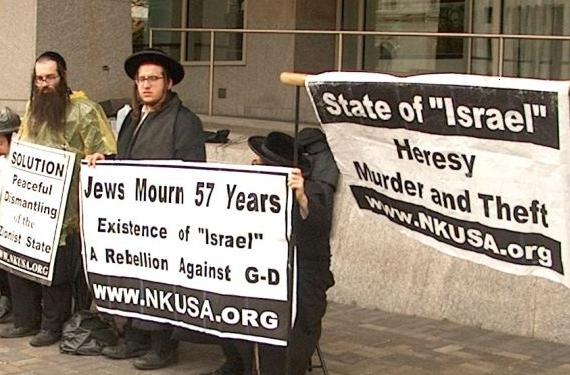
Some Jewish people are Zionists in neither sense (1) nor sense (2). This is the case, for example, with the gentlemen pictured, who are members of Neturei Karta, who hold a view that was quite common among Orthodox Jews prior to the founding of Israel.

This view is that the Jewish people should not try to control the land of Palestine on their own and that they should regain statehood there only through the coming and the actions of the Messiah. Trying to take control of Palestine prior to that point, on this view, constitutes a usurpation of God’s plan and is viewed as a violation of the three oaths held to regulate relations between the Jewish people and the nations during the present age.

Neturei Karta is by no means the only Jewish group holding this view, BTW.

These people are not anti-Semites. They don’t even deny that the Jewish people have a special title to the land of Palestine. They simply see the legitimate control of this land as an eschatological reality that should not be confused with contemporary Zionist aspirations.

I thus hope that the difference between anti-Zionism and anti-Semitism is a little more clear and that we can discuss the issue without people wanting to automatically play the anti-Semitism card.

That said: Who owns the land?

There are two main perspectives from which this question needs to be evaluated: the prophetic and the ethical. In this post we’ll look at the prophetic perspective.

Many here in America have reflexively treated the prophetic aspect of the question as unambiguous and definitive: God promised Israel the land in the Old Testament, and so it’s theirs. Case closed.

But prophesy often is not so straightforward in its interpretation or application. God also made it clear that, if Israel committed certain sins—or sins of a certain character and magnitude—that it would be dispossessed of its land, at least for periods of time. And there are passages warning the Jewish people to submit to their conquerors and that they will not be restored to the land for a set time and things like that.

There is also the question of the way in which many Old Testament prophesies have found fulfillment through Christ in ways that would not have been expected previously. The impact that this phenomenon has on the promises regarding the land is something that cannot be ignored.

For its part, the Catholic Church acknowledges that the Jewish people still have a special role in God’s plan. That’s something I’ve written about before. But the Church does not teach that the Jewish people have a right to possess the land of the modern state of Israel in the present day by divine promise. In fact, the Holy See has studiously avoided saying that.

It has even gone so far, in its 1993 Fundamental Agreement with Israel, to state:

The Holy See, while maintaining in every case the right to exercise its moral and spiritual teaching-office, deems it opportune to recall that, owing to its own character, it is solemnly committed to remaining a stranger to all merely temporal conflicts, which principle applies specifically to disputed territories and unsettled borders [art. 11:2].

In its specific application, this passage is referring to disputed territories like the West Bank and Gaza rather than to the territory of Israel as a whole, but the same principle applies in general. The Holy See treats the question of what people have title to what territory as a temporal affair and thus something that goes beyond the Church’s purview. The Church can certainly raise moral objections to various courses of action, like trying to forcibly kick out the people who currently have title to a territory. But the question of who has title is treated as a temporal rather than theological issue. The Church does not hold that any particular people has an immutable divine right to a particular territory.

This is not to say that a Catholic could not hold that Israel does have a right to the land in the present day due to God’s promise. That is an opinion within the realm of permitted theological speculation. But it is not something the Church has signed off on. The Church has remained conspicuously neutral on that theological question as it applies in our age.

One could thus hold the opinion that the Jewish people have a right to that land in our day, that they have a right to the land but not in our day (perhaps at the Second Coming or near it, if we are not now near it), or that they no longer have a special right to the land. Each view is permitted.

This deals with the subject from the prophetic perspective. What about the ethical one?

That will be the subject of our next post.

In the meantime: What are your thoughts?

Antichrist Update!

In my previous post, I took on a silly video that has more than a million views of different versions of it. The video centered on Jesus’ statement in Luke 10:18 that, after the disciples had come back from a preaching mission, Our Lord had seen “Satan fall like lightning from heaven” and claimed that if you back translated this statement from Greek to Aramaic and then to Hebrew that “lighting from heaven” would come out as “baraq o baw-maw” or “Barack Obama.” This, the nameless creator of the video suggested, might mean that Jesus was telling us the Antichrist’s name would be Barack Obama.

I greeted the logic of this video with a great big gift bag full of “Nope.”

Whatever Barack Obama’s role may be in the great scheme of things, whether he’s The One who will cause the oceans to stop rising and the planet to heal or whether he’s just the one who went golfing while the Gulf filled up with oil, Luke 10:18 doesn’t establish him as the Antichrist.

One reason, as previously explained, is that this passage isn’t a prophecy at all. On its face, it appears to be Jesus congratulating the disciples on a well done evangelization mission.

Another reason, as previously explained, is that if you translated “lighting from heaven” back into either Aramaic or Hebrew, you wouldn’t get “baraq o baw-maw.” Instead, you’d get something like “baraq min ha-shamayim” (Hebrew) or “barqa min shmaya” (Aramaic).

After posting my post, I thought, “Hey, this isn’t the first time somebody has translated this phrase into this pair of languages. Let’s see what we find if we look it up in a Hebrew New Testament an an Aramaic New Testament!”

So that’s what I did.

Consulting this Hebrew New Testament [.pdf] online, we find that the phrase in the passage is this:


Transliterating that from right to left, it reads “kbaraq min ha-shamayim” (ignoring the effect of a few Hebrew punctuation marks that don’t transliterate well into English). The “k” on the front of this is actually a different word. It’s a preposition meaning “as” or “like,” which is part of what Our Lord was just saying: “like lighting from heaven.” But if you just want the phrase “lightning from heaven,” you’d leave off the “k.”

So the translators of this Hebrew New Testament bore out what I said: If you translate the phrase into Hebrew, you’d expect to see “baraq min ha-shamayim,” not something that sounds like “Barack Obama.”

And if you don’t happen to know the Hebrew alphabet, don’t just take my word for it. CHECK ME OUT!

Of course the whole Hebrew thing is really just a red herring—or maybe that should be a red lox—because Jesus wouldn’t have been speaking Hebrew in this combination, but in all likelihood Aramaic. The video maker just jumped to Hebrew because he knew even less about Aramaic than he did about Hebrew.

So what happens if we check an Aramaic New Testament?

The standard Aramaic translation of the New Testament is the Pshitta, a version of which is online here. This version happens to be an interlinear, with the English words appearing over the Aramaic ones they correspond to. Just remember that the Aramaic letters read right to left rather than left to right.

Here’s the phrase from Luke 10:18:


This edition isn’t pointed for vowels, but transliterating it you get “barqa min shmaya” (there is no “k,” as in Hebrew because the Aramaic uses a separate preposition for “like” here).

Again, don’t just take my word for it. CHECK ME OUT!

(BTW, these other alphabets may look different, but they aren’t that hard to learn. Give ‘em a try!)

Anyway, either way you go—baraq min ha-shamayim or barqa min shmaya—neither sounds much like “Barack Obama.”

What are your thoughts?