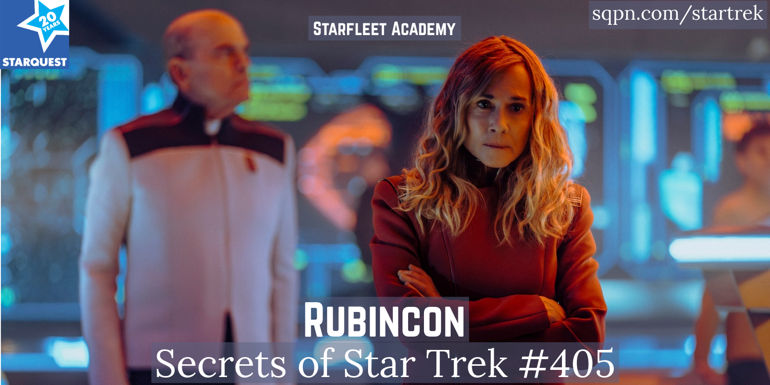
The season finale of Starfleet Academy Season 1, “RubinCon,” stages a live-broadcast Federation trial, sends cadets racing to neutralize omega mines, and asks whether a season’s worth of character work can pay off in a single hour. Dom Bettinelli, Jimmy Akin, and Fr. Jason Tyler break it down.
Nus Braka’s show trial is equal parts spectacle and procedural chaos. Anisha is appointed judge despite already knowing Caleb is alive and a plan is in motion — and still rules irrationally, leaving the panel wondering why the writers gave away the dramatic tension before it was needed. The larger problem is the backstory reveal: Braka’s entire vendetta turns out to be rooted in a childhood misperception. Strontium burns red. Federation weapons fire doesn’t. His father’s missiles killed his colony, not the Federation’s. The panel argues that while the twist is clever in isolation, it radically deflates a villain who had genuine menace — and fits a troubling modern pattern of antagonists whose menace is unhinged irrationality rather than cold calculation. Khan, the benchmark they’re all chasing, had both.
Captain Ake’s courtroom defense prompts a comparison worth having: how would Picard, Sisko, or Kirk have handled the same tribunal? The panel finds Ake emotionally credible but lacking the steel those captains brought — the restrained righteous indignation of Sisko, the Shakespearean reserve of Picard, Kirk’s barely-contained fury. Meanwhile, Reno’s command of the Athena is the episode’s clearest win. Her instinct to keep teaching even in crisis — quizzing cadets rather than simply ordering them — functions as both character consistency and a practical way to keep nervous young officers focused on what they’ve been trained to do.
The omega mine neutralization leans on Trek’s most reliable crutch: technology that conveniently fails until it just as conveniently doesn’t. The air-pressure-as-sensor-countermeasure gets particularly rough treatment, capped by listener feedback cataloguing the three 20th-century detection technologies — thermal imaging, audio, Doppler shift — that would have blown the plan in seconds. The panel also maintains a “hug counter” throughout, which reaches impressive heights by the time the group embrace closes the episode.
Stepping back, the season one verdict is nuanced: better than feared going in, but structurally hampered by the abbreviated episode count that defines streaming-era prestige TV. Short seasons rush character development and leave the cast emotionally remote. DS9’s Julian Bashir took time to become someone worth caring about; Starfleet Academy’s cadets never quite get there. Season 2 is confirmed as the last, and all three panelists are cautiously open to returning — especially if the rumored shift away from a central villain in favor of a situational threat bears out.
https://youtu.be/IeeHJfrUhUg
Subscribe on iTunes. | Other Ways to Subscribe.
Podcast: Play in new window | Download