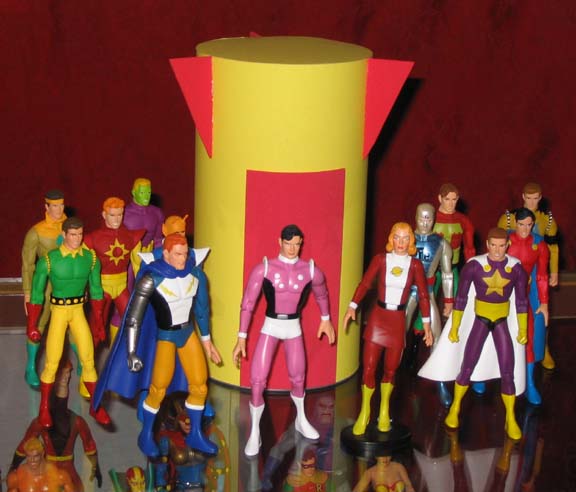
Legion Clubhouse

A reader writes:


I couldn’t resist…


…showing off my homemade Legion clubhouse. Finely crafted from a Quaker
oatmeal canister and, if my old comics are any indication, it’s correctly
proportioned. (I assume they’re all outside because Bouncing Boy is already inside.)


Love your site.

Legion_clubhouse

Kewl!

That’s just what the original Legion’s clubhouse looked like! (I.e., a rocket accident.) Good work!

Kudos on the action figure collection, too!

Canon Blawging

For several days I’ve been meaning to link to a couple of pieces on Ed Peters’ canon blawg, In Light Of The Law.

Ideally, I’d like to do two separate posts linking to Ed’s two most recent blog entries. Unfortunately, like I did when I first started blogging, Ed is doing a hand-coded blog that does not have permalinks, so I can’t.

(Hint, hint, Ed! Automated blogs are much better! And will get you more traffic by making it easier for folks to link to you–among other things. I’ll even help you convert yours over to automated form if you’ll let me!)

Anyhoo, here’s what’s up on the good Dr.’s canon blawg:

1) There’s been a lot of silly talk about the pope being forced to resign. Can’t be done. Shouldn’t be done. And Ed has some great commentary on the subject.

2) Apropo of papal succession, turns out that one cardinal thought to have the ability to vote in the next conclave had lied about his age (to the tune of five years) and was actually over the cutoff age for cardinals being able to vote in papal elections. Fortunately, the guy outed himself before the time came, but the thought of an ineligible papal elector participating in a conclave ought to give everyone the willies.

GET THE STORIES.

Chupacabra Question

A reader writes:

Hey Jimmy – I pretty regularly frequent your blog (and
voted for it as well), but I must get something
cleared up right now: I hope I wasn’t just being
gullible when I accepted your chupacabra blog as a
real story. I took it as fact, but now am not sure if
that was one of your tongue-in-cheek articles. I
forwarded that link to some of my friends who are
laughing at me. They say it’s like something out of
those zany tabloids that doctored up the pictures with
computer modifications. Am I this naive? Please tell
me if that whole thing was a hoax. I told them I got
it from a credible source.

FIRST, HERE’S THE LINK TO THE ORIGINAL POST.

This was definitely not a hoax, at least not on my part. Whenever I do a tongue-in-cheek post, I try to signal what I’m doing by dragging the (fictional) newspaper The Daily Planet into it. If I attribute something to the Daily Planet, that’s the signal that I’m doing humor. Thus, for example, I may run a real press story at the top of a post and then have a Daily Planet comment on it at the bottom.

If there is a hoax in this case, it’s on me, too, but I don’t have evidence at this point that there is a hoax. I always do due diligence to try to verify what I’m reporting from multiple sources. I don’t usually link all the sources I check, but check several of several different types.

In this case, the first page I linked was to a story hosted on the web page of the San Antonio NBC affiliate WOAI (Channel 4) (and its sister radio station of the same name), which is a real station listed in the yellow pages.

That story contained these pictures:

Chupacabra2

These images are confirmatory to the other images linked.

The second page I linked was to Linda Moulton Howe’s web page. Linda Moulton Howe is a reporter who has reported on the weird for years and who spoke to some of the individuals who were involved in one of the incidents. She also provides copious (graphic) pictures that seem excessive if someone was doing a hoax and that certainly look like a real creature.

Others are also taking this seriously.

So while I can’t tell you that I’ve seen the thing with my own eyes, I can say that I’ve done my best to verify that the things are real live dead critters that got shot in a couple of towns in Texas.

Whether it’s the basis of the chupacabra legend, I couldn’t tell you, but it is weird looking.

MORE INFO (AND PICTURES) HERE.
Seven Churches Visitation

A reader writes:

As a child I remember going to seven churches on Holy Thursday evening to
visit the Blessed Sacrament.  Can you explain the origin and significance
of this practice to me.  Is is still being done today?

I don’t have a lot of detail on this, but it apparently is a custom has been practiced in different places. I have evidence that it is a Polish Catholic custom, though it is also shared by other ethnicities, such as Italians.

Common sense would suggest that it may also be an urban custom (cities having the abundances of churches needed for folks to do this) compared to a rural custom (where churches are fewer & farther between).

There’s info on it and other Polish customs ON THIS PAGE.

It also appears to have been mentioned on a Knights of Columbus Page that has moved or is no longer on the web. That page stated:

The Altar of Repose

When the Eucharist is processed to the altar of repose after the Mass of Lord’s Supper, we should remain in quiet prayer and adoration, keeping Christ company. There is a tradition, particularly in big cities with many parishes, to try and visit seven churches and their altar of repose during this evening.

As to whether it is still practiced, according to the Denver Catholic Register, it is:

To this day, Italians customarily visit seven churches for Eucharistic adoration on Holy Thursday night, a reflection of the ancient pilgrimage practice of visiting seven Roman basilicas to obtain the plenary indulgence. Austrians light bonfires on Holy Saturday night to welcome the light of the risen Lord [LINK].

Perhaps others can comment with their knowledge of the custom.

Ashes, Ashes, All Fall Down

A correspondent writes:

How long does one leave the ashes from the Ash Wednesday service on ones forehead?

Is it wrong to wipe them off?

It is not wrong to wipe them off.

As far as how long one leaves them on, there is no standard answer. It is a matter of your choice.

As a matter of public witness, I would recommend that you leave them on until you are done going out in public on Ash Wednesday.

I would defintely wipe them off by the morning of the Thursday following Ash Wednesday.

LMLK: A Mystery!

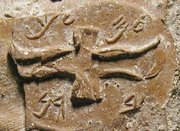
LmlkWe’ve found something like 2000 clay seal impressions in Israel that contain the legend LMLK (lamed, mem, lamed, kaf).

This is a significant legend because it likely is to be parsed L-MLK.

L, in this case, being a preposition that means "to" but also can signal personal property.

MLK is probably to be understood as MeLeK, or "king."

LMLK thus probably means "Belonging to the King."

The king in question seems to have been King Hezekiah, who reigned about seven hundred years before Christ.

There are lots and lots of these seal impressions, but the thing is . . . we’re not sure what they were used for.

READ THE THEORIES.

Water & Wine

A reader writes:

Hi Jimmy

I was listening of KIHM’s rebroadcast of Monday’s show this morning as I am

wont to do and enjoyed it as usual.  I liked your answer to the question

about why water is mixed with the wine at Mass and as I do know something

about the history of wine (I used to sell the stuff for a living) I do want

to expand on the subject if I may.

You said that wine in ancient times was concentrated.  This gives the

impression that it had a very low water to solids concentrate not unlike

juice concentrates that one buys in the grocery store today and to which one

adds water in order to drink.

But rather ancient wines were both slightly more alchoholic and considerably

sweeter than modern wines, cloyingly so.  Therefore it was part of all

Mediteranean cultures (all of whom were wine drinkers) to add water to the

wine simply to make it palatable.

Indeed the definition of immoderate drinker in Greco-Roman culture was not

one that drank to much, but rather one that drank unwatered wine.  The

implication being that if you did that you were too uncivilized to know

better.

Of course there were exceptions to the rule.  The wines of the Greek island

of Chios were considered to be of the highest qualtiy and it was considered

bad taste to dilute them.

So I suspect (and I admit I’m just making an educated surmise here) that in

the early days of the Church, when it was time for the Eucharist the

celebrant simply did what was the cultural norm and added the water to the

wine.  But I also suspect that fairly early on someone also realized that

this cultural norm also was a excellent symbol for the Incarnation and the

dvinization of man through the Eucharist as you mentioned and the prayers

were subsequently added.

Thanks much for the info!

(LINK TO THE READER’S BLOG.)

Water & Wine

A reader writes:

Hi Jimmy

I was listening of KIHM’s rebroadcast of Monday’s show this morning as I am
wont to do and enjoyed it as usual.  I liked your answer to the question
about why water is mixed with the wine at Mass and as I do know something
about the history of wine (I used to sell the stuff for a living) I do want
to expand on the subject if I may.

You said that wine in ancient times was concentrated.  This gives the
impression that it had a very low water to solids concentrate not unlike
juice concentrates that one buys in the grocery store today and to which one
adds water in order to drink.

But rather ancient wines were both slightly more alchoholic and considerably
sweeter than modern wines, cloyingly so.  Therefore it was part of all
Mediteranean cultures (all of whom were wine drinkers) to add water to the
wine simply to make it palatable.

Indeed the definition of immoderate drinker in Greco-Roman culture was not
one that drank to much, but rather one that drank unwatered wine.  The
implication being that if you did that you were too uncivilized to know
better.

Of course there were exceptions to the rule.  The wines of the Greek island
of Chios were considered to be of the highest qualtiy and it was considered
bad taste to dilute them.

So I suspect (and I admit I’m just making an educated surmise here) that in
the early days of the Church, when it was time for the Eucharist the
celebrant simply did what was the cultural norm and added the water to the
wine.  But I also suspect that fairly early on someone also realized that
this cultural norm also was a excellent symbol for the Incarnation and the
dvinization of man through the Eucharist as you mentioned and the prayers
were subsequently added.

Thanks much for the info!

(LINK TO THE READER’S BLOG.)