Annual Lent Fight

Hokay. Every year there’s a big Lent fight about different aspects of Lent. To try to blunt the force of the Lentomachy, let me gather together relevant links that folks can read. This will now become a permapost (at least approaching and during Lent). Here goes:

DURATION

PENANCE IN GENERAL

ABSTINENCE

ASH WEDNESDAY

HOLY THURSDAY

GOOD FRIDAY

FRIDAY PENANCE OUTSIDE OF LENT

Birth Of A News Medium

In the wake of the Eason Jordan scandal there are a lot of people asking questions about the role of bloggers in what might be called "the new situation." Specifically, some are askind: Are bloggers just a lynch mob possessed of a vigilante justice mentality?

HERE’S AN INTERESTING DISCUSSION OF THIS AND RELATED QUESTIONS.

I’d like to ad my own thoughts on the subject.

First, in the interests of full disclosure, I would note that I have blogged on the Eason Jordan story twice: HERE and HERE.

It seems to me that several factors are relevant to the "new situation" with respect to bloggers and the mainstream media (MSM):

  1. For a long time, the MSM has had a monopoly on the news. This was not originally the case. What we now are calling the MSM was previously called "the free press." Originally, the press was not free.
  2. When it did become free, notably with the advent of American democracy and the protections afforded to the press in the First Amendment to the U.S. Constitution, there was a period of turmoil.
  3. These protections were granted because it was believed that a free press would serve as a check against corruption of the ruling authorities: specifically, the government and the police. As long as there was a free press out there, bad behavior by the government and the police would be exposed and, under the pressure of public concern in a democracy, could be corrected. The free press thus served as an answer to the classic question "Who watches the watchmen?" (Latin, Qui custudiet ipsos custudios?). The free press was thus intendend to serve as a guardian of "meta-justice," the justice wrought on those charged with ensuring justice.
  4. Some have observed that freedom of the press belongs to whoever owns a press, and this is quite true. The owners of (printing) presses, being human beings, sought to advocate their own interests and viewpoints via the presses they owned, and so the newspapers of early America entered into a period of intense partisanship, with different papers advocating different political points of view and seeking to attract to themselves as many readers as possible.
  5. This situation persisted as long as the newspapers remained Americans’ principal source of information about current events. But with the advent, in the early and mid 20th century, of broadcast media, the situation began to change.
  6. While there had been newspaper chains prior to the advent of broadcast media, there had been no truly national chains that dominated the news in the way that broadcast networkd (first on radio, then on TV) did.
  7. With the advent of national news networks, the diversity of the news marketplace began to narrow. In order to compete amongst each other, the emerging national news networks sought, for business reasons, to attrack the largest number of listeners (and later viewers) possible. This meant changing their content in such a way that it appealed to a broad swath of Americans, exclusive of perspectives that would be advocated by those most committed to the hardline "left" and "right" of the political spectrum. In other words, it meant creating what was meant to be a "centrist" newsmedia.
  8. In the course of time, though, a trend emerged among the resulting national news networks. With the takeover of American academia by the left, the degreed-professionals who were now being hired by the national networks, the newspapers, and similar news outlets, the journalists populating the news media came to have a left-leaning outlook on the news, which affected both the stories they chose to cover and the angle they took on these stories. This went along with the general liberalizing trend in American culture evident from the 1950s to the 1970s.
  9. With this trend, exclusive as it was of the hard left and moderate-to-hard right, the mainstream media (MSM) emerged from what had once been a more truly free press. Now, in order to gain and retain jobs, journalists had to toe the MSM line in terms of story selection and content. Those journalists who sought to pursue hard left or moderate-to-hard right perspectives would find themselves marginalized or unemployed.
  10. The hegemony achieved by the MSM was not long to last, however. Following the heyday of liberalism in American culture (1966-1976), American culture (though not academia) began to turn right, leading (among other things) to a conflict between the MSM and (by proxy) the American public.
  11. Early signs of this conflict emerged in the 1990s with the advent of popular talk radio (e.g., Rush Limbaugh) and, later, Fox News, as well as a general and sustained critique of the liberal bias of the MSM via groups such as Accuracy In Media. The MSM has not yet (as of 2005) fully reconciled itself to this debate, but it at least is willing now to report on the fact that many in the American public percieve the media to have a liberal bias.
  12. With the advent of the commercially-available Internet in the mid 1990s, the equation changed further. While it might still be true that freedom of the press belonged to those who had a press, the press no longer had to be physical. It could be virtual. With the advent of blogs just afte the turn of the century, now anyone willing to spend a few moments filling out an online form could publish his thoughts on matters of the day to anyone wanting to read them.
  13. With an increasing number of folks online, more and more people were wanted to read them, and by 2004 the number of folks wanting to use blogs as a significant source of their news and editorial content reached critical mass and had a significant impact on national affairs. One result of this was (undoubtedly) the popularity of Howard Dean. Another (debatably) was the re-election of George W. Bush. Whatever effects blogs might be having, they were unquestionably having an effect.
  14. This included effects on the MSM. After decades of hegemony in controlling the news, MSM outlets were dismissive of blogs, dissmissive of the idea that they needed to enter in to dialogue with anybody with a modem and a blog and the talent or luck needed to engage an audience. They were still operating by the rules of yesterday, when they set the news agenda.
  15. It came as a rough shock to them, therefore, that within a handful of months bloggers were able to force such matters as–among others–(a) the allegations of the Swift Boat Vets against John Kerry, (b) the resignation of Dan Rather from the CBS nightly news anchor chair, (c) the resignation of Republican "reporter" Jeff Gannon, (d) an apology from journalist Bill Moyers to former Secretary of the Interior James Watt, and (e) the resignation of CNN news chief Eason Jordan.
  16. It was a traumatic few months! After a long period of MSM hegemony, journalists were no longer accustomed to having their stories vetted by the competition in the way that they were in the days of the free press, when newspapers of significantly different viewpoints cross-checked each other. Who would not be uncomfortable to have their writings cross-checked in this way after so many years of mutually-agreed non-hostility? So the MSM began to squeal and squeal and squeeeeeal!
  17. What the advent of the blogosphere amounted to was the advent of a new "player" at the media table. If the MSM served to "watch the watchmen" with a kind of meta-justice, the blogosphere, et al., was serving to "watch the watchers of the watchem" with a meta-meta-justice. If formerly there were two players–the "Establishment" and the MSM–now there were three: the Establishment, the MSM, and the "new media" (including the blogosphere).
  18. The MSM was sure to resent the entrace of the blogosphere, while the Establishment was sure to welcome it, as now there was a check on the formerly unchecked critique of the MSM.
  19. This brings us up to the present point, but how are things likely to play out from here?
  20. The attachment of the MSM to the old way of doing things likely to lead to a continuing number of confrontations with the new media and the blogosphere–until the reality of the new situation sinks in on them. Once that happens, they will begin to recognize that things cannot be done the old way. The selection of news stories and the angle of by which those stories are to be covered must change and, in time, it will.
  21. While the MSM continues to operate according to the rules of the old situation, the blogosphere and other new media will enjoy a heyday. It will seem to be one successful take-down of a MSM story or figure after another. The blogosphere will not be victorious in every instance, and (with MSM help) it will fail ignominiously in a number of them, but in the main, it will win.
  22. The advent of the blogosphere in significant ways is a return to the days in which ordinary individuals owned printing presses. Now everybody owns (or can own) a press. This means a return to the days of intense partisanship, whereby each press-owner sought to advance his interests and his agenda. In the interests of his interests, each blogger will seek to attract the largest number of hits (i.e., the largest audience) he can, just like the MSM does today. He will also seek to fill his site with the content he believes best reflective of his viewpoint (again, just like the MSM).
  23. What is changed about this situation is not the fundamental motives of news-providers (self-interest and agenda) but the marketplace in which these are pursued. Formerly, in the chaotic environment of the free press, people with significantly different interests and viewpoints competed with each others. Then, in the era of the MSM, narrowed interests and viewpoints reigned. Now, with the opening of the press to anyone willing to fill out a form and provide interesting content, we are back to people with significantly different interests and viewpoints competing.
  24. In this opening phase, the bloggers–many of whom have suffered for years under MSM hegemony–will naturally be tempted to lash out at any perceived infraction on the part of the MSM (or, if they are liberal, on the part of the Bush administration). But these overreations will pass with the passing of time.
  25. The worm may turn again. It is ineviable that certain bloggers, by their being "first on the scene" or their greater talent at blogging, will capture a larger number of reader than others. Their viewpoints will emerge as major new media voices to rival the national new networks of old. This is already happening.
  26. The public will also, naturally, come to rely on certian voices more than others. While some portions of the public may now treat the blogosphere with the credulousness that they formerly treated the MSM, in time they are likely to treat it with the incredulity they now show to the MSM. In other words: Blog readers will become more discriminating about who they feel they can trust.
  27. This may lead to a solidification and standardization of which blogosphere voices are able to compete with the MSM, but–given the "anybody can join" nature of the blogosphere–it is unlikely to lead to the same hegemony that the MSM enjoyed in the late 20th century.
  28. In other words, just as the advent of a free press served as a permanent check on the "Establishment," the blogosphere is likely to serve as a permanent check on the MSM.

A new player has arrived at the table.

The Power Of Myth

Bill Moyers is a recently-retired, long-time journalist who is perhaps best known for two things: His series on mythographer Joseph Campbell titled The Power of Myth and his hard-left bias in reporting.

In more than one way, Bill Moyers has been long acquainted with the power of myth.

Take recent events, for example.

In a recent column Moyers recently wrote the following:

Remember James Watt, President Ronald Reagan’s first secretary of the interior? My favorite online environmental journal, the ever-engaging Grist, reminded us recently of how James Watt told the U.S. Congress that protecting natural resources was unimportant in light of the imminent return of Jesus Christ. In public testimony he said, "After the last tree is felled, Christ will come back."

Trouble is . . . Watt never said it. He didn’t say it in front of Congress or anywhere else. In fact, he said things to Congress in direct contradiction of such views.

Moyers didn’t do his homework. He found a juicy quote in his "favorite onine environmental journal, the ever-engaging Grist" and ran with it.

In so doing, he gave his opponents . . . well . . . grist for the mill.

James Watt, in particular, took offense and

HE WROTE THIS EDITORIAL DEFENDING HIMSELF.

The paper that printed the Moyers’ column (the Minneapolis Star-Tribune) has issued a non-apology apology in which it says it will "will report any further developments in the Grist inquity" to its readers, as if it is holding out hope of finding a basis for the quote now that they’ve been called on the carpet.

Similarly, Moyers has issued a non-apology apology, saying:

Despite [the] widespread currency [of such quotes attributed to Watt], I should have checked their accuracy before using them. Grist and the Washington Post have now published corrections concerning the quote attributed to Watt in 1981.

I talked to Mr. Watt on the phone and expressed my own regret at using a quote that I had not myself confirmed. I also told him that I continue to find his policies as secretary of the interior abysmally at odds with what I, as well as other Christians, understand to be our obligation to be stewards of the earth.

So Moyers can’t simply say a gentlemanly "I’m sorry for being delinquent in my duties" without simultaneously issuing an attack of the form "You were also delinquent in your duties." In other words, the pot can’t simply apologize. It also has to call the kettle black.

Ah, well. In the days before the blogosphere came around to popularize this story (via Powerline), Moyers might have gotten away from it.

That’s the power of myth.

Blogs, Politics, and the MSM

A couple of op/ed pieces worth reading.

First, there’s

THIS INSIGHTFUL PIECE ON THE IMPACT INTERNET HAD ON THE 2004 ELECTION.

Its conclusion?

So what hath the blogosphere wrought? The left blogosphere has moved the Democrats off to the left, and the right blogosphere has undermined the credibility of the Republicans’ adversaries in Old Media. Both changes help Bush and the Republicans.

Then, there’s

THIS PIECE OF INTERNET-SAVVY JACK KELLY ON HOW "OUT OF IT" THE MSM IS.

As an MSM (if blog-friendly) journalist himself, he concludes:

The earth rumbles, and we think it’s our big feet, stomping the Lilliputians. But what if it’s an earthquake about to swallow us up?

R.O.U.S.es: Rodents Of Unusual Size

Capybara_1A reader writes:

It turns out that in certain parts of Venezuela the Catholic populace is allowed to eat Capybara on Ash Wednesday and Lenten Fridays, due to a Vatican ruling centuries ago that the animal could be considered a fish.

See: http://en.wikipedia.org/wiki/Capybara

Some of my friends want to know why this dispensation has not since been lifted. I recall reading that this is because of the economic situation of the country, something about how it would be placing an undue burden on these peoples to forbid the Capybara on Fridays.

To me this seems reasonable, but these friends don’t see it that way. They would like to know why the poor on Fridays can’t just forego meat for a single day of the week, and get their protein from some plant source, like beans.

Of course, they accuse the Church of just being hypocritical and wanting to justify a rediculous papal declaration.

I don’t have independent information on this, but it strikes me as plausible. We noted below that aquatic mammals such as beavers and otters have not traditionally been counted as prohibited on Fridays. Since capybaras spend a good bit of their lives in the water, like beavers and otters, the same would apply to them.

Mind you, I’m not in favor of that. I might let someone get away with counting dolphins and whales as sufficiently fish-like that they don’t count, but anything with four legs and fur, whether it lives in the water or not, I would want to count as carnis. That’s just me, though, and not how traditional moralists have regarded matters.

I don’t see any grounds for charging hypocrisy here, though, especially in regard to a papal decision. I have no proof that the pope ever involved himself in the question, and the Church’s present law doesn’t address the subject, meaning that we have to fall back on the older moralists for tough cases. If the older moralists chose to adopt a "lives in water = okay on Fridays" rule for the sake of not confusing people, we might disagree, we might even think it’s dumb, but we can’t charge them with hypocrisy. It’s not like the pope invented "capybara" Fridays for the sake of cropping up the capybara industry.

I understand that a similar situation exists with Barnacle Geese (once thought to be a fish; to be grown-up barnacles) and also a certain type of Puffin in some parts of Ireland.

Basically, what could be so dire about one’s economic situation that could not possibly, for one day of the week, substitute meat for something else?

I think that someone may have misunderstood something somewhere. It ain’t that impoverished people get to eat meat-like things on Friday because they’re poor. It’s the other way around: The discipline was that everyone refrained from the meat of land animals on Fridays because it was a sign of rejoicing as most people couldn’t (usually) afford it very often.

That has persisted until very recent times. I remember once as a boy, growing up in the impoverished South, going over to a friend’s house and my friend was all excited since, as I was company, his parents were going to serve meat that night.

The reason that things like water-dwelling animals or costal birds that spend a lot of their time over the water were not regarded as counting was not that the people eating them were poor but that they were connected with the water and moralists decided that, lest people get confused and scrupulous, any kind of water animal was okay.

I don’t like that. I think it’s dumb. But that was the consensus on the issue.

The consensus has been changing somewhat. For example, Henry Davis is quite down on villages where seabirds are exempted and says this is likely bogus (he doesn’t use the word "bogus") and that it has more to do with villagers obstinately hanging on to traditional privileges. I can look up the quote if needed.

So, while some might not approve of eating Rodents Of Unusual Size, there’s no question that you can have a pie made with . . . shrieking eels, for example.

UPDATE: Welcome Amy Welborn readers! MORE LENT RESOURCES HERE.

"I Want Droidekas!!!"

Excerpts:

A large black ball, originally designed by Swedish scientists for use on Mars, could be the latest weapon in the war against burglars.

The device, developed at the University of Uppsala, acts as a high-tech security guard capable of detecting an intruder thanks to either radar or infra-red sensors. Once alerted, it can summon help, sound an alarm or pursue the intruders, taking pictures.

It is capable of travelling at 20mph, somewhat faster than a human being. Even worse for intruders, the robot ball can still give chase over mud, snow and water.

While the current version can only raise the alarm, it could be adapted to corner an intruder if the customer wanted, Mr Hulth added.

Patrick Mercer, the Tory MP who is campaigning to give people greater rights to defend their property against burglars, thought the robot ball could have potential: "It would be interesting to see whether the ball had used grossly disproportionate force or whether it would be deemed reasonable.

"But I would much rather a burglar be terrified of householders and shopkeepers, rather than some sort of futuristic device."

GET THE STORY.

“I Want Droidekas!!!”

Excerpts:

A large black ball, originally designed by Swedish scientists for use on Mars, could be the latest weapon in the war against burglars.

The device, developed at the University of Uppsala, acts as a high-tech security guard capable of detecting an intruder thanks to either radar or infra-red sensors. Once alerted, it can summon help, sound an alarm or pursue the intruders, taking pictures.

It is capable of travelling at 20mph, somewhat faster than a human being. Even worse for intruders, the robot ball can still give chase over mud, snow and water.

While the current version can only raise the alarm, it could be adapted to corner an intruder if the customer wanted, Mr Hulth added.

Patrick Mercer, the Tory MP who is campaigning to give people greater rights to defend their property against burglars, thought the robot ball could have potential: "It would be interesting to see whether the ball had used grossly disproportionate force or whether it would be deemed reasonable.

"But I would much rather a burglar be terrified of householders and shopkeepers, rather than some sort of futuristic device."

GET THE STORY.

Ciboria

A reader writes:

Dear Mr Akin,

Do you have a photographic memory? You have been a Catholic for only a short period of time, relatively speaking, yet your knowledge of Encyclicals and abstruse bits of Church teaching – including which number and page has me gob smacked.

Aw, shucks, ma’am. . . . T’ain’t nuthin.

In regard to my memory: I regard it as nothing but frustratingly inadequate. It forgets the things I want to remember and remembers the things I want to forget.

I am told, however, that others think it is a good one. Sometimes folks who have sat in on the radio show have remarked that they’re surprised I’m not looking up answers–not usually at least (unless I want to give an exact quotation as part of the answer).

I don’t really know, but I have been told that my memory is eidetic or "photographic." This does not mean that I remember everything I’m exposed to. (I’m not Lt. Cmdr. Data!) That kind of memory does not appear to occur in humans, despite a popular impression to the contrary. Our brains are designed to forget stuff.

I am told, however, that my memory is eidetic in that I remember things in an (apparently) more vividly visual way than some folks. For example, I will remember what part of the page a piece of information is on and have a mental image of it, even if I can’t remember the information itself. I assumed this was the way everyone remembers things until I was in my early thirties and someone told me that it ain’t. I haven’t asked enough folks to know if that’s true or not, though. It may be that my friend and his family have unusually non-visual memories and mine is only normal.

Now to the not so pleasant part! lol

On page 7 of your booklet, Mass Appeal (fantastic booklet for our undercatechised people) you wrote: ‘On the altar are vessels used during the eucharist, such as the ciborium, a plate or dish-like vessel…’ Should that not be ‘patern’ ? The ciborium is the large chalice like container which holds consecrated hosts from other Masses I think. I am not saying this to be a smarty pants but when/if another edition comes out if this is an error it can be corrected.

I remember when I was writing Mass Appeal that I had to do a good bit of research on the term "ciborium." It’s used in respect to liturgical vessels that have several different shapes. One, as you mention, is chalice-shaped. If that’s not in Mass Appeal then it should be. I’ll check it out and mention it to Publications and see about getting it added, though we’ll need to call the diocese to get in included as the booklet has an imprimatur.

My memory is also that my research turned up that "ciborium" is also applied to certain plate-shaped vessels, like a paten, though I don’t recall the sources I looked at that supported this. I’ll go back and verify them.

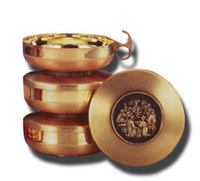
Finally, it is also applied to bowl-shaped vessels, like those in this picture:

Ciboria_1 [SOURCE.]

In any event, it seems that the term has a somewhat broad semantic range that can apply to a number of different shapes.

I will keep praying for the Catholic Answers apostolate.

Thanks! Please do!