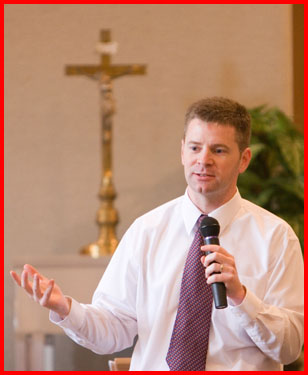
 This post is going to be about the current dustup in the blogosphere regarding Christopher West and the recent ABC News piece on him.
Before I get to the controversial stuff, though, let me say a few words about the task Chris is undertaking.
Christopher West has a difficult job. As a chastity speaker, he's got to juggle several things at once:
They'll also selectively edit the stuffing out of an interview with you and leave the audience with carefully chosen, out-of-context quotations.
That's what happened to Christopher West in this ABC Nightline piece . . .
I've been interviewed by the press, and misquoted by it, often enough that when I first watched this piece, I employed the only safe rule when dealing with an MSM story of this nature: Ignore everything that doesn't come out of Chris's mouth. Do not rely on summaries of his position offered by the reporter.
The summaries that reporters use to link quotations are key means by which they distort, sensationalize, and just plain get stuff wrong.
And, as one would expect, the most controversial stuff in the piece is not stuff that Chris says but that the reporter attributes to Chris in a summary.
The statement that Hugh Hefner is one of Chris's "heroes" or "muses," for example, is something the reporter says–and it's exactly the kind of erroneous "observation" that a reporter in search of a sensationalistic angle would make.
Similarly the statement that Hefner and John Paul II, each in their own way, "rescued" sexuality is something that the reporter says, not West.
Even when one eliminates reportorial summaries and observations, though, and just sticks to the quotations of an interview subject, there is a significant risk of out-of-context presentation.
I know that firsthand because back during the priestly sex abuse scandal I was interviewed by a news program that took an answer I gave to a question on one subject and juxtaposed it with video that made it appear that I was commenting on something that I had never even been asked about.
I was livid.
And so I've always got in the back of my mind, "What's the context for the quote I'm seeing? Could this be taken out of context?"
An example of that is West's statement "I love Hugh Hefner."
Jerkily introduced, without seeing the discussion that led to this statement, after the reporter has just been telling you that Hefner is one of West's heroes, the quotation creates the impression that West endorses Hefner.
But . . . c'mon. I'm guessing that Chris West loves Hefner in the same way that Fundamentalists love Catholics–that is, they love them so much they want them to repent of their lifestyle.
And that's hinted at by what West says next: "I really do. Why? Because I think I understand his ache. I think I understand his longing because I feel it myself. There is this yearning, this ache, this longing we all have for love, for union, for intimacy.&q
uot;
So this is not an endorsement of Hefner and what he's doing. It's compassion toward him, a recognition that there is something broken in Hefner–and all of us–that needs to be addressed.
The language about "feeling his ache" doesn't strike me as the best way to say this. I don't really want to get into Hugh Hefner's head in quite that way (though that's what the language invites me to do).
And there is a danger of spiritualizing away the sexual urges to which Hefner caters if they are presented as just longings for love, union, and intimacy.
But it's clear that West intends to be expressing a sentiment of Christian love towards a broken individual with whom we all share various forms of brokenness.
The response was awkwardly phrased–as likely would be the case when hit by a reporter with a "What do you think of Hugh Hefner?"-type question (you don't want to feed prejudices by coming off as a stereotypical, venom-filled Christian bigot by saying "He's a son of hell," so it's easy to fall back on unnuanced Christian love-type language)–and I think West would be well advised not to make "I love Hefner"-like statements in interviews in the future since we've seen how easily they can be taken out of context or otherwise misunderstood–but it's clear that West is not proclaiming his membership in the Hugh Hefner fan club.
If you want to see what West has to say about Hefner when he's in control of the message, take a look at this video . . .
So I think folks in the blogosphere should cut West some slack and remember that he's on the side of the angels.
At the same time, I think West should use this as a learning experience and take the occasion to purify his message so that he can be even more effective in the future.
Just as a general matter, it's important to keep in mind that there is more than one audience that needs to be (basically) comfortable with what's being said.
Getting through to the people who most need the message of chastity is so difficult that it is easy for chastity speakers to spend so much effort focusing on how to get into that audience's head that not enough attention is paid to the already-convinced crowd and to what will–in the classic Catholic phrase–"offend pious sensibilities."
I think that's at the root of what happened here.
In the TV and YouTube age, the pious crowd is going to see the message being presented to the unpious crowd, and if the sensibilities of the message are too oriented toward the unpious folks then one's relationship with the pious ones ("the Base") will be injured.
Injuring one's relationship with the Base is not a good thing, as our recent former president found out.
The trick, the thing that makes the kind of work West is doing so difficult, is not settling for messages that just please the Base or that just please the worldly target audience. What one has to try to do is find ways of reaching the unchaste without simultaneously alienating the chaste.
That's the challenge.
And it can be done!
You can't please everybody every time, but it is possible to craft messages that will reach the unchaste while not unnecessarily offending pious sensibilities.
In that regard, what I'm about to say isn't specifically applicable to Christopher West. In various points it may or may not apply. It just consists of observations that I've made after listening to the tapes of a lot of different chastity speakers as part of my job.
For example, leaving out invitations to get inside the heads of people as they experience sexual temptation or conjuring uncomfortable imagery in the audience's minds.
Every chastity speaker is aware of the importance of modesty in dress and of modesty in relation to sex in general. Indeed, sexual modesty is a human universal, appearing in one form or another in every culture, even very depraved ones.
There is a parallel that chastity speakers need to observe in modesty of word and image and suggestion (and especially in humor).
It can be tempting, to show the audience that you understand where they're coming from, to talk about your own temptations in too demonstrative a fashion, to dwell on them, and end up oversharing in a way that makes people uncomfortable, causes unnecessary offense, or even constitutes an occasion of sin.
I've heard multiple speakers (not West) do precisely this to show the audience that they understand.
And it's really not necessary. One doesn't need to dwell on the details of one's temptations, their history, or their intensity.
The audience will be convinced if you simply say with conviction, "Believe me. I know where you're at. I'm subject to temptation, too." And leave it at that.
Another potential source of problems is trying to grab the audience's attention by doing something arresting and unexpected.
Sometimes chastity speakers try to push the envelope by violating the audience's preconceptions of what a chastity speaker should be.
There is a role for this. Chastity speakers do need to challenge the stereotype that the unchaste will want to impose on them. If they don't do something to neutralize that stereotype, they won't be able to reach the people who need to be reached.
And so some arresting, unexpected, envelope-pushing is to be anticipated and even necessary.
But it's easy to overdo it or to have it misfire.
I think that's what's happening with West's use of Hugh Hefner. In its present form, I don't think that this part of his message is helpful, even when done on his own terms rather than ABC's.
Watch the second video and notice what he's doing: He's using Hefner as a way of getting around the prudish Puritanical/Victorian Christian stereotype. He presents both Hefner and John Paul II as men who proposed alternatives to the stereotype. He then urges people to accept John Paul's solution rather than Hefner's.
The problem is that he does this in such a way that he makes it sound like John Paul II and Hugh Hefner are basically on the same side, struggling against the evil common enemy of sexual Puritanism. Hefner just has a misguided solution.
And that's false.
West is also overselling the potential for Puritanism. He makes it sound as if our natural inclination as Christians is to see sex as bad and shameful and our bodies as evil, and that's not the case. That's the stereotype of what Christians think, but that's not what they really think.
I don't know any adult Christians who think that way.
And I think it sells Christian culture short to make it sound as if this is the big danger for Christians.
It would be more effective to give Christian culture its due and challenge the stereotype by saying something like, "C'mon . . . when has anybody ever told you that your body is shameful or that sex is dirty. Have you ever heard a priest say that from the pulpit? How about a bishop? How about a pope? If anybody has told you this, they weren't speaking for the Church. This is a false stereotype of Christians that the media tries to sell you to justify a loose-sex lifestyle."
Whatever one makes of that way of fighting the stereotype, it's not true that John Paul II and Hugh Hefner are on the same side against the common enemy of Puritanism. If we have to say there are two sides here, John Paul II and Puritanism are on the same side against the evil represented by Hefner.
It's Puritanism, not Hefner and his pornographic lifestyle, that has the well-meaning but misguided solution to the problem posed by the enemy.
So I think West should at least reframe the way he handles this issue. The stereotype needs to be fought, but not by making Hugh Hefner sound like someone who's on our side but just misguided.
It can be so easily misunderstood.
I also wouldn't give too much credit to Hefner's rationalizations of his own actions. Human monsters always accuse other people, or the culture at large, of being to blame. They'll also cast themselves in the role of heroic revolutionary as a mask for baser motives (like money and access to naked, sexually-attractive women).
He really should not do that.
Particularly problematic, I think, is the defense of this that is offered on his web site:
The Song of Songs is of great importance to a proper understanding of Christianity. Indeed, the saints and mystics of the Catholic tradition have written more commentaries on the Song of Songs than any other book in the Bible. It is in the very center of the Bible for a reason. Calling it the "centerfold" in Scripture, Christopher intends to redeem the common understanding of the word "centerfold," which is usually associated in popular culture with pornography. In no way is it meant to compare the sacredness of the Song of Songs with the distortions of pornography.
In no way is it meant to compare the sacredness of the Song of Songs with the distortions of pornography.
People thought he was inappropriately comparing the Song of Songs in the Bible to the centerfold of a Playboy.
Even if he doesn't, though, let's try to keep a proper perspective on this.
West is a man on the side of the angels, and he's an effective speaker who has done a great deal of good. He stands to do much more good in the future, and he should be encouraged in that.

Thanks so much, Jimmy, for your comments on this. I agree that Christopher West has done some great work, and I pray that he will continue to be a blessing in the New Evangelization. He really inspired my husband and me to study the Theology of the Body and become presenters for our diocesan marriage preparation program.
I think you meant that the Song of Songs in not quoted in the New Testament?
Thanks, Leah. Problem fixed.
Jimmy: I very much appreciate your balanced (as usual) approach to Mr. West’s apostolate. One thing, however, that I wished you had covered was this quote from the West interview: “Interestingly enough, John Paul II, long before he became pope, in the late 1950s, wrote that if a man is truly to love his wife he must learn how to contain his own climax in order to learn how to bring his wife to climax with him.” I think this severely misrepresents Karol Wojtyla’s teaching in Love and Responsibility. Concerning this I ran across the following article: http://culturewarnotes.com/forum/content/what-does-john-paul-ii-really-say-about-sex.
Very interesting Jimmy!
Randy Engel offers a free MP3 response to this dust up as well to anyone who emails her at
rvt161@comcast.net.
Excellent post, Jimmy. As is true of your posts in general, this one is thorough, even-handed, and interesting to read.
If anyone asks me about the Christopher West interview, this blog post will be the definitive commentary that I will point them to.
I don’t watch tv. While I can get some of what happened from Jimmy’s post, could someone give some background on the controversy for the tv-less. This is the first I’ve heard of this [putting head back into sand].
The Chicken
Um, wow.
West is actually pretty convergent with Karol Wojtyla here. Instead, the article you cite seems to selectively quote other stuff JP2 says while ignoring the relevant comments.
From Love and Responsibility (explicit language caution: Wojtyla is a lot franker than some of his modern defenders are comfortable with!):
“We have defined love as an ambition to ensure the true good of another person, and consequently as the antithesis of egoism. Since in marriage a man and a woman are associated sexually as well as in other respects the good must be sought in this area too. From the point of view of another person, from the altruistic standpoint, it is necessary to insist that intercourse must not serve merely as a means of allowing sexual excitement to reach its climax in one of the partners, i.e. the man alone, but that climax must be reached in harmony, not at the expense of one partner, but with both partners fully involved. This is implicit in the principle which we have already so thoroughly analysed, and which excludes exploitation of the person, and insists on love. In the present case love demands that the reactions of the other person, the sexual ‘partner’ be fully taken into account.
“Sexologists state that the curve of arousal in woman is different from that in man—it rises more slowly and falls more slowly. Anatomically, arousal occurs in the same way in women and in men (the locus of excitement is in the cerebro-spinal system at S2-S3). The female organism, as was mentioned above, reacts more easily to excitation in various parts of the body, which to some extent compensates for the fact that the woman’s excitement grows more slowly than that of the man. The man must take this difference into account, not for hedonistic, but for altruistic reasons. There exists a rhythm dictated by nature itself which both spouses must discover so that climax may be reached both by the man and by the woman, and as far as possible occur in both simultaneously. “
That’s for starters. Wojtyla goes on to discuss the physiology of orgasm, in ideal and non-ideal realizations, in both the man and the woman, in considerable detail (including women faking orgasms to soothe male pride). See a longer excerpt here.
I don’t know about anyone else but hearing the pope talk about sex is pretty much hearing your parents talk about sex… not something you want to hear.
Add me to the list of those who appreciate your even-handed analysis of Christopher West and the ABC piece. Some of the criticisms I have heard in the blogosphere, which you also write about here, are valid concerns that hopefully Mr. West will humbly take to heart. Others seem to just be piling on with their own nits, snide remarks, and outright ad hominem attacks such as this from one such article:
From rock ‘n’ roll to the movies, TOB’s chief spokesman has a little something for everyone. He’s now dispensing moral advice gleaned from, if you can believe it, Spider-Man 3!
…
But for all of Mr. West’s good intentions , what does it say about TOB when one of its foremost experts—the man who understands it best!—is a “big fan” of rock ‘n’ roll who spent three years siphoning moral lessons from Spider-Man 2 and likes to ‘bang on the drum all day’?
I suppose clever digs are easy to make and hard to resist. I was hoping to see a little more charity from fellow Catholics.
SDG: Thanks for the clarification. My copy of L&R is at home and I wasn’t able to check the citation myself.
One point I would like to make: It is fine if Christopher West uses Karol Wojtyla’s writings for the benefit of his sexuality/marriage talks, articles, etc. I believe, however, that there should be a line drawn between what is actual Magisterial teaching with what is the personal philosophico-theological writings of Wojtyla–not that there is necessarily anything wrong or misleading in his writing.
http://forums.catholic-convert.com/viewtopic.php?f=19&t=107574&start=180#quick_reply
I’ve listened with fascination to tons of West’s work. Boo on mainstream media, and without going into details, I raise my eyebrow on Akin’s analysis as well.
If we’re going to be fair, West’s characterization of Hugh Hefner is about as bad as Akin’s characterization of Puritanism. The Puritanical attitude that West refers to is a variant of the Manichean heresy and has a fairly recent pedigree in things such as Victorian anti-sex literature and the like. As a heresy opposed to the full truth of God’s creation, Puritanism must, by Akin’s own logic, be an error every bit as serious as Hefner’s with consequences just as eternal.
Further, Akin’s objection that he himself does not know any adult Christians who “see sex as bad and shameful and our bodies as evil” proves nothing. I seem to recall a journalist in 1984 dumbfounded by the presidential election results since he didn’t know anyone who voted for Reagan. Even if Akin’s acquaintances represent an accurate sample of Christians generally, he ought to know that evil does not always call attention to itself by donning red tights, a pitchfork and horns. By the same logic, one could stroll into an abortion clinic and conclude that there are no murderers there since no one defines themselves as such.
Matthew: The link you provided requires registration, and even then won’t let me at least view the forum you linked to. What’s the deal?
Just-Me (familiar?)
According to the dictionary, the word puritanism may be used also in the general sense of “strict and austere religious conduct”. Probably Jimmy is using the word in that sense and not defending a historical heresy.
http://www.giftfoundation.org/products_naked.cfm
You can get his 10CD set for under $5, basically what it costs to produce them. I enjoyed his earlier cassette talks better, but there was some language that I think could be taken out of context and be disconcerting to others. Furthermore, the man is an ordained deacon with an extensive therapy (if that’s the right word) practice. I can imagine he is qualified to say what a lot of Americans experience. Furthermore, there’s no denying he just wants to give as much honor to JPII as he can, quoting him as much as possible. He is in Abp. Chaput’s Diocese of Denver and has his endorsement, and his thoughts are very logical (and passionate), so I think we can trust West’s orthodoxy.
One thing to keep in mind here is that Christopher was interviewed for
EIGHT HOURS
and they boiled it down to
SEVEN MINUTES
This is what they call an “in depth” story.
Matheus,
If Akin is using the word “Puritanism” in a way other than the way West is using it, then Akin’s criticism is unsound.
I have limited familiarity with Christopher West, but anyone who can help this neurotically guilt-ridden Catholic wife/mom overcome her (neurotic) feelings of shame re sex is a hero in my book. (No, it’s not Catholic Guilt; it’s “raised-by-a-hypercritical-father” guilt.)
And re the Song of Songs: While it may not have warranted citations in the NT, it certainly has played an important role in mystical theology (e.g., Saint John of the Cross).
@Anthony Rowe — I had just the opposite reaction. When I read some of what JPII said about sex, I said to myself, “Whoa! The pope says it’s OK for a married woman to experience pleasure. Awesome!” For me, it was totally liberating.
Maybe that just reflects my generation. Maybe it reflects my neuroses. I don’t know. I know only that, for me, it was awesome for a pope to acknowledge female sexualtiy / sensuality. Three cheers for the late, great John Paul II — and count me among those who still say: “Santo subito!”
I would really like to see a citation for the “most quoted book” line. It struck me as very strange too. As far as puritan Christianity being a myth. It is a myth many Catholics believe. I know I showed Chis West DVD’s at our parish and lots of people raised their hands when he asked who was taught “spirit good, body bad” message growing up.
This interview, like so many others, should spur anyone being faced by the media to bring his or her OWN camera and recording equipment and record the interview for one’s own record. That way, you can “go to the tape” to dispute the distortion produced by the interviewing organization.
“Even when he did see the problem with calling the Canticle of Canticles the “centerfold” of the bible, he brushed it off as a delivery problem. Uh…Jim…think about this for a minute. What does it say about the mind of a man who compares sacred scripture to porn? How ’bout we deal with the fact that this degradation of the sacred scriptures, the cause of this comparison, which apparently is only a trifling matter of delivery, is to be found in his reading of the same book which he takes as an ‘erotic poem’? Such a reading of that book has always been considered heretical by the Fathers”
I stopped watching (and reading) MSM a while ago.
A concern I have about Christopher West is that he presents a lot of these very complex and delicate subjects to Teens. Teens, especially being raised in the hyper-sexualized culture we’re in, will have a hard time correctly contextualizing these things.
Hebrews 5:14 comes to mind.
If Akin is using the word “Puritanism” in a way other than the way West is using it, then Akin’s criticism is unsound.
Not if Mr. West is using the word to mean something other than its generally accepted meaning:
http://dictionary.reference.com/browse/puritanism
Very well written. My thoughts exactly. I hope Mr. West reads this.
Dcs,
If we are to go by the definition in the link that you provide, “extreme strictness in moral or religious matters, often to excess; rigid austerity,” then it can’t be too far off the mark to ascribe a Manichean character to such an ethic. As your generally accepted meaning affirms, Puritanism is extreme, excessive and rigid. None of these qualities conforms to a healthy faith.
Good analysis, Jimmy.
A good friend of mine and I had a long conversation about this interview yesterday and were both of two minds about it.
On the one hand, West was clearly mishandled by the media. They took his quotes out of context and made him look like he was saying things he wasn’t.
On the other hand, as you pointed out, you must must must must must expect exactly this from the media and give them nothing to do it with.
The entire ethos of the modern media interview is to get you to say something they can use to their benefit on air. You simply have to go into any interview like this with your clear talking points and repeat them, no matter what kind of questions they throw at you.
That said, if one of those talking points is your admiration for Hugh Hefner, you’re bound to get taken out of context. You just can’t walk into the interview with that as one of the things you want to say.
In my very humble opinion, West should have seen this coming a mile away and found another way of saying what he wanted to get across.
I also think some of the criticisms of his approach as playing into concupiscence are not entirely without merit.
We’ll be held accountable for every idle word, even when we’re talking to ABC news.
Finally, I’m curious about the mythos surrounding simultaneous orgasm. I’m all for working towards better sex, but is this an attainable goal for every couple? If it’s not, is it right to make it seem like a mandate for every couple?
Fr. Angelo Geiger has posted an excellent commentary over at Dawn Eden’s blog:
http://dawneden.blogspot.com/2009/05/christopher-wests-blind-spot-guest-post.html
It’s well worth reading…he seems to quite an insightful and talented writer.
Re: The claim that saints and mystics of the Catholic tradition have written more commentaries on the Song of Songs than any other book in the Bible.
I knew I’d heard that claim made before and I finally found it – in Jaroslav Pelikans’s “Whose Bible Is It?” he says,
“An especially piquant documentation of the interpretation of the Bible in the Middle Ages, and of the difference between the Jewish and the Christian interpretation, can be found in their use of ‘the book which was most read, and most frequently commented in the medieval cloister, a book of the Old Testament: the Canticle of Canticles’ or Song of Solomon.”
for this quote Pelikan cites: Jean Leclercq, “The Love of Learning and the Desire for God” (New York 1982)
He goes on to say, “Of the countless expositions of the Song in the Middle Ages, one of the best known is the collection of the word-by-word commentary in the sermons of Bernard of Clairvaux . . .”
He also mentions that Thomas Aquinas was dictating a commentary on the Song of Songs when he died.
Interesting. So there’s at least some support for West’s claim. 🙂
As a journalist and a Catholic, I respectfully disagree with Mr. Akin.
I think Mr. West was treated fairly in the ABC News video, with the exception of that editorial comment about Hugh Hefner being his hero. But if you watch the whole video it is clear that West does not endorse his sexual ethos and that he advocates a more rigorous (e.g. no pre-marital sex, no contraception) and more liberating response to Victorian/Puritan sexual morality.
Where you might run into problems is with people hearing only about the Hefner/hero comment and not seeing the video. As a reporter, I understand the pressures of trying to consolidate copious amounts of information into limited space (or time, in the case of television). You’re never going to be able to reproduce all that information in all the thoroughness that those interviewed want. Like that comment that other poster made about eight hours of interviews. I’m sorry a multi-hour documentary on this topic just isn’t happening.
Inevitably, you have to do some summarizing. Ideally, this summarizing should be more analytical than editorial, and that’s where ABC News went off the reservation, when they took liberties with what he said about Hefner.
All too often, I’ve seen people just react to headlines without reading the stories and I think that’s what’s happened with this video. Other than the Hefner comment, can anyone give me any other concrete example from that segment where ABC “got something wrong”? Sensationalized – probably. Distorted – maybe. But overall, I’m sorry, but that was fair and for the most part, accurate.
I’ve done interviews for NPR Science Friday and Science News Magazine and the secret to preventing oneself from being misquoted is to use big words 🙂
It’s Friday…
The Chicken
+J.M.J+
>>>Interesting. So there’s at least some support for West’s claim. 🙂
Well, only insofar as the fact that the Song of Songs (SofS) was much commented upon in the past. However, the content of those commentaries, especially that of Saint Bernard of Clairvaux (which I own a copy of) is entirely allegorical, with Christ as the Bridegroom/King and the Christian soul, or the Church or even sometimes the Blessed Virgin as the Bride/Shulamite.
The allegorical interpretation tends to mute the “sexual” aspects of the SofS by spiritualizing them, interpreting them as symbolic of a higher truth. Hence the praise of the Shulamite’s “two breasts” becomes praise directed at the Christian soul’s dual love for God and for neighbor, or maybe the virtues of charity and fear of the Lord. Or, if the Shulamite is seen as the Church, they could signify the Old and New Testaments on which Mother Church feeds her children, etc. The latter interpretation emphasizes the function of the mammary glands as nourishment for infants, thus turning ones attention away from erotic implications of those anatomical structures.
So yes, the SofS has been commented on at length, but from a very chaste perspective. It was not seen as a mere love poem extolling human marriage, but as something much higher.
I studied the allegorical interpretations of the SofS extensively many years ago and that is basically how I approach that inspired book. So when I hear someone claim that the SofS contains a “biblical endorsement of oral sex as forplay,” it makes me wince. I’ve certain Evangelicals claim this very thing about at least three verses in the SofS. Until watching this interview online yesterday I had no idea that West also taught it, though I don’t know to which verse(s) he is referring.
At any rate, I am dismayed that he has adopted this novel interpretation, which has absolutely no basis in the ancient Christian commentaries on this book that he mentions. As Matthew points out above, the Church Fathers insisted that the SofS should not be read as earthly erotic poetry, but as a mystical allegory or parable of God’s love for His people (the rabbis agreed with them on this point as well).
Needless to say, I cringe even more to hear this beautiful book called a “centerfold.” A centerfold is something lewd to be gawked at, the SofS is *emphatically* not something lewd to be gawked at! Both the ancient rabbis and Church Fathers were very strongly opposed to such vulgar use of that holy book. Even if he doesn’t mean it that way, that’s how it came across and I agree completely with Jimmy that he should ditch that terminology yesterday!
Okay, off the soapbox, now. Great analysis Jimmy, BTW.
In Jesu et Maria,
And great comment, Rosemarie, BTW.
As a critic of Freud might say, “Sometimes a mammary gland is just a mammary gland.”.
If such a grossly carnal and even heretical reading of the scriptures forms a major premise in West’s understanding of doctrine, he ought to be censured immediately and taught the correct understanding. Afterall, he is attempting to teach millions of Catholics his perverse opinions on the matter. If he refuses to be corrected, then he should be excommunicated. The man is out of control and ruining souls.
Rosemarie, very good post. Please contact me about your sources, I have a couple of questions when you get some time. masnyder10@hotmail.com
Or Freud himself, for that matter.
The allegorical, spiritual readings of the Song of Songs are clearly very important. The literal sense, though — the primary sense, upon which all other senses are founded — is erotic, as Jimmy indicates.
No its primary sense is not erotic, that is a serious error.
I don’t know that I would call SofS “erotic” poetry (that would tend to encourage an understanding of SofS that is base and shallow, which it emphatically isn’t), but there’s no getting around the fact that, as an allegory, it is in the form of romantic poetry, and that eroticism is one aspect of that.
If the author had wanted, he could have used imagery that didn’t involve breasts and kisses and perfumed oil, and such… but he did choose to write about those things. As with all scripture, in plumbing the deeper levels of spiritual meaning present, the primary, literal meaning of the text can’t be leaped over or neutralized (or, of course, contradicted).
The erotic sense of some passages can’t – shouldn’t – be avoided or glossed over, but it SHOULD be understood in context, and not EVER presented as *simply* erotic. The erotic sense is presented as only a fraction of a much broader and fully complete appreciation of the Beloved. It is a picture of human romantic love, but untainted by sin, which perverts the erotic sense and magnifies it beyond all reasonable proportion.
SofS speaks of erotic attraction, but tamed and in its proper place. In this context – and only in this context – is it safe to celebrate romantic/erotic love. There is longing for the beloved, whole and entire, not just his/her eyes, dusky skin, breasts, etc…
I am not familiar with Christopher West’s work, but I would say that the Song of Solomon is one of those pearls you don’t want to cast before swine. No insult intended (at all), it’s just that anyone who doesn’t already possess a reliable moral compass properly oriented straight at the True North of church teaching is likely to get lost in there. They will take from SofS only what they bring to it.
Kudos to Mr. West for giving it his best, though. As Jimmy said, “We’re talking about a very small part of West’s overall message, and his message as a whole is extremely positive.”.
I just think the Song of Solomon is like nitroglycerin… very dangerous if not handled properly.
“The allegorical, spiritual readings of the Song of Songs are clearly very important. The literal sense, though — the primary sense, upon which all other senses are founded — is erotic, as Jimmy indicates.”
You beat me to it, SDG.
“Theodore of Mopsuestia aroused such indignation by declaring the Canticle of Canticles to be a love-song of Solomon’s, and his contemptuous treatment of it gave great offense (Mansi, Coll. Conc., IX, 244 sqq; Migne, P.G., LXVI, 699 sqq.). At the Œcumenical Council of Constantinople (553), Theodore’s view was rejected as heretical and his own pupil Theoret, brought forward against him unanimous testimony of the Fathers (Migne, P.G., LXXXI, 62).” CE, Canticle of Canticles
“No its primary sense is not erotic, that is a serious error.”
Pardon me, but in making such a statement I believe the burden of proof rests squarely on you. The plain, ordinary meaning of the text in a number of passages of SofS is very frankly erotic.
Now, you may rightly maintain that it is much more than erotic, or that the deeper, symbolic meaning is more significant than the ordinary, plain meaning, but you can’t, with a straight face, deny that the primary (that is “first”, not “most important”) meaning is erotic.
It’s okay, old chap. Sex is good. God invented it.
“Theodorus Mopsuestenus said that in Sacred Scripture and the prophecies nothing is explicitly said about Christ, but about certain other things; but they accomodated it to Christ: as Psalm 21. They divided my garments among them. is not said of Christ, but of David as according to the text.
This mode is condemned in that Council, and he who says Scriptures are so to be expounded is a heretic. Hic autem modus damnatus est in illo Concilio, et qui afferit sic exponendas Scripturas, haereticus est.” St. Thomas, Exposition of the Psalms of David.
Thanks, Tim J. Yes, obviously by “erotic” I don’t mean “prurient” or “inflammatory,” but rather relating to the love of a man and a woman, including physical love.
Matthew: If you mean to say that the text in its primary sense must be regarded as an allegorical celebration of the mystical romance of God and his people, or something like that, I would like to see a defense of that thesis in keeping with the exegetical principles set forth in Dei Verbum and related documents, or at least rooted in authoritative magisterial texts, as opposed to relying on traditional exegesis.
+J.M.J+
The OT Prophets sometimes used the imagery of human spousal love to describe God’s love for Israel – and yes, they sometimes included “erotic” imagery in that metaphor (Ezekiel 16 for instance). They were not describing an actual human relationship between an actual man and woman, but using such a relationship as an allegory for a higher reality.
So it is, I believe, with the SofS. I don’t think that the literal meaning of the song is, say, King Solomon’s marriage to a princess, as some modern Bible scholars suggest – though, SDG and Tim J., you may not mean that anyway when speaking of the “literal” meaning of the text. I’m just trying to clarify what I’ve been saying.
Based on my studies of it, I believe that the SofS is intended to be allegorical or maybe parabolic. If even the rabbis saw it that way then that view is certainly not a later prudish interpretation of the SofS by sex-hating Christians, as some try to suggest (I’m NOT talking about present company, BTW).
Now, the “erotic” imagery in the book (which as Tim J. points out, is only part of the whole) can certainly be seen as evidence of the goodness of marital love as God originally created and intended it, since only a good thing can be an image of heavenly realities. However, I don’t believe that the book primarily exists to extol human married love. That is a secondary truth that can be drawn from the use of such imagery, but the primary meaning of the book is the love between God and Israel or Christ and His Church (or the Christian soul).
If this is so, then it is futile to look for a justification for any particular “sex act” in the SofS, as Chris West and others do. Whether or not oral stimulation during foreplay is acceptable is for moral theologians to hash out among themselves; one shouldn’t look to an allegory of the love between Christ and the Church for a “biblical endorsement” of any such practice. That’s what I was trying to say above.
In Jesu et Maria,
Is the implication that the exegetical principles set forth in Dei Verbum somehow vindicate the erotic reading of Scripture? In other words, are you saying that Dei Verbum contradicts traditional exegesis of Scripture?
This would seem to be an affirmation of the literal sense of the text to the exclusion of allegorical senses — of David and not of Christ. That is indeed serious error.
However, it would be equally erroneous to say that “They divided my garments among them” is said of Christ and not of the psalmist.
The correct statement, following the fourfold senses of scripture and the exegetical method set forward in Dei Verbum, is: “They divided my garments among them” is said first of all, in the primary sense of the text, of the son of David, and also typologically of Christ the true and final Son of David.
Matthew, as SDG was getting at above, “erotic” doesn’t mean “dirty” or prurient.
“If this is so, then it is futile to look for a justification for any particular “sex act” in the SofS, as Chris West and others do… one shouldn’t look to an allegory of the love between Christ and the Church for a “biblical endorsement” of any such practice.”
Heartily agreed. You are correct, Rosemarie, that I do not believe SofS gives a real account of any actual events, just as Jesus’ parables don’t.
Keep in mind, please Matthew, that “primary” in the sense I have been using it does not mean “the most important” meaning of the text, or “the main point of” the text, it means the first, literal sense of the text, from which all symbolic meaning flows.
+J.M.J+
Yes, by “erotic” I don’t mean dirty or prurient. I mean describing activities relating to the marital act. It’s only a portion of the SofS, probably not even half of the book all together, but some people overemphasize it and that’s dangerous – I like the nitroglycerine comparison here.
In Jesu et Maria,
No and no, but a third no, to deny that your two interrogatives are interchangeable forms of the same query “in other words.”
It may be quite possible to maintain an “allegorical” reading of SoS as the “literal” (i.e., primary) sense of the text, as Rosemarie seems to be suggesting. I do doubt whether this interpretation can be so strongly defended that it would be fair to call an erotic reading “serious error.”
In keeping with what I wrote above, I absolutely agree that it would be serious error to reject traditional exegesis, on SoS or any other book. Not infrequently, however, I think that traditional exegesis is often concerned with secondary senses rather than the primary, literal sense of the text. (Note that, rather confusingly, the literal sense of the text is not necessarily the same as the literal meaning of the words. The literal meaning of the words “My heart is broken” is that I have a serious cardiopulmonary issue; the literal sense of the phrase is that I am emotionally devastated. In short, the literal sense refers to the meaning the human author expects and intends his words to communicate to his audience, whether literally or metaphorically.)
If modern exegetes are correct in viewing SoS as a celebration of human love first and foremost, this does not invalidate traditional exegesis. It does mean that traditional exegetes were doing allegorical exegesis, not literal or primary exegesis.
To pick an easier example, I think it is beyond reasonable question that the passage you cite from the psalms, “They divide my garments,” was inspired first and foremost by the psalmist’s own experiences. That is the primary and literal sense of the passage. However, this does not exclude or undermine, but is the basis for, the application to Jesus.
Whether something parallel is true of SoS may be a somewhat more complicated question, but I don’t see any basis for automatically excluding as serious error the proposition that it is.
What part of “this mode of interpretation was condemned by an Ecumenical Council of the Church” don’t you understand? “Theodorus Mopsuestenus said that in Sacred Scripture and the prophecies nothing is explicitly said about Christ, but about certain other things; but they accomodated it to Christ…”. The primary meaning of the CofC is related to supernatural realities. To make the primary meaning anything else is anathema. I think you’ve spent too much time associating with rationalists.
I think that the two sides of the issue on the Song of Songs are missing a fairly important connection between their viewpoints:
If the meaning of the book is primarily an allegorical or spiritual, that is, it refers primarily to the relationship of Christ to the Church, then doesn’t the use of sexual imagery essentially make Mr. West’s entire point that the sexual relationship between spouses serves as a representation or a type of the love between Christ and Church?
In other words, if the primary meaning of the text is allegorical or spiritual, then far from detracting from the book’s praise of and commentary on marital love, it actually elevates this praise and deepens this commentary to higher degrees.
God bless,
Shane
Thanks, Shane. It’s a point well worth emphasizing, though FWIW I don’t think that that point was lost on Rosemarie, who I think makes more or less the same point, or on me for that matter, though I didn’t address it, in part because I wasn’t writing about West.
You need to read my post more carefully. I agreed that it was an error to say that the verse was written of David and not of Christ.
Not according to the sources you’ve provided so far. I don’t see any “If anyone says, that these things were written first of the psalmist, but also of Christ, anathema sit.”
+J.M.J+
Okay, now that I’ve thought it through, let me try to present my position more systematically, since prior explanations have been a bit scattered.
The SofS is an allegory of God’s love for Israel/Christ’s love for the Church. This is how both the ancient rabbis and the Church Fathers all saw it. As Matthew points out, Theodore of Mopsuestia was condemned for proposing otherwise.
This inspired allegory uses the idiom of a Hebrew love poem and occasionally has a description related to the the marital act. However, the SofS is not a mere human love poem and those “sexual” descriptions should properly be interpreted allegorically as I described above.
Now, one can infer from the use of a marital allegory in the book that marital relations must be a good thing as God intended them. However, that does not mean that one should read the book to “gain a better understanding of the goodness of sex,” or search it for biblical justifications for certain acts between married couples. That’s not its purpose. And calling the book a “centerfold” is simply beyond the pale – no, No, a thousand times NO!
In Jesu et Maria,
Matthew,
You are misunderstanding St. Thomas’ words and the meaning of the council.
Theodorus said that Old Testament passages such as from the Psalms did not refer explicitly to Christ, but only to the literal or historic events they described. In his view, Christians later took these passages and read Christ into them.
The proper view is that these Old Testament passages referred both explicitly to Christ and to the literal or historic events that they described. In other words, when the Psalmist wrote Psalm 22, he was referring to himself, and we can be certain that that person truly was experiencing that sense of abandonment at the time. On the other hand, we also know that by Divine inspiration, the passage was intended by God to refer to Christ.
This is the key here: was the passage originally intended by God to refer to Christ – is that what God meant when He inspired it? Theodorus essentially said “no.” This view was condemned. However, as the Second Vatican Council has explicitly taught, this does not exclude that God may have intended other things as well. In fact, we know for certain that He did, for the Church teaches that we are to follow the four-fold Biblical interpretation “system” of the fathers.
God bless,
Shane
For a better analysis of this controversy, see:
http://www.catholicnewsagency.com/new.php?n=15950
The prescription is not political calculation. The prescription is truth, however offensive it may be to anyone, and whether it be labeled “rigorist” or not. It need not be presented as an infomercial as in the second video above. This approach is no coincidence. West presents it in this repulsive way because his approach is rooted in marketing calculation and rank sentimentality. A “rigorist” – that is, a true – approach is desperately needed, no matter how unpopular it may be. Jesus always let those who found his words too hard to leave him.
Regarding the Song of Songs, see this from Peter Kreeft:
http://tinyurl.com/ow7tyj
From the words of St. Thomas, it appears that Theodore thought that the primary sense referred to the historical figure explicitly and only to Christ in an implicit way thereby necessitating appropriation.
Rosemarie’s exposition is once again rooted in wisdom. I know that such a possiblity is extremely remote, but has it occurred to anyone here speaking in a contrary manner, that they could be perhaps, not fully grasping or understanding the meaning and depth of Sacred Scripture? I know its a stretch, but it is a reality that we should all seriously ponder since the sacred text deals, as all admit, in profoundly deep and sublime truths.
Could it be, just maybe, that whoever wrote that book was writing explicitly of supernatural love between Christ and the Church and that the use of such mystical poetry is of an entirely different order than we are ordinarily familiar with? In other words, that it has nothing at all to do with eros or carnal love of the lower appetites?
Do you think God, knowing our fallen state, would seriously inspire a book for public reading that contains an incitement to impurity?
What Theodore thought I can’t say, but what was claimed by the proposition that seems to have been condemned was that the text referred to the historical figure and not to Christ. If the proposition that was condemned was not what Theodore thought, that wouldn’t make him the first figure in church history to be associated with a sternly condemned error that he didn’t actually affirm.
I can’t imagine why you couch it like this. Of course I take for granted that I may, and indeed do often if not always, fail to fully grasp and understand the meaning and depth of sacred scripture. I take it for granted that you do too. That consideration, in itself, doesn’t help me to conclude that a particular exegetical approach is more or less plausible than another.
That is indeed a possibility I’m willing to consider and discuss, as I’ve repeatedly stated. What I objected to was the point-blank insistence on this one possibility as the only correct one, with other options being “serious error.”
Um, no, that it can’t be. At the very least, on the level of imagery, the writer is clearly drawing on eros, carnal love, the lower appetites, just as the parable of the prodigal son draws on paternal love. The parable of the prodigal son is certainly about far more than ordinary human paternal love as we know it, but to say that it has “nothing at all to do with ordinary human paternal love as we know it” would clearly be an overstatement.
I don’t see how this is a helpful consideration at all. For one thing, I think by now it’s pretty clear no one here thinks the book is an incitement to impurity. For another, if the imagery in itself is incitement to impurity, why would God use it at all, whether literally or metaphorically? You don’t see God comparing himself to an adulterer, say. Because adultery is bad.
Again, Matthew, we have explicit Church teaching that there are various senses of Scripture, and that a single passage of Scripture can mean more than one thing. Indeed, this is precisely the “depth of Scripture” that you speak of!
You say, “From the words of St. Thomas, it appears that Theodore thought that the primary sense referred to the historical figure explicitly and only to Christ in an implicit way thereby necessitating appropriation.”
There are a variety of problems with using this argument in the way you are.
First, if we assume you are correct, this does not exclude the possibility that the passage refers to Christ explicitly and to the historical figure explicitly. As I said before, the human author may have intended to refer to himself or to some other historical person, while the Divine author may have intended to refer to Christ. Furthermore, an even better take on it follows from the rather well-known fact that Biblical prophecy quite often has two fulfillments: and immediate, proximate fulfillment, and a future fulfillment. Thus, a text is entirely capable of referring explicitly to a contemporary figure at the time it was written, and explicitly to the Christ who will later come.
In other words, we have many different ways to see such a thing without restricting us to one explicit reference and one implicit reference.
Second, the way you take St. Thomas’ words is by no means certain, and in fact it’s not the impression I get when I read them. Rather, it seems to me that Theodorus was condemned for the belief that the Scriptures did not, in fact, refer to Christ at all, but rather that the Christians read Him into the text. Note how St. Thomas says, “‘They divided my garments among them,’ is not said of Christ, but of David as according to the text.” Here St. Thomas’ example of Theodorus thinking holds that the passage is not said of Christ, but refers to David. He doesn’t say that it is not primarily about Christ, or that it is only implicitly but not explicitly about Christ, but that it is not about Christ. Further, the example states that it is referring only to David because the text itself refers only to David.
The example here very much so seems to be one, not of putting one sense of Scripture over another, for there is no reference whatsoever to rank or to order of importance, but rather is of altogether excluding anything other than the precise, literal meaning of the text.
God bless,
Shane
Just-Me writes:
If we are to go by the definition in the link that you provide, “extreme strictness in moral or religious matters, often to excess; rigid austerity,” then it can’t be too far off the mark to ascribe a Manichean character to such an ethic. As your generally accepted meaning affirms, Puritanism is extreme, excessive and rigid. None of these qualities conforms to a healthy faith.
I did not say that Puritanism was healthy, only that Mr. Akin is not wrong in his characterization of it. If Mr. West is using a special meaning for Puritanism then he ought to be at pains to define it first. That way he won’t be misunderstood. And it is simply wrong to call Puritanism (in its normal sense) as an error as serious as Hefner’s (which, for lack of a better word, we might call “hedonism”). The former is a remedy for sin (albeit an unhealthy and extreme one), the latter is a celebration of sin. And I also have to wonder whether traditional Catholic views on modesty and chastity are being grouped together with the un-Catholic views of Puritanism.
It seems like a large source of the confusion is that Matthew is unaware of or misunderstand the medieval fourfold method of Biblical exegesis which states that there are four levels or layers of meaning in any text:
1. the literal or historical,
2. the allegorical,
3. the moral,
4. the anagogical or mystical
SDG says the literal is the primary sense not meaning that it is the most important but that it is the first which must be considered.
for example “Jerusalem”
–Literal: a city in Judea
–Allegorical: the church
–Moral: the soul
–Eschatological: the heavenly abode of the saints
Thus the Song of Songs is literally an erotic poem, it describes the romantic encounter between a man and a woman. But allegorically it represents Christ’s love for the Church, morally it represents the soul’s quest for God. Saying that the erotic love poem is primary isn’t to say that’s the most important meaning but that it can’t be overlooked because to understand what it’s telling us about the moral or the spiritual life all hinges on the literal meaning of the language.
You can’t just skip over the literal meaning of a passage and say Jerusalem isn’t really a city in Judea or that the Song of Songs doesn’t really describe an erotic encounter between a man and a woman. At the same time, it would be equally wrong to stop at the literal level and say that Jerusalem is only a city in Judea and that the Song of Songs is only an erotic love poem.
Dcs,
But West has gone to great lengths to define the word “Puritanism” as he uses it in his lectures and writings. He equates it with Manicheanism, exactly as I have said. In this context or in the context of the definition that you have provided, Puritanism remains an evil which sees the human body only as a source of sin. It could also be a form of Angelism. The fact remains this is a heresy every bit as evil and every bit as distorted as Hefner’s hedonism. If either are followed at the expense of the truth, they will lead to Hell.
“Others seem to just be piling on with their own nits, snide remarks, and outright ad hominem attacks such as this from one such article…”
I don’t know: is it too much to expect dignified allegories and examples when dealing with sex and theology, or must it all by brought down to American Idol level to be heard? Of course, West really just takes a page from Scott Hahn’s bad pun-ridden playbook or Pat Madrid’s painful jokes page and runs it another direction. Did domeone impose a ban on thoughtful theology that aims for a somewhat sophisticated prose, or will things spiral further as we struggle to reach a Twitter-ing culture? The fact it took a piece this long to correct the missteps of a guy who has been writing on this stuff for years does not inspire faith in West’s general prudence.
The fact it took a piece this long to correct the missteps of a guy who has been writing on this stuff for years does not inspire faith in West’s general prudence.
A few points.
First, this is not really a fair statement as the entirety of Mr. Akin’s piece was not aimed at correcting Mr. West’s missteps. Rather, the length of the piece was due to the fact that Mr. Akin’s goal was to address the controversy in such a way as to be fair to both Mr. West and his critics and to do so in such a way that it could be read by persons of all sensibilities.
In other words, Mr. Akin had to use an excess of qualifiers and very precise language so as to make sure that as many people as possible would gain something from it. He had to avoid saying things which would cause die-hard West fans from turning away, as well as those things which would be off-putting to folks who may find anything short of Victorian-era prudence to be going too far.
That kind of writing is extremely difficult, and more importantly, space consuming. I most often write in such a manner, and as such am rarely able to produce a remark on a discussion or an answer to a question that is any shorter than a few pages. I get a lot of flak for it, actually :).
In any case, the point is that it’s not as though Mr. Akin spent paragraph after paragraph correcting missteps of Mr. West’s. In fact, the amount of text devoted specifically to this is a rather small part of the article.
And this leads into point 2: this is precisely not the way that Mr. West approaches things, because his goal is, as Mr. Akin stated, not to be approachable to all persons, but rather to a particular group who are in need of a particular message. He says things in a way to try to get the message across to these people, and as a result he often needs to say thins which may not be appropriate for those who are already on board with the Church’s teachings on sex.
Jesus is a good example of someone who acted similarly. In order to reach the sinners, He often went into places that may not be appropriate for the ordinary righteous man to go. This is neither to say that Mr. West is without error nor to compare everything that he does to something Christ would do.
Jesus, of course, never erred, as I am certain Mr. West does. Additionally, Jesus knew what everyone needed, and so we see that at times He harshly criticized sinners, while at other times He gently corrected them, and at yet other times He offered no correction at all, only the call to sin no more.
Yet we can see from this an important principle: people at different spiritual points need different types of evangelization. Christ knew perfectly what each person needed and offered to each person only what he or she needed, and to others what they needed. Christopher West is approaching a particular crowd, yet his message, unlike Christ’s, is not available only vocally to individuals or small groups of people.
Rather, his message may end up on the computer screen of a worldly 22 year old man – his audience – just as easily as a chaste 44 year old husband or a 83 year old woman. That makes it a bit difficult. The question here is really how one ought to handle giving a message in this case. On the one hand, it is important to avoid offending the pious sensibilities of many, but on the other hand, it’s also important that one’s audience get the message they need. I have not any answer, but I do hope that my explanation of the problem has helped.
I think the thing to look at is the comments of the people who go to his talks and the fruit it bears. People like myself have been brought back into the church because of his teaching and how he makes it digestable for the common person. After being away from the church for ten years, his talks changed my life, helped heal my marriage and bring me and my wife back into the church. I think the theologians who slam him are much like those that slammed John the Baptist and Jesus himself. Just jealous and petty. Its a shame because he touches lives and brings them into new life in the church
+J.M.J+
As Jimmy Akin quoted above, Chris West’s own website says: “Christopher intends to redeem the common understanding of the word “centerfold,” which is usually associated in popular culture with pornography.”
So even West acknowledges that the word “centerfold” is commonly associated with pornography. It is to this common meaning that he alludes when he calls the Song of Songs a “centerfold” based on its “erotic” content.
As for Hefner, his publication still displays impure images and promotes sexual immorality regardless of how many Christians associate with him or how accepted he has become in our degenerate society. I also doubt that Chris West would disagree that Hefner is a pornographer.
In Jesu et Maria,
Please don’t feed the troll.
+J.M.J+
Oh, that’s a troll? Okay, sorry; haven’t been here in a while. 🙂
In Jesu et Maria,
It’s discouraging to me that so many people have jumped on the bandwagon to critize West. I imagine the man faces enough resistance and cynicism from the skeptics, and now he has people who should be encouraging him jumping down his throat as well. Very disheartening. How about a word of encouragement for the man? If someone wants to offer him constructive cricism, it should be done privately.
Well said, Jesse. The man is a true JPII protege. Listening to his tapes is listening to the heart of the deceased pope.
“That kind of writing is extremely difficult, and more importantly, space consuming. I most often write in such a manner, and as such am rarely able to produce a remark on a discussion or an answer to a question that is any shorter than a few pages.”
This may flow not from the complexity of the subject, but from deficient writing skills. Since you can rarely produce less than a few pages to any comment or question, this seems likely. If so, this book would be especially helpful:
http://tinyurl.com/qukrx9
And, of course, this:
http://tinyurl.com/pbq864
You might be constantly violating rule 17 (13 in the 1918 edition) of the latter book:
http://www.bartleby.com/141/strunk5.html#13
Jitpring,
Thank you for your kind suggestions. I can assure you that my writing skills are in fact quite good. Of course, I do not take the time to exercise them to any great degree when posting on blogs in my spare time :).
Regarding the rule #13 that you linked, because I have often spent hours removing every unnecessary word from material I have written, I have a sense of to what degree I use them. More importantly for the purpose of this discussion, I know to what degree one can shorten the length of a piece by removing such words while maintaining the full breadth of it’s meaning.
In particular, I have a lot of experience trying to discuss complex and/or sensitive subjects in writing, where there is no opportunity for dialogue to sort out misunderstandings. Because words and phrases can have multiple meanings, it’s often necessary to go to great lengths to clarify just what you intend to say when discussing these kinds of topics. You essentially need to anticipate and respond to every possible misunderstanding in your original text, for unlike in a conversation there will be no possibility of clarifying later.
If you’re really concerned about the sensitivity of the subject, it’s also important not to rely on picking the word that has the right meaning or connotation for clarity. I mention this because it’s easy to look on this as a way of avoiding misunderstanding while keeping a piece short: say that a person’s timing was “unfortunate” rather than that it was “bad” and you won’t have to worry about explaining that you don’t mean to blame him for anything, for example. The reality is that this kind of caution doesn’t guarantee how any individual is going to interpret your words, especially when the audience you are writing to is intellectually diverse. If avoiding confusion is indeed of primary importance, then it’s far better to simply more explicitly spell out your point at the expense of space.
I write all of this because I believe that this is what Mr. Akin was doing here, far more than writing a post that was lengthy because of the amount of correction Mr. West was in need of.
God bless,
Shane
Shane, I fear that you’ve indeed caught the unfortunate prolixity bug!
Jitpring, your opinion of Shane’s literary style has been noted. Move on.
Its funny, myself and Rosemarie post positive things about Christopher West and the dribble continues between the snooty intellectuals.
Answer the question:
Does what Christopher West teach bring people closer to God,Jesus, the Church, desire for the Eucharist, Confession and their spouse?
GC, does language like “snooty intellectuals” and “the dribble continues” bring people closer to God, Jesus, the Church, desire for the Eucharist, etc.?
An Appeal:
Before posting, please consider
(a) what it is you want to say
(b) whether what you have to say is appropriate, on-topic and (likely to be) helpful
(c) whether it advances the discussion and adds to what has already been said
(d) how to say it in a way that is at least polite and respectful, if not (stretch goal!) charitable.
Dissent and argument is fair game. Rudeness is not.
Thanks for your cooperation.
I have followed Christopher West’s work for a while. Here is one comment:
I have been uncomfortable with the general tenor of the “new Evangelization” approach that tries to use new theological/philosophical idioms to express traditional Catholic truths. While I sympathize with the endeavor to present the traditional teachings of the Church in a way that will allow the uncatechized to “buy in,” I think that all too often this approach leads people astray by failing to make key distinctions. Anyone who has read theology or philosophy knows the importance of distinctions to the endeavor.
John Paul II was a philosopher and theologian. That does not mean that his private theological writings were the most lucid explanations of Catholic theology. As an academic, JPII engaged certain philosophical and theological debates within the academy. West and other JPII cheerleaders have taken everything the man has said and elevated it to some new, sublime approach to Catholic teaching. I have a problem with this; not the least that it trivializes the real academic debates JPII engaged in.
JPII wrote much of his work to address specific philosophical controversies. His answers may or may not be convincing. As a layman, I lack the academic credentials to judge this. What I do know is that Holy Mother Church has laid out Her teachings in Catechisms and offical documents for me. Instead of chasing down the latest novel approach, perhaps time should be spent on passing on the traditions of the Church in the traditional formulas. It seems that by continually chasing after novelty as the next magic key that will unlock the door to the unconverted, we risk losing the richness of our traditional theological expressions. I think that this has been the case in the last 50 years.
SDG,
I would hope it would make you think. You and others are missing the forest for the trees. Answer the above question:
Does what Christopher West teach bring people closer to God,Jesus, the Church, desire for the Eucharist, Confession and their spouse?
I apologize if I have offended you but the question remains. I am a firemen who is a work in progress. I come from the rougher side of life. This man helped me out of darkness into the light. I have read enough of the attacks on him all over from the intellectuals. Look at the fruit that his ministry bears.
Answer the question…
I must say Jimmy, I found your blog on this subject to be the best one I have read so far.
I wish more people would have your insight and charity.
GC,
I’m all for trying to make people think. In that connection, there’s nothing wrong with your question, and I’m happy to answer it. I doubt though that you were trying to make people think with the language I objected to. I appreciate that you are a work in progress; I hope my comments are helpful in that process.
My answer to your question is yes, he does. As I see it, the theology of the body is the Church’s necessary response to the sexual revolution. John Paul II made an astonishing contribution to the Church’s dialogue with the wider culture in this respect, but his contribution was at a high level, and needs popularizers to unpack and bring his insights to the masses.
Chris West does this, and I think on the whole he does it well. Fundamentally, he’s a good egg, and he’s doing good work. That doesn’t put him above or beyond constructive criticism by any means, but constructive criticism should begin by recognizing the good work being done. Those whose take on West is limited to fault-finding may have some valid points to make, but they create new problems even as they point others out.
Jimmy’s take above is, I think, just about pitch-perfect. West would be well advised to benefit from Jimmy’s insight. And West’s critics would be well advised to learn from Jimmy’s method.
Jimmy goes to great lengths in his piece to make it clear that Mr. West is doing good, important work and is “on the side of the angels”.
As SDG points out above, this does not place Mr. West above criticism in every aspect of his work. In fact, it is likely *because* so many think highly of his work in general that they think it a shame that, in this case, he has left himself (and the teaching of the Church) open to distortion and ridicule unnecessarily.
What a great post. This is exactly what Catholic bloggers should strive to do: carefully and critically analyze items of interest from a Catholic perspective to see both what is good and what is bad, with an emphasis on the good since, of course, God is on the side of good and we are supposed to cling to what is God and think about it.
That’s a little like saying that a little poison in your tea isn’t all that bad. I intend on responding to the posts directed at me, but not here. I don’t do “comboxes.” I invite anyone interested to come over and join in the conversation here: http://angelqueen.org/forum/viewtopic.php?t=25867
Objections are most welcome as they serve to sharpen the arguments for an upcoming critical essay.
SDG said: “As I see it, the theology of the body is the Church’s necessary response to the sexual revolution.”
This is the typical hyperbolic rhetoric I hear all around. Has not the Church dealt with “sexual revolutions” in other places and times without the theology of the body? Hasn’t the traditional theology of the Church explained the moral theology of sexuality clearly? Perhaps, the theology of the body IS a good response to the sexual revolution. But comments like one SDG made are all too common among purveyors of novelty.
“Now, one can infer from the use of a marital allegory in the book that marital relations must be a good thing as God intended them. However, that does not mean that one should read the book to “gain a better understanding of the goodness of sex,” or search it for biblical justifications for certain acts between married couples. That’s not its purpose.”
As one who has used the Theology of the Body as conceived by John Paul II and as presented by Christopher West as a guide over many years to become “a man on the side of the angels”, I suspect that our late pope did, among other things, specifically read the bible to gain a better understanding of the goodness of sex. It is specifically by mining ever deeper into the meaning of words such as “my sister, my bride” and “a garden enclosed” that John Paul II teaches us how to be fruitful and multiply as God would have us do so. His teachings are very detailed and can be shocking to some as the post by Jimmy Akin demonstrates.
Upon reading an article earlier this week in which Dr. Alice V presented a negative response to West about the ABC interview, I perceived that she did not actually know what the teaching of the Theology of the Body contains. In this excerpt from Rosemarie I get the same feeling. I do not pretend to be anywhere as educated or enlightened as several of you as evidenced by the many lengthy postings and the glossing over of my eyes, but I do believe that a serious study of John Paul II’s Theology of the Body would help some here.
Rick,
Please consider that those purveyors of novelty may include George Weigel. JP-II addressed many areas in TOB. The “sexual revolution” in our society may only be one fruit of our times – albeit an obvious one. The effort to destroy Christian Marriage and the family may be a more important concern.
The development of Theology in the Church is done in Church Time. The TOB was a reaction to what JP-II had seen and experienced in the cultures and nations of his lifetime. The philosophical basis for these cultures had developed over the last two centuries. Catholic Social Teaching has warned against the beliefs and actions of nations based on these philosophies for at least those two centuries. The offspring of those philosophies are still with us and very active in our own culture(s) today.
These theories of society are a perversion or warping of the Catholic teaching that we are members of the Body of Christ. All of them subvert the just needs of the individual to the “rights of the society”. They call the individual by many names. Comrade, Citizen of the Fatherland and Consumer are just a few of the names. In all cases the nation or culture teaches that the needs of the society outweigh the needs of the individual. The society becomes the greatest good. Almost by definition they are antithetical to individual faith as the society takes the place of God. Belief in anything greater than the society is cause for persecution. Another description for these societies is “Godless ism’s”. Even without persecutions, the life of any individual is willingly/wantonly sacrificed for some “greater good.”
JP-II saw the results of the beliefs and actions of two nations based on these “godless ism’s” in his lifetime. He saw their disregard for individual lives. He also saw that the offspring of the ideas and actions of those nations and societies would carry over into our time and our culture.
IMO with the grace of God and through our actions, TOB will have a counter effect to those views.
In order for TOB to reach the society as a whole it will require BOTH the development of sound Theological understanding AND a popularizing Catechetical approach. Remember that the most subtle of creatures (the serpent or the father of lies) will attempt to obstruct these teachings. Both the Theology and Catechesis will be perverted where possible, subverted otherwise or obstructed as a last resort.
We must not fall prey to a cultural tendency to want immediate perfection in everything. God is not finished with us. This includes Theologians and Catechists. We are all imperfect. We must remember that the just man falls many times. This does not say anything about the times he is pushed down or his words are twisted!
I hope that this only echoes the sage words of Mr. Akin.
Just-Me writes:
“But West has gone to great lengths to define the word “Puritanism” as he uses it in his lectures and writings. He equates it with Manicheanism, exactly as I have said. In this context or in the context of the definition that you have provided, Puritanism remains an evil which sees the human body only as a source of sin. It could also be a form of Angelism. The fact remains this is a heresy every bit as evil and every bit as distorted as Hefner’s hedonism. If either are followed at the expense of the truth, they will lead to Hell.”
If he is going to use the word (“Puritanism”) in an interview with the media, which will be broadcast to a wide audience that will not be familiar with his lectures and writings, then he has to define it for them or use some other word. Again, I agree that Puritanism is unhealthy but it cannot be compared with hedonism. The former is an unhealthy way of combating sin while the latter is a celebration of sin. Puritanism might lead to hell indirectly (one rebels against Puritan austerity and falls into sin), while hedonism leads directly there. I don’t see how they are remotely comparable.
+J.M.J+
>>>Upon reading an article earlier this week in which Dr. Alice V presented a negative response to West about the ABC interview, I perceived that she did not actually know what the teaching of the Theology of the Body contains. In this excerpt from Rosemarie I get the same feeling.
I know the basics of the Theology of the Body, but that doesn’t mean I agree with everyone who teaches their own version of it. I also know that the oldest Jewish and Christian understanding of the SofS is that it is an allegory of the love between God and His people. If that is so, then it is not intended as some kind of divinely-inspired manual for conjugal relations.
In Jesu et Maria,
The Theology of the Body, for those who understand, will alienate a new generation of Catholics. BTW, I think JPII was confused on many matters and created a touchy feely manifesto that is in blatant contradiction to the Scholasticism of the Middle Ages. But this will not bother American Catholics who are more attracted to the cult of personality than the inerrancy of dogma.
Rick and Gruesse, well said.
SDG, I, not you, will determine when I’ll move on regarding Shane’s prolixity.
Thanks for the insults, Gruesse. I’m sure that will convince a lot of people.
“I also know that the oldest Jewish and Christian understanding of the SofS is that it is an allegory of the love between God and His people. If that is so, then it is not intended as some kind of divinely-inspired manual for conjugal relations.”
Correct me if I am wrong, but if a pope of the Roman Catholic church provides teaching whereby he indicates that some of “SofS” is more than just “allegory” but can also be effectively used as a “divinely-inspired manual for conjugal relations” then shouldn’t I believe him?
His Peace
+J.M.J+
If he was making an ex cathedra declaration on a matter of faith or morals, then yes you should definitely believe him. Otherwise, it is technically possible for a pope to err.
Though I guess my first question should be: Where did JPII say that about the SofS? If he did indeed state that, then we would have to look at the exact quote in context and judge the relative authority of the speech or letter in which it appears.
In Jesu et Maria,
“the cult of personality”
Hey! You can’t mention the David B. fan club without paying them royalties! FWIW, I start at 10%.
I thought he meant the Jimmy Akin Personality Cult. I even dusted off my secret decoder ring.
No, Bill912. Anytime someone mentions a non-specific personality cult, it means mine. That’s how it works. BTW, I’m sorry I haven’t mailed out your decoder ring yet: the cult is many, but their moms won’t give them the credit cards.
JPII first gave his teaching on TOB orally as a series of 100+ Wednesday sermons early in his pontificate. SofS 4:9 and 4:12 are specifically expanded upon in the teaching of the TOB. After JPII had delivered his series of sermons they were bound and published by the Vatican. Are they “ex cathedra”? I don’t know. Was he clearly teaching us, his flock, on an issue of faith and morals? Most definitely.
Interestingly, the book that West is holding in the second video of the Jimmy A article, is an exposition of the first part of B16’s encyclical “Deus Caritas Est” in which B16 expounds upon eros and agape. Having read this book, it appears to me that B16 agrees with JPII. In the introduction B16 is quoted saying he “wanted here … at the beginning of his pontificate … to clarify some essential facts concerning the love which God mysteriously and gratuitously offers man, together with the intrinsic link between that Love and the reality of human love.”
His Peace
+J.M.J+
Wednesday audiences do not qualify as ex cathedra declarations. I’d have to read the relevant sections in context to comment on them. I’m not 100% opposed to the TOB, just wary now of some of Chris West’s interpretations of it and his way of presenting it. It’s possible JPII’s discussion of those two verses is innocuous; at least I’m certain the Holy Father wouldn’t call the SofS a “centerfold”!
In Jesu et Maria,
+J.M.J+
Hmm, I posted a response but it seems to have disappeared. Hope it doesn’t show up again after I post this:
Talks given at Wednesday audiences are not infallible declarations. I would have to read the actual quotes in context to see what the Holy Father said; it might be innocuous. I’m certain, however, that JPII would never have called the SofS the “centerfold” of the Bible.
At any rate, I don’t reject the TOB out of hand, I just don’t agree with everything its popularizers like Chris West make it out to be. I’ve noticed that they often add generous portions of their own thoughts, opinions and reflections to the meal.
In Jesu et Maria,
Um. Try to curb your enthusiasm for the Holy Father’s vision, Rosemarie. 😉
+J.M.J+
Heh. BTW, you can delete the earlier double-post above. Sorry about that.
In Jesu et Maria,
Why do some posters, such as Ben, think that Puritans are worse than Hugh Hefner? They are not Catholic, and so, fine, they are heretics. But they are on the side of the angels with respect to the deadly sin of lust, and are standing as devoutly against concupiscence and prurience as any orthodox Christian. That they are heterodox makes their solution wrong-headed, just as Jimmy said in his post, but their wrong-headedness about sex is, as Jimmy says, a consequence of original sin, and the ORIGINAL PROBLEM IS ORIGINAL SIN. A lack of clarity on this point is devastating to any teaching effort, whether it is apologetics, or catechesis.
Hugh’s many sins are not merely his promotion of pornography in the public sphere, but also the normalization of deviant lifestyles (such as his “swinging” and decades of well-known public debauchery at his “mansion”) and the dragging of all those men, young and old, down with him, into the depths of depravity. It is for the fall of others on our account, that our public figures are accountable, in addition to their own personal sins.
However heretical an ascetic may be, he is neither advocating any sin, nor practicing it himself, nor dragging others down with him. How anyone can casually assign the Puritans to a more base level of depravity than Hugh seems to me to be only possible based on an emotional guttural response, and not only any logical or philosophical grounds whatsoever.
W
Thanks, Jimmy, for your attempt to offer a balanced critique of Mr. West. I thought your criticisms of Mr. West’s teachings were good, as far as they went.
I understand Mr. West has taken on a challenging task in presenting himself as one who wishes to reach the unreached, without offending the guardians of our treasured Tradition. The formidability of the task notwithstanding, if you can’t pull it off without disgracing the doctrinal heritage of our Church, then pull yourself out of that spot, and make room for someone else who potentially can.
I think you are being way too easy on this guy. He is a modern-day Jovinian, but I would be surprised if you could see that. And if he is, think about the implications of that.
Rick said: “Hasn’t the traditional theology of the Church explained the moral theology of sexuality clearly? Perhaps, the theology of the body IS a good response to the sexual revolution. But comments like one SDG made are all too common among purveyors of novelty.”
Over the course of the centuries, the Church puts herself at the service of all to answer the burning questions of the day. While the ground rules have been in place from the beginning, today’s generation questions the very notion: “male and female He made them,” which was blindingly obvious before this. Or was it? The definitions of “marriage” and “family” are under attack and intimacy is seen as merely a contact sport (thanks to the ubiquitous contraceptive mentality).
As always with contemporary challenges, theology unfolds according to the guidance of the Holy Spirit and the previous actions of the Magisterium. This is not novelty, but depth — mandated by the newer questions.
As for Jimmy’s comment that he doesn’t know anyone with shameful views of sex and the body, I can easily say I was raised that way and know many who were. (I’m 48 years old.) It’s called Jansenism and has a home in many pockets of the Protestant world from which I converted. From the feedback in a recent CW TOB class with many older cradle Catholics, I believe I’m not alone. Don’t even get me started on Queen Victoria who was deeply coloured in that sort of thinking, so much so that she protested violently when one of her daughters wanted to breast-feed a child. (Same in my family.)
We can always learn more about sexual morality and the beauty of intimacy — and suffering (for they are linked). It’s all the more interesting to know that the Angelic Doctor was studying the Song of Songs when he had his final vision, on which he commented, “it’s all straw.” Who knows what he may have seen…?
For a couple of analyses of Christopher West’s approach as a whole, see these two pieces by David Schindler and Alice von Hildebrand:
http://www.headlinebistro.com/hb/en/news/west_schindler2.html
http://www.catholicnewsagency.com/new.php?n=15950
How tragic for Christopher that he has become the subject of these attacks. Reading through some of the public analysis of his comments seems to confirm for me how protestant some of our theology has become given the descriptions set out about the definition “concupiscence”. While I understand that it is about a selfish human desire, this protestant notion that human beings have an innate tendency to do evil. Surely our desire is for good, and so based on the opinions of prominent Catholics on this, one is left with the sense that there is no hope to be redeemed or to be transformed through Christ. Its also unfortunate that prominent Catholics have had to undergo this public attack. It seems more about one up man ship. Why not discuss these matters out of the public arena, determine what has been misrepresented, and then come out more unified. However, I think there are conservative Catholics who are more interested in self promotion than perhaps giving consideration to the need to present a united voice.
“Do you think God, knowing our fallen state, would seriously inspire a book for public reading that contains an incitement to impurity?”
Ezechiel 23
jennifer w,
“this protestant notion that human beings have an innate tendency to do evil”
We are inclined to sin, since the Fall.
“one is left with the sense that there is no hope to be redeemed or to be transformed through Christ.”
Not at all. But each of us must know our weaknesses, and as we say in the act of contrition, we must “avoid the near occasion of sin.” We therefore have to exercise prudence in all things which, thanks to concupiscence, could lead one to sin (especially misuse and misunderstanding of things relating to sexuality). I think neither Jimmy Akin nor several other bloggers are being unfair to or judgmental of Mr. West: they are being cautious, and trying to point out important things in spite of the noise.
I’ve seen some pretty bad fruit come out of West’s “unpacking” of JPII’s TOB. I’ve sat and listened to a rather self-important young man justify divorce because the sex-life in the marriage is not the ideal described in TOB. And I really don’t think this type of thinking among young TOB devotees is all that uncommon. And when I mentioned that I didn’t think JPII meant for his TOB to deny or negate the Church’s long-standing teaching regarding the theology of the cross, I was looked at as some type of archaic, pathetic Catholic who is not able to experience the New Enlightenment.
They are taking the ideal and insisting that be the everyday reality. Going to be a lot of broken hearts and souls, given the selfish interpretations young people are coming away with from West’s “unpacking”.
We don’t need to give any other answer to the so-called sexual revolution other than the one that our Lord gave to us, His example from the Holy Cross. Most of this unpacking seems to just lead young people into a very selfish interpretation of what they should expect from marriage.
Dave,
You wrote: “Are they “ex cathedra”? I don’t know. Was he clearly teaching us, his flock, on an issue of faith and morals? Most definitely.”
The only two clear examples of ex cathedra (Pope speaking alone infallibly) we have are the Assumption and the Immaculate Conception encyclicals and if you read them you will see a very stylized and exact format of wording that has never been used about this issue at hand.
What did happen after the IC and the Assumption is that the ex cathedra wording was imitated and reduced to a concise form in three parts of Evangelium Vitae when the Pope also spoke infallibly but this time not alone (ex cathedra) but with all the Bishops in agreement remotely by way of poll which is his alternative (besides within a Council) to speaking ex cathedra and still speaking infallibly. In Evangelium Vitae then, John Paul spoke infallibly against abortion, euthanasia, and killing the innocent with a form resembling that of the IC but resulting from getting all Bishops worldwide to agree (virtual agreement since there can always be several holdouts that do block virtual agreement..Aquinas: “reason accounts little as nothing”).
On birth control, there is a group who feel it is solved infallibly in the ordinary magisterium as so universally condemned throughout history that it rises to the level of universal ordinary magisterium (which is a third way of infallibility). This group contains the writers Germain Grisez, John C. Ford S.J., Fr. Brian Harrison, and Professor May and other writers. A group who opposed this as being solved in the ordinary magisterium so as to be universal was Fr. Josep Fuchs, Fr. Karl Rahner and Fr. Bernard Haring…then of less authority, Fr. Charles Curran who was decertified to teach Catholic theology for reasons beyond this one issue (he said many NT dictums could not really be reached but were ideals).
While Curran was thus the reprehensible part of the second group, he comes in handy when you are stopped for speeding by a cop. You simply note to the officer that the speed limit is an ideal that cannot be reached by most men howsoever they strive. Let me know how that works in your town.
So what is the status? Talk to theology departments of Catholic colleges near you and ask who is right…Grisez or/ Haring and Fuchs and Rahner. Why would major theologians say it is not yet solved infallibly? Because tradition has been similar on other issues and those issues are now gone. Slavery was supported in Augustine, in Aquinas, in the decretals (or older Church canon law), and then was opposed by Popes but with exceptions that the Popes knew of as existing in the theologians of the Universities and that obtained until 1960 in the “Theologia Moralis” of Iorio in its 5th printing. That is why religious orders had slaves despite the bulls by Popes against slavery which bulls were few when you see that 40 Popes held office during the time period involved and used no interdicts to support their bulls.
Secondly you will only find about 8 Popes if that who wrote more than a sentence on the matter and there were 265 Popes. The most cogent force in the tradition was really the writings of Augustine on the matter.
That is all I’ll say. I’d rather that people use the local theology departments of Catholic colleges to has out this area. Dissenters in Washingto DC per Rome had only to sign a statement that the papal position was “authentic Church teaching” which in dogmatic theology terms is less than infallible. And you will note that no Pope sought to punish Karl Rahner nor Fuchs nor Haring on this issue. The reason is that moral theology tomes used in seminaries mainly allow for studious, prayerful and counseled dissent from the non infallible. Most of the dissent against Humanae Vitae may not be prayerful or studious nor counseled….and thus that group may end up with high divorce rates. The group who dissent with prayer, study and counsel may or may not be a smaller group. We should leave this to God so that human ego stays out of this whole fracas.
To follow NFP seems to be a wonderful thing but if the person then proceeds from that to use the issue to judge others in an area where even Popes have not punished others….then all the wonder fades and the demons are pleased that it has become one more divisive hobby within Catholicism.
Dear Bill Bannon,
You wrote:
Because tradition has been similar on other issues and those issues are now gone. Slavery was supported in Augustine, in Aquinas, in the decretals (or older Church canon law), and then was opposed by Popes but with exceptions that the Popes knew of as existing in the theologians of the Universities and that obtained until 1960 in the “Theologia Moralis” of Iorio in its 5th printing.
Contraception and slavery are not the same in scope, nor do they bear the same mark of historicity. There is some Biblical precedence for slavery or at least the acceptance of slavery when it cannot be avoided. There is no acceptance – none – for contraception. There is also no acceptance in any of the Church Fathers as far as I know. Linking the histories of contraception and slavery reception to imply that the argument about contraception is not settled is simply wrong. In fact, unlike slavery, you will not find, I think, a single Catholic moral theology text prior to Vatican II that lists contraception as an option. In fact, the same year (1930) that the Lambeth Conference allowed contraception in rare instances for the Episcopal Church, Pope Pius XI published Casti Connubii precisely to clarify the situation (in the negative) for Catholics. Before him was Leo XII, who published the encyclical, Arcanum, in 1880 (not specifically on contraception, but on marital principles, in general). I do not think you can name a single Pope who ever held that contraception was not a moral evil.
One difference is that slavery does not, per se, impede a person from reaching heaven, whereas not being conceived (the goal of contraception) does. I do not, in fact, think the issue is open to question. Was not Humanae Vitae written, specifically, to answer those who thought contraception would be accepted by the Church?
The teaching of the Church regarding the proper regulation of birth is a promulgation of the law of God Himself. And yet there is no doubt that to many it will appear not merely difficult but even impossible to observe. Now it is true that like all good things which are outstanding for their nobility and for the benefits which they confer on men, so this law demands from individual men and women, from families and from human society, a resolute purpose and great endurance. Indeed it cannot be observed unless God comes to their help with the grace by which the goodwill of men is sustained and strengthened. [HV 20]
Contraception will never be allowed in the Church and to argue such, either by reference to a false analogy of slavery or by force of theological arguments that have been voided, does not serve the interest of the Church.
I am rarely this blunt, but contraception is one of the great dangers in modern society, in my opinion and those, at least implicitly, of many Popes. Pope Leo XII in 1880 had this to say about the similar (then rare) Protestant allowing of divorce:
The Romans of old are said to have shrunk with horror from the first example of divorce, but ere long all sense of decency was blunted in their soul; the meager restraint of passion died out, and the marriage vow was so often broken that what some writers have affirmed would seem to be true-namely, women used to reckon years not by the change of consuls, but of their husbands. In like manner, at the beginning, Protestants allowed legalized divorces in certain although but few cases, and yet from the affinity of circumstances of like kind, the number of divorces increased to such extent in Germany, America, and elsewhere that all wise thinkers deplored the boundless corruption of morals, and judged the recklessness of the laws to be simply intolerable.
To argue that dissenters may contracept with a clearly formed conscience is simply wrong and was, in my opinion, a misunderstanding of how conscience should be formed by those who put forth the idea.
The Chicken
Note: I am not implying that you, Bill Bannon, are making the claim that contraception, like slavery, might be an example of a changeable moral teachings. I am making the comment against the theologians whom you say might hold this position.
The Chicken
Actually, I did, uncharitably, make the comments against Bill Bannon, because I either misread or misremembered or lost my train of thought about what Bill was saying, but, of course, Cat-like, but Chicken-hearted, instead of simply saying I made a mistake, I quickly denied that I mis-wrote and changed the subject to the theologians.
Longest. most convoluted apology you will find on many a blog. Sorry, Bill.
The argument is correct as a refutation against the theologians’ positions Bill mentioned and now, suitably chastised, I offer it, thus – or you can ignore it, which ever is most charitable.
The Not-Closely-Reading-and-Shooting-Mouth-Off-too-Early Chicken
P. S. Note from Left Brain to Right Brain:
Is it really worth posting blog comments, since they often reveal either my ignorance or sinfulness?
[Oh, this is a private conversation between my brain lobes – the Right Lobe made me type it, just so I wouldn’t forget – you can go back to reading the blog, honest.
Sincerely,
The Left Lobe]
Reply from my Left Brain Lobe to my Right Brain Lobe:
“Yes, it is…For TMC, I mean.”
Don’t be so hard on yourself. 😉 🙂
Masked Chicken
No offense taken. But take this whole thing to a dogmatics prof in a Catholic college near you and show him my post and yours.
PS for example, even though HV has strong wording within it (“The teaching of the Church regarding the proper regulation of birth is a promulgation of the law of God Himself”), it avoided using the wording that would clearly indicate it as infallible and it was introduced at its press conference by the Pope’s spokesman as non infallible despite the sentence and he stated so twice and was never contradicted by Paul VI in ensuing weeks or months. These are the things that professional theologians look to. Do you remember Leo X in Ex Surge Domine denouncing Luther’s idea that burning at the stake was against the Holy Spirit and Leo X noted Luther’s idea as being “against the Catholic Faith” which again is strong wording but it turned out to be the opposite of section 80 of Splendor of the Truth which denounced torture and thus agreed with Luther and not Leo X’s strong words.
This is why all these things present problems to long standing theologians.
Hey Jimmy,
That is a great response to Christopher’s work and teaching. Of course sex and the magisterium creates a kerfluffle! Upon reading amidst the different vantage points which have come up after Christopher West appeared on Nightline Dr. Janet Smith wrote a really great piece you might want to check out if you haven’t already: http://www.headlinebistro.com/en/news/janetsmithresponse.html
I stumbled across these articles today while reading another Catholic blog. I have heard of Christopher West, but never had a chance to read any of his books or attend his seminars. I have a general idea of what the Theology of the Body is but have never studied it in detail. Now I would really like to know more.
To those who question why West addresses very intimate issues such as what marital acts are permissible and why: I think it’s because there are people out there who NEED to know this.
I would really like my husband to hear some of these talks as he has for many years insisted upon practices that I know are wrong, but I have never been able to explain to him in a way that doesn’t sound like prudery or fanaticism, WHY they are wrong, so I gave up trying. I cannot bring myself to ask a priest about these things, or what I should do (I worry that just saying no will only drive him to seek gratification elsewhere).
I wonder if West’s materials might get through to him in a way I have not been able to do on my own. I am sure there are MANY other Catholic wives, and probably some husbands, in the same boat, whose spouses have sexual histories and tastes that are or have become more worldly than their own, leading to significant conflict.
My understanding of the Theology of the jBody comes from Genesis 3 when Adam told God he hid because he was naked. “Who told you that you were naked? God asked. Original Sin had removed that First Innocence. From this I have deducec that that First Innocence was lost and could never be regained. The danger when we talk about Marriage as a good intended by God is that we do approach it as imperfect beings and this the `Puritans` understand. But the marriage act is still good in the sight of God and when we co-operate with him and conduct ourselves in the way he intended he perfects that which is imperfect in us. There is a danger that we can believe that with an acto of will within marriage we can love our own bodies and regain that First Innocence but this is false. I think this is where the controvesy within the Church lies.
I just noticed this above. Posted by: Ben | May 14, 2009 4:23:24 PM
Furthermore, the man is an ordained deacon …
Just to correct the record, Christopher West is not an ordained deacon.
http://www.christopherwest.com/christopherwest_cv.pdf
Jimmy: your defense of this chap is laughable. I suppose you libs have to stick up for one another, huh? Lest anyone reading this thinks that this was West’s first guffaw let me enlighten you a little. This is the guy who said that couples should bless their genitals before engaging in intercourse, that @n@l $ex was technically OK, that a woman’s uterus was a type of “tabernacle”, etc. Does this guy moonlight with Annie Sprinkle or what? I’m SICK to death of MORONS like West getting a pass from the NeoCatholic Media Complex! ENOUGH ALREADY! The guy should be FIRED! But keep excusing him, Jim-Bo, keep bending reality to get the sheeple to believe that what he said was just a big misunderstanding.
God save the Church!
Here is what Trent says and it squares with what has been said by Jimmy and some comboxers:
If the roots of Penance are bitter, its fruit is sweet indeed … It restores us to the grace of God and unites us to Him in the closest friendship. In pious souls who approach this sacrament with devotion, profound peace and tranquillity of conscience together with ineffable joy of soul sometime accompany this reconciliation.” [My emphasis]
Opp, wrong thread. Meant for the Post-confession feeling thread. Ignore.
The Chicken
You stay classy, Steve!
BTW, when calling someone else a MORON, it’s not a smart idea to sound like one yourself.
BTW, Steve, you provided zero evidence to support your rant. That makes you look more than a little loco.